Episode 23
Jane Suffin – Family Connections and Childhood Adventures
Hosts & Guests
Florence Cretaro
Jane Suffin
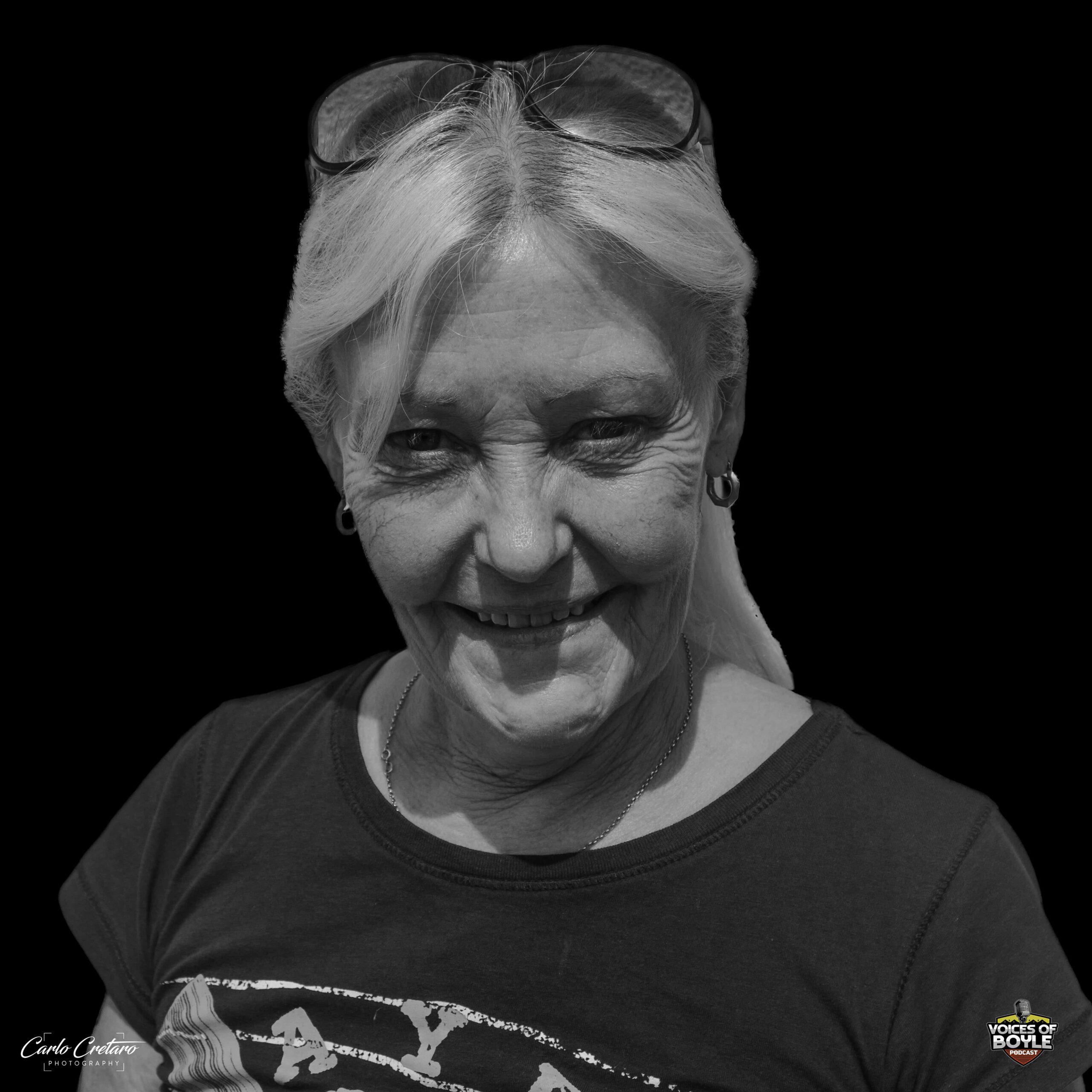
In Manchester, Jane Suffin’s family had a council house with a bathroom and hot water. In Boyle, her grandparents’ cottage in Felton had one porcelain sink in the pantry with cold water only, a big open fire that everything was cooked on, and a toilet you reached by going out the back and round the side of the house.
The children did not mind any of it. They came over every couple of years, whenever their father, a self-employed landscape gardener, had the money. And when it was time to go home, the four of them cried the whole way from Boyle to the ferry.
“We were like animals out of cages when we came to Boyle.”
About fifty years ago the family moved home for good. Jane sat down with Florence to go back over what came after.
They made happiness out of the little that they had
Jane’s grandparents were Annie and Dudley Sharkey. Dudley was a shooting and fishing man who played the bodhrán. Annie, a Regan before she married, played the accordion. They played all over the country, at bonfires and in country pubs, with Kevin Meehan, Jack Regan and others, in a band the recording gives as the Goatskin Band. Dudley was well over six foot with a little bodhrán. Annie was Jane’s own size with a big accordion. People home on holidays still stop Jane to talk about them.
“They made happiness out of the little that they had.”
Annie worked in Stewart’s Mill, where Dr Maguire’s is now, and for years for Paddy and Mrs Daly.
He carried on poaching for many the year afterwards
Dudley was also, in his granddaughter’s words, a master poacher. Eels, salmon, deer, pheasants, anything that could be poached. Some time in the late 1960s, as Jane thinks, he was caught. He was fined, refused to pay, and was called back to court. In between, he had a major operation in Roscommon. He was a shadow of himself, and the judge sent him to Mountjoy anyway.
Dominic Cosgrove, who had a pub on Patrick Street and a taxi service, drove him to Dublin. That same night Dudley walked into Johnny Spellman’s pub. The prison officers had taken up a collection, put him in a taxi and sent him back to Boyle with a few pounds in his pocket. He carried on poaching for years.
It was a bigger adjustment for her than it was for us
The family moved into the cottage in Felton with Annie and Dudley, until the grandparents got a house up the Green. Jane’s mother came from a family of nine in Nottingham. In Felton she was cooking on an open fire in a pot oven, with the kettle on a crook. She fitted in. Jane’s father and grandfather fished eels for a living, Dudley taught her to run the eel lines, and inside a few months she was doing that and planting spuds as well.
School was harder. In Boyle she went into fifth class in the convent. She is not sure who got the bigger shock, her or the nuns, and she thinks the nuns got the raw deal. She left not long into first year.
What she got instead was friends. Bernadette was the first, then Tina, Katie, Julianne and a gang that grew on the walk up the road to school. Fifty years on, Jane counts them among her best friends.
We had it on our doorstep
Marble season started at the end of January at McCormick’s wall. Then the marbles went out and the hopscotch came in, then skipping. But what everyone waited for was the summer, and the river.
“We did not need to go to Spain or anywhere else on the holidays. We had it on our doorstep.”
They went out to Assylin and St Patrick’s Well across the fields or along the railway, legs cut off their trousers if they had no togs, and stayed until night, eating sloes off the bushes and wild strawberries from the railway bank. Nobody came looking for them, Jane says, because everybody was looking out for everybody else.
The Termon children kept to their side and the Patrick Street children kept to theirs. Both claimed the third rock, because it was the deepest. The smallest started at the rock and worked their way up to the floodgates. There were camps made of plastic bags in a field across from her mother’s, and sausages on a small fire. The family holiday was a day on the islands on Lough Key with her father.
It was just in him
Her father, Mickey, was the same in Manchester. Sundays at Pickmere Lake. And one weekend away in the back of a van on a mattress, to a town a few miles down the road, where he set a nightline in a river in the middle of the town while the children kept watch for the police. They had their feed of eels in the morning.
It was in him, Jane says, and in her brother Paddy, and it has come down the family. Paddy taught her sons Wayne and Jim to drive not long after they could walk, and brought them shooting and fishing. Wayne was 17 and Jim was 13 when Paddy died, and she still sees him in things they do. Now her grandchildren Chloe and Jimmy, who is eight, have her head annoyed asking when the next fishing competition is.
The lamb thought it was a dog
Lulu was a lamb whose eye was taken by a fox. Jane fostered her, brought her to work in the back of the car, and went out to feed her during the day. At home Lulu lived in the shed with Sid the German shepherd and Ramble the Jack Russell, walked on a lead, and as far as anyone could tell believed she was a dog. When Lulu got too big she went to an animal farm. Her friend Katie remains convinced Jane ate her. Jane would like the record to show she did not eat Lulu, whatever about the others.
There was Sissy, a grass snake bought for Wayne one Christmas when he had painted his bedroom windows black. And there was a rabbit bought for Jim at the Country Market that took people by the leg. It got out, and for three years it lived on the street, eating Mrs McLaughlin’s cabbages and Mary Flynn’s. It was, Jane says, a landmark on Plunkett Avenue and Station Road.
A voice for people that hadn’t got one
Jane worked for about nine years in the shop, first for Dan and Olive in the old shop, until a bout of pneumonia, and then for Neil behind the deli in the new one. On Fridays the pensioners came in, and in the old shop she would bring down a stool and a cup of tea and they would sit at the bottom of the stairs.
She served two terms on Boyle Town Council, first as Cathaoirleach as an independent, and later as the first Sinn Féin female Mayor of Boyle. Not the first female Mayor, she is careful to say. The first Sinn Féin one. She is proud of it.
“That was the whole aim of it, was to be a voice for people that hadn’t got one.”
She thinks abolishing the town councils was a mistake. Town councillors were the people anyone could stop on the street. In her view, once they went, people had nowhere to turn. Her phone still rings.
That’s where my ancestors came from
The family lived at the corner of Termon and Station Road for 17 years, in what was Derby’s House, then Suffin’s Corner, then Derby’s House again. Then four years in Felton, until something happened and they took the chance to move out to Cloonloo.
Now it is home, beside the lake, with room for the dogs and the horses. It is where her father’s people came from, the Sharkeys of the island on Lough Gara. Some of them worked for Madame MacDermot at the big house, then in the railway house at Tinnecarra, and that was how they came into Boyle.
Every day you go to the graveyard you see something new
Wayne restores headstones in Assylin and the Boyle graveyards. He started on his own during COVID, leaving a full time job with two children at home, and Jane credits the community’s support for how far he has come. He now has work all over the country.
Jane is in the graveyard every day herself, and has been for 21 years. Some of the names on the old stones are gone out of Boyle. She would like the councils to do more, and points to cemeteries elsewhere that restore one old grave a year where nobody is left to mind it.
He always brought happiness
Jerry McGlynn was part of the Sharkey family’s life for five generations. Dudley was reared by the McElroys, neighbours of the McGlynns. Jerry was there on his bike when the children came over on holidays, in their grandparents’ house, in Johnny Spellman’s, at Eddie McDermott’s for the tug of war. He and Jane’s uncle Jim were inseparable, and she says he never got over Jim’s death.
He never asked anyone for anything, she says, and helped a lot of people quietly. His stories were often stretched a little, but never gloomy. She wishes they had said thank you. His parting line was always the same.
“Well, we’ll leave it there till the next time.”
Neighbours like no other
Jane has a list of people she wants remembered. Sally and Joe Gaffney, for batch bread unsliced with a big wallop of butter. Lizzie Clancy, Jack Regan’s sister, who picked the lumps out of the marmalade and put them on your bread specially, so you had to eat them. Mary Coleman, Mary Flynn, Mrs Higgins, Mrs McLaughlin, Margaret Casey. John Murphy and Patricia Sweeney, who started the Termon Residents Association, where Jane was secretary for years.
Her father told her about the little houses on the Mill Road, buried so deep in the blizzard that people opened their doors onto snow and dug each other out, and about Dudley out shooting rabbits, hares and pheasants to feed whoever needed feeding. They had nothing, she says, and a lot more than we have today.
We gel together
Jane has been 30 years with the Boyle and District Angling Club, going since 1980, and made some of the best friends of her life there. One of the founders used to tell meetings he had never been in a room with as many thick so-and-sos in his life, and that they always worked it out in the end.
The club runs about twelve events a year. The Easter Festival is the biggest, running about 37 years by Jane’s count, with anglers still coming who came to the first one. There are memorial cups for Paddy and Mickey Sharkey, the Paddy Kelly Cup, the Clancy Cup and the Merton Mitchell Perpetual Cup. The Albert Cup, handmade silver, was left to the club by the last of the Albert family at Greatmeadow and is fished every year for trout during the mayfly.
Give them the few minutes
Near the end, Jane tells Florence about the Saturday before. She was at the family grave when a woman she did not know came over and started talking about people from Boyle. Jane remembered them. They talked for about two hours. She had not spoken to anyone from Boyle in a long time.
“If a few minutes out of your time can make someone feel that much better, then give them the few minutes.”
The dinner, she says, can go on another half an hour.
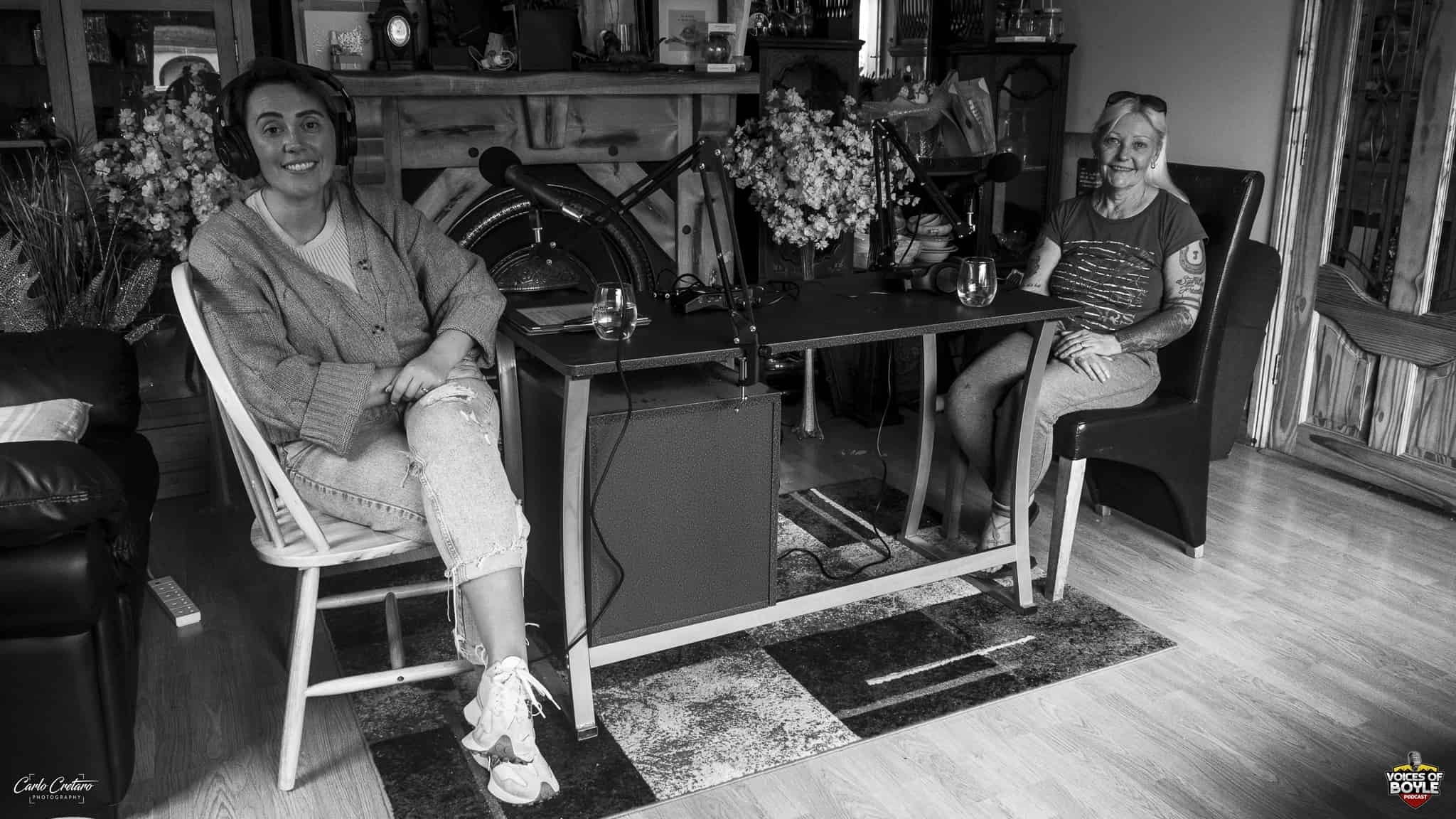
Thanks to Brendan O’ Dowd for creating and recording the musical piece for the podcast.
BE A GUEST ON THE SHOW!
If you’ve a story about Boyle, we’d love to hear it. You don’t need to have done anything remarkable, and you don’t need to prepare a thing. We sit down, have a chat, and you talk about whatever you want to. It usually takes about an hour.
Thinking of someone else? A parent, a grandparent, a neighbour who remembers how it used to be? Tell us about them. Some of our best episodes started because a son or daughter got in touch. You can find us at info@voicesofboyle.com.