Episode 25
Oliver Fallon – Memories of the 1970 World Cup: A Nostalgic Trip Down Marian Road
Hosts & Guests
Carlo Cretaro
Oliver Fallon
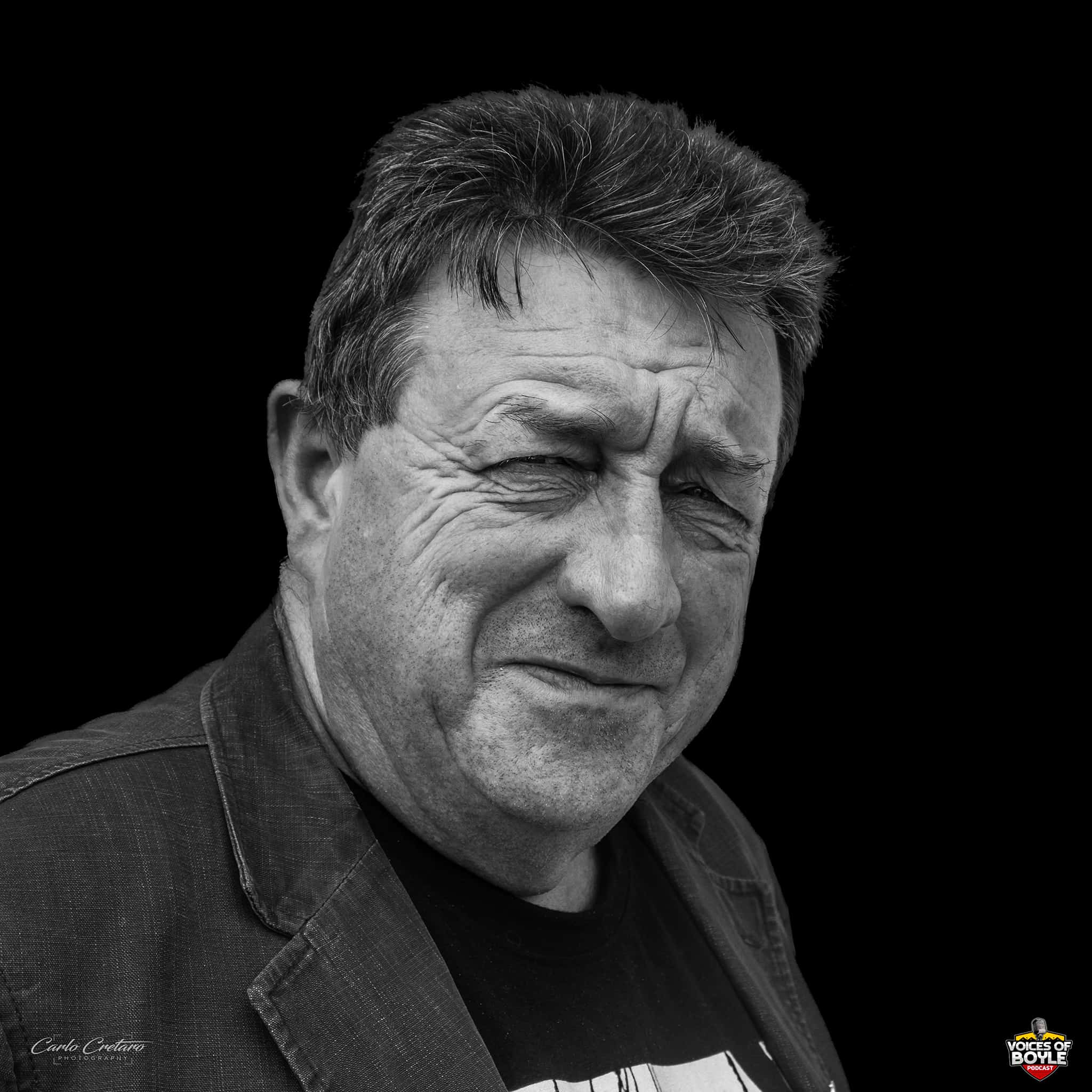
The 1970 World Cup final finished in the evening, Irish time. Brazil had beaten Italy 4-1 in the Azteca Stadium, and on Upper Marion Road in Boyle a boy who had backed Brazil, and had backed Jairzinho to score, was still in front of the black and white television when the doorbell went.
He went out, and it was his neighbour Mickey Mulrennan, paying up. A shilling, Oliver Fallon thinks, or it might have been sixpence.
Oliver’s conversation covers Boyle between 1966 and 1972: a street with hardly any cars, a school that grew overnight across the road, and a town that did something which will sound strange now. It supported England.
“Very few cars, very few televisions.”
From Ghana to number 28
Oliver was born in Dublin, but he did not stay long. At six months old he went with his parents to Ghana, where his father had a job as a teacher. They were there three years, then two more in Nigeria. He went to international schools and played with local children and with the children of Dutch and Canadian families. The household had cooks, and the cooks made curries, spicy food and rice.
Neither parent was from Boyle. His father came from Co. Galway, and his mother, a guard’s daughter, had spent part of her childhood in Croghan, just outside Boyle. Oliver calls it “quite a tenuous” link.
In 1966 his father became headmaster of a national school between Boyle and Ballymote, and the family moved into number 28 Upper Marion Road that spring. The first thing Oliver noticed was the food. He found it very boring and very tasteless, and the curries were gone.
He puts the move in its time. After the emigration of the 1950s, Sean Lemass’s programme for economic expansion had started to produce jobs, limited ones, and some people began coming home. The Fallons, Oliver thinks, were part of that.
The street was our playground
Upper Marion Road was a cul de sac then. You went up as far as the railway gate and could go no further. The estates now behind it, Hanley Avenue and Churchview, were open fields.
Oliver can still name the neighbours. Martin and Marie Higgins lived on one side. Martin drove the ambulance, and with no car of his own he brought the ambulance home and parked it outside the house. “Why wouldn’t he?” Oliver says. On the other side was Liam, a commercial traveller, and his wife. Beyond them were Pat and Peggy Mulrennan and their large family, and past the Higgins’s were Dessie and Peggy Healy. Dessie worked for Posts and Telegraphs and drove home in the van. Further along were Mrs McLaughlin, the Raleighs, the Scotts and Patsy Quinn.
With so few cars, the children owned the road, especially on summer evenings. When the Fallons arrived Oliver can only remember two houses with a television, and knocking on a door to ask could you come in and watch was not easy.
His father’s car and Liam’s were the only two private cars Oliver remembers. His mother could drive too. She had learned in Africa, and as far as Oliver knows she was the only woman on Marion Road who could. He is happy to be corrected. But, as he says, cars were scarce anyway, “and what would women want with them?”
One of the darker memories
That line had a hard edge to it. Oliver remembers that all the men on the road were in work, and that all the married women, his mother included, had been required to give up their jobs when they married. The marriage bar, which he dates to about 1932, kept married women out of public service work until Ireland joined the common market in 1973.
“My own mother was a very qualified woman.”
She had trained as a TB nurse and as an orthopaedic nurse. When she married in 1959 she had to give it up, and she never really worked full time again. Oliver pictures the women of the road, children gone to school, husbands gone to work, left at home with nothing to do but have the dinner ready. He does not think it was good for any of them, and he knows it was not good for his mother. He calls it one of the darker memories he has of the time, and something that has never been properly addressed.
A very small building suddenly becomes a huge complex
Directly across the road was a small secondary school for boys, opened by Canon Dodd. In September 1967 free secondary education came in, and from then on every boy and girl in the country was entitled to it.
The little school became a building site. Prefabs went up fast, along with a big science hall that cast a shadow over the front of Oliver’s house, and the buses started bringing lads in from the country. It would become St Mary’s College and is now Abbey Community College.
Soccer was the king’s sport
Boyle had been a garrison town, Oliver says, and in the town it was soccer, not Gaelic games. The children went down to the end of Marion Road, sat on the wall and watched the matches in the Pleasure Ground. The referee lived in a house directly opposite and had firm views about back passes. And everyone, playing on the street afterwards, wanted to be George Best.
You rented it off Tommy
By 1968 the Fallons were getting a television of their own, and you did not go to a shop for that. You went to Tommy Murray and rented one. Tommy arrived, you found space for it, and in came a huge black and white set.
Tommy did Boyle a great service, in Oliver’s view: he set up an aerial somewhere so his customers got the BBC as well as RTE. “I’m sure it wasn’t legal at the time,” Oliver says, before allowing that maybe it was. On the first night they turned straight to the BBC and the Mike Yarwood show was on. His parents mostly stuck with the BBC after that. His father could not stand the American programmes that filled RTE.
For the children, the highlight of the week was Match of the Day on a Saturday night, and George Best scoring four or five in the mud for Manchester United.
Oliver dates the television to 1968 because of Vietnam, the first war he remembers on television, with BBC reporters in Saigon. He recalls nearly 15,000 American troops killed that year. With so many Boyle families having relatives in America, those deaths felt closer than the far greater Vietnamese losses, which he finds strange looking back. His mother was very upset by it.
England was our team
Then came Mexico 70, live on television for the first time, as Oliver remembers it. Games kicked off around noon in Mexico, which meant seven o’clock in Boyle.
“England was our team.”
He knows how that sounds now. Oliver, who holds a season ticket for the Republic of Ireland at the Aviva, is aware of the attitude in Ireland today, where you would support anyone playing England. But in 1970, the English players were the ones on Match of the Day every week. “They were our neighbours,” he says. Everyone had relatives there. You were hardly going to support El Salvador, and the war had only been over 25 years, so it was not going to be West Germany.
Panini, and the lads with all the best cards
That year an Italian company called Panini printed World Cup cards and an album to stick them in, and Boyle took to swapping. Oliver filled the Israel page in no time but could hardly get an England player. Two lads in town, Donald Brennan from the Crescent and Donny Farrell, seemed to have a monopoly on the good cards, and swapped their doubles for an extortionate number of players from the smaller teams.
England beat Romania 1-0 in Guadalajara. Then they met Brazil, and Brazil played a different game altogether. Jairzinho scored, Pelé had a header saved by Banks in one of the great saves, and England lost 1-0. Allegiances were already starting to wobble.
Against Czechoslovakia, England in white and the Czechs in light blue were very hard to tell apart on a black and white set. England won 1-0 anyway. Then came West Germany in the quarter final, a replay of 1966. England led 2-0, Alf Ramsey took off Bobby Charlton, Gerd Müller got loose, and England lost 3-2 after extra time. “Devastation,” Oliver says. You had to pick another team.
The doorbell rang
He picked Brazil. Mickey Mulrennan picked Italy, who had played well in the semi-final, and the bet was made, with Jairzinho to score as a sweetener on Oliver’s side, since he had scored in every game. Brazil won 4-1 and Jairzinho scored.
“The game had no sooner ended when the doorbell rang.”
Mickey was at the door with the money straight away. Oliver says he was a great neighbour and a good friend over the years. Mickey has since died.
Oliver never saw the tournament in colour until later that summer, when the official film, The World at Their Feet, came to the Abbey Cinema on the Crescent, Tony Farrell’s cinema, or his father’s at the time. Oliver went twice. In 1993 he found himself in Mexico City and made a point of visiting the Azteca, where the final had been played in front of over 105,000 people.
“It actually brought a ray of sunshine from sunny Mexico to Ireland.”
Twenty years later, he points out, Jack Charlton, who played for England in Mexico, took the Republic of Ireland to the quarter finals of Italia 90.
The school that kept moving
Oliver’s primary education happened all over Boyle. He started at the convent, which he still passes most days coming in from Carrick. Then came two years at his father’s school, until it closed in 1970, and back to St Joseph’s National School, which at the time was where Carty’s garage is now, up Chapel Street.
That building was sold and became what was known locally as the knickers factory. With the new school not yet built, the boys’ national school was homeless. It moved to a hall where a funeral home now stands, then down to the convent. His teachers were Michael Carty, later the headmaster, and Paddy Kennedy, who had him in sixth class. He finished in 1972 without ever attending the new St Joseph’s. His children find it hilarious that he went to the same school in so many places.
His childhood, he says, was a happy one. The teenage years were a different matter, when “the social scrutiny of a small town” started to close in. But at ten and under, with young parents who thought you were great, it was carefree. And the weather was always good.
A tribute to Patsy Quinn
Before finishing, Oliver wanted to mention one more neighbour. Patsy Quinn, whose son Michael walked to school with Oliver, had lived in London for years before coming home in the sixties with his family, first to Carlow, where his wife was from, and then to Boyle. Almost single handedly he got a piece of land near the old school off Chapel Street, behind what is now Carty’s garage, and built a factory, the Naira factory (spelling unconfirmed). It opened in November 1966, the year the Fallons arrived, and it employed people in Boyle for many years.
“How many of those families would have had to emigrate or move somewhere else?”
For Oliver, Patsy was that decade in one man: he had left, done well, and come back once there was a chance to build something at home. When they recorded, Oliver had met him recently and wanted him on the podcast.
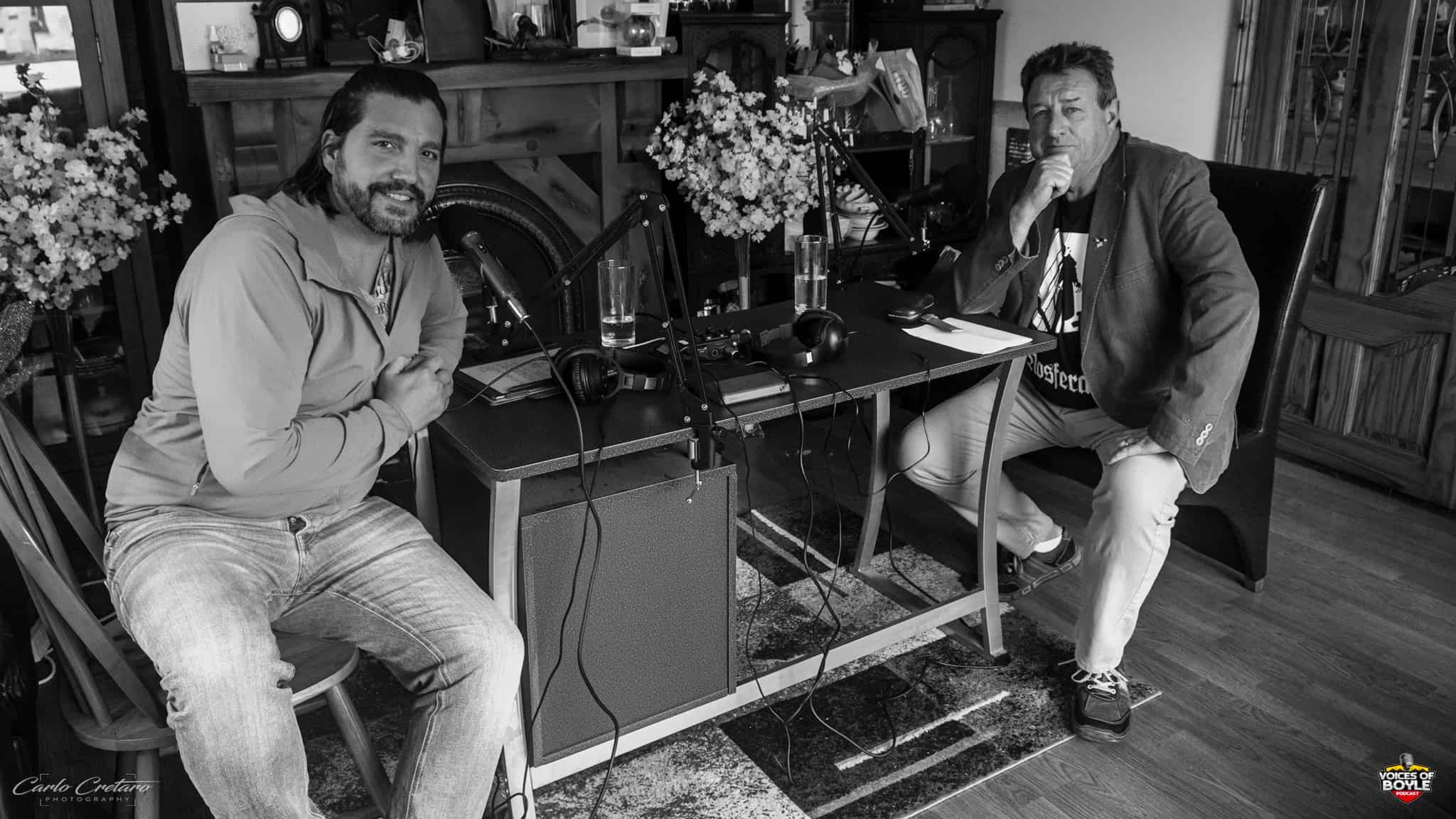
Thanks to Brendan O’ Dowd for creating and recording the musical piece for the podcast.
BE A GUEST ON THE SHOW!
If you’ve a story about Boyle, we’d love to hear it. You don’t need to have done anything remarkable, and you don’t need to prepare a thing. We sit down, have a chat, and you talk about whatever you want to. It usually takes about an hour.
Thinking of someone else? A parent, a grandparent, a neighbour who remembers how it used to be? Tell us about them. Some of our best episodes started because a son or daughter got in touch. You can find us at info@voicesofboyle.com.