
Episode 34
Dennis Dodd – A Chat At Christmas
Hosts & Guests
Carlo Cretaro
Florence Cretaro
Dennis Dodd

On a Saturday night in the early 1970s the Tarpeys would settle down to watch Match of the Day, and every so often the picture would go. The trouble came from Dodd’s. They had one of the first microwaves in Boyle, and whenever somebody in the bar ordered a burger, the Tarpeys’ television felt it. Teresa Tarpey, who told us the story on her own episode, was the one sent over to ask them to turn it off until the match was over.
Dennis Dodd laughs about it now. That’s the way it was, he says. The microwave was about four foot by two and a half and was never once serviced, and in its later years it would overheat and have to be switched off to cool down before it would go again. It served its purpose anyway.
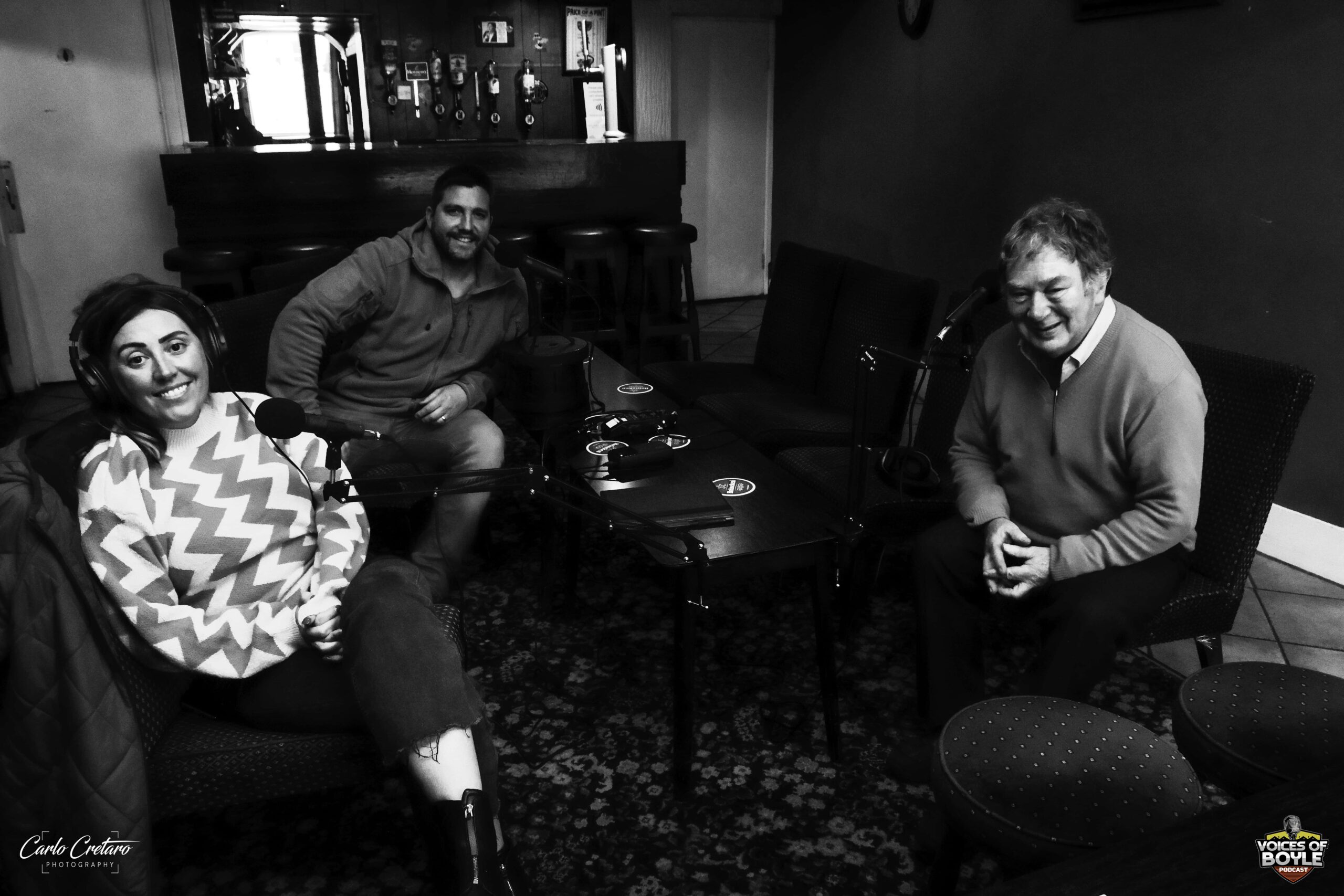
Dennis has spent his whole life in and over the Crescent Bar. We sat down with him in the back lounge.
He bought a cow
The pub came into the family in 1948. Dennis’s grandfather had a grocery shop on Main Street, and his father, Joe Dodd, the second oldest of six, bought the Crescent Bar with him when Joe was in his mid twenties. The name was already over the door, from the family who had it before, and nobody saw any reason to change it. Joe married Eileen in 1953, and the two of them reared four children upstairs.
Joe was an auctioneer as well as a publican. One day he came home and told Eileen he had bought a cow. She asked him why. Because he wanted to, he said. She asked what he was going to do with it, and he said he would milk her. He didn’t know how, but he would learn.
He had no land. Dennis remembers going up to Great Meadow in the evening to collect a couple of cows, bringing them down to be milked at the back of the pub, and bringing them back out again. His mother boiled up the feed in a big iron pot in the back kitchen.
“I can still remember the smell of that.”
Joe went on to take first prize at the RDS with a shorthorn bull, which was a big thing at the time. It was a novelty, Dennis says, and it went with his father when he died.
The right thing at the right time
Joe’s auctioneering office was a corner of the bar. Dennis tells the story of a farmer from just outside town, the grandfather of the McGraths, who came in to say he was thinking of selling. Joe sat him down to one side and wrote out a description of the farm as the man gave it to him. Then he read it back. The farmer listened and told him it sounded so good that he didn’t think he’d bother selling at all. He went home, and the family are there since.
“He just had a great way of delivering, saying the right thing at the right time.”
Joe was well liked. He was also a young man when he died, and his four children were still very young.
She kept things going
Eileen Dodd was not from Boyle originally. Her own mother died when she was a child, and the family was split up, her two sisters and her brother going to other people. She came into Boyle at six and lived in the town for the rest of her life, until she was about 87. After Joe died she kept the pub going in her own way, and Dennis remembers great nights in it. She passed away a few years ago. He calls her strong and determined, and the family are very grateful to her.
Florence remembers coming in as a child for lemonade and crisps, and Eileen never once putting the children out.
Four pubs on the Crescent
When Dennis was a boy there were four pubs on the Crescent, and none of them did food. There was Grehan’s, where the Grehan sisters made their name in music, Paddy and Rita Heavey’s, Frank and Rita Tarpey’s, and Dodd’s. Somebody gave him a copy of the 1936 licence renewals for the town not long ago: 32 licences. Every pub was busy, he says, and there was no real money around. Now people have money and the pubs are quiet.
Bit left, bit right, bit higher
The first colour television in Boyle went into Dodd’s in 1969, in time for the 1970 World Cup in Mexico. There is a photograph of Joe switching it on. Dennis says it is the one photograph the family has of his father on his own.
Tommy Murray put up a high mast in the yard, and John “Jingle” Carrigan was up on top of it searching out the signal while Tommy stood below calling bit left, bit right, bit higher. They got it in the end. Storms brought the mast down twice.
The microwave came a few years later. Frozen burgers were piping hot in a minute, with onions, and people came in specially for it.
The petrol pumps at the door made about five pence a gallon. They got people in, which was the point.
So many calves in the one day
On fair days the dealers gathered on the Crescent at about 12 o’clock, coming up from the earlier fair on the Green, and some of the cattle that didn’t sell on the Green were bought here. Dennis remembers a calf dealer who was good to him after school. The day before we recorded, that man’s children came into the bar.
His favourite trick of the trade: a cow tied to an ESB pole, with a calf beside her. Somebody buys the calf and off they go. A few minutes later another calf is produced from a yard nearby, and somebody else buys that one. Then another. It was some cow, he says, to have that many calves in the one day.
When the fair finished, a man came up with a hose and washed down whatever needed washing, and many a time he was invited in for a treat.
Walking on somebody’s head
Dennis was born in 1960, the year of the first Fleadh in Boyle. The second was in 1966, and there is a photograph of it in the front bar. There were so many people in the town, he has heard, that to get from one end to the other you would be walking on somebody’s head. People camped in front gardens and back gardens, and the College field was all tents.
Half time at the hall
There was no drink at the Sunday night dances in St Joseph’s Hall, so the men came across to Dodd’s at half time. The women stood on one side and the men tried to get a partner for the night. There was many a night Dennis was disappointed, like a lot of people. He says he became experienced.
Bingo nights were the same. On court days some of the legal crowd sat in the back lounge, and there was never any problem. In the 1970s and 1980s the pub opened at half ten, and Dennis would run upstairs for his dinner and straight back down.
The white bag with the red writing
The 8th of December was a huge day, a family day, with people in from the country for shopping, a stop in Dodd’s for minerals and crisps, and Santa with the little white bag with the red writing. On Christmas Eve people came in for a drink or two before midnight mass, and a few of them were fairly tanked by the time they got to the back of the church. The Dodds were always cleaning up and went to morning mass instead.
About twenty years ago Dodd’s was the place for the Sunday session. At four o’clock there would be people up on the tables.
The stories that are gone
The standout storyteller for Dennis was Pat Spellman of Elphin Street, a builder who served in the fire brigade and could tell a story without ever cracking a smile. Then there was John Tom Connolly, Micky Ward, Paddy Connan and Roscoe, whose surname Dennis can’t bring to mind but who people will know. The most entertaining customer of all was Johnny O’Byrne. He could sing and tell a story, and he had a great heart. He and his wife adopted three children.
“There’s great characters out there that never took a drink.”
People think you have to be in the pub to enjoy life, he says, and it isn’t true. A lot of the stories are gone, and they will never be recovered.
Some of the songs were saved. John Reilly, a Traveller and a single man, spent a lot of time in Grehan’s. Dennis was told he couldn’t read or write, and yet he passed on a great many songs, and Christy Moore got some of his through John Reilly by way of the Grehans. He died in about 1969. Across the road was Morris’s, which Dennis reckons was the real trad house of the time.
Brendan Gleeson came to Boyle for the music. He has been coming to Boyle for about fifty years, since he was 19, and he is a friend of Francis Gaffney and John Carty. For all he has become, Dennis says, he is still the same.
When Dennis turned 60 in lockdown, Majella and their four daughters gathered video messages from people he hadn’t seen in years, and Brendan gave him a mention on national television the same week, and for a couple of days Dennis was a celebrity on the streets of his own town.
Every day is a Good Friday
Out walking in lockdown, Dennis met John McQueen, a customer whose father had been friendly with Joe. Dennis asked him how he was finding it.
“It’s like every day is a Good Friday.”
Dennis said John had hit the nail on the head. Nothing was open, there was nobody around, and nobody knew what the future held for the pubs. People died and were buried alone, At home there was family time. One of the girls was working on the front line and was anxious and worried the whole way through. There were a lot of heroes and heroines, he says, who looked after other people.
When the beer garden was allowed to reopen in June 2021, the family decided to open at one o’clock and see what happened. It was mad for six to eight weeks, and after the first day every bone in Dennis’s body ached.
Boyle is my town
Now there is a trad session every second Friday, practically all locals, the Morrises, the Gaffneys and the O’Connors among them. Tony O’Connor helped set up the first Thursday folk club, which fits about fifty people comfortably and has built up a regular crowd. Dennis singles out Bernie Flaherty, who can play anything and has a great traditional voice.
He is grateful for the voluntary groups that do so much for the town, and for Lough Key and the canal on the doorstep. The pub trade has challenging years ahead, he says, and the family has decisions to make in the future, whatever they turn out to be. If there are only a few pubs left in Boyle in the years to come, he would be delighted if Dodd’s is one of them.
He finishes with the song The Town I Loved So Well, and what it means to him.
“Boyle is my town.”
Thanks to Brendan O’ Dowd for creating and recording the musical piece for the podcast.
BE A GUEST ON THE SHOW!
If you’ve a story about Boyle, we’d love to hear it. You don’t need to have done anything remarkable, and you don’t need to prepare a thing. We sit down, have a chat, and you talk about whatever you want to. It usually takes about an hour.
Thinking of someone else? A parent, a grandparent, a neighbour who remembers how it used to be? Tell us about them. Some of our best episodes started because a son or daughter got in touch. You can find us at info@voicesofboyle.com.
I knew Fr Dodd well, who used to be rhe parish priest in Ilford,London. His family had a shop in Boyle. I called in there when I was younger and met his parents. Is it still there and is Fr Dodd still serving.
Are you referring to a Father Kieran Dodd? If so, he would have been an uncle of Dennis (as far as I know).