Episode 49
Noel Sheerin – A Journey Through Boyle Part 2
HOSTS & GUESTS
Carlo Cretaro
Noel Sheerin
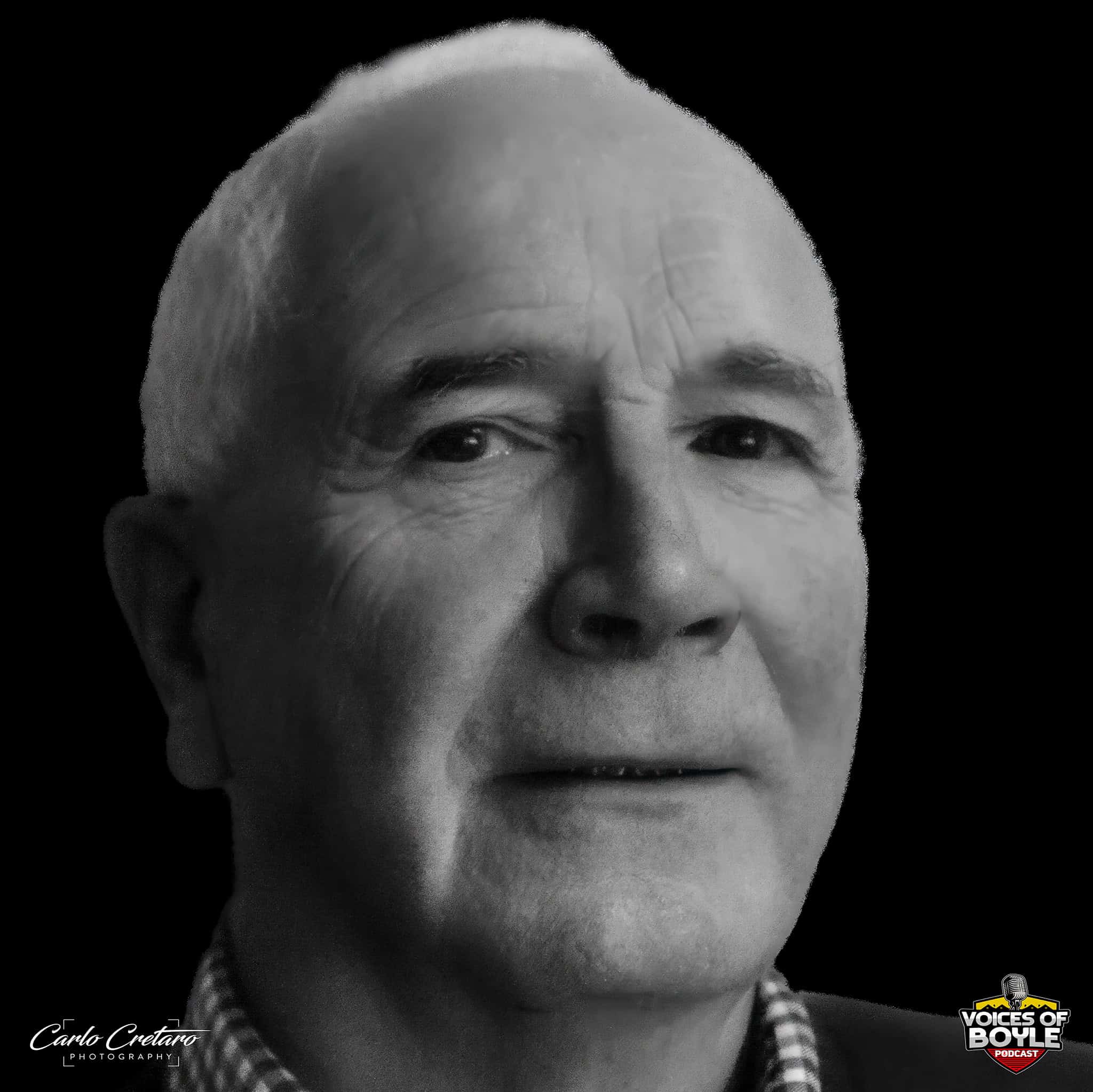
In November 1963 Noel Sheerin was nine years old, going on ten, and he was sitting in Cosgrove’s pub next door to his family’s shop in Boyle. The Cosgroves had a television. The Sheerins did not. So around six o’clock he was in there with the family watching the news when it came on that the president of the United States had been shot.
He ran out and down to his own hall door. The shop was shut by then, so he hammered on the door of the house until somebody let him in, and then he could not get the word out. His father supplied it.
“Assassinated,” he says. “That’s the word. That’s the word.”
The handball alley, and the teacher who brought them down
The alley is up on St Patrick Street and it is closed now, which he is sorry about. When he was in the old St Joseph’s boys school, Paddy Kennedy the teacher would take a few of them down after school and show them how to master the game. Boyle had a serious handball tradition and Noel starts to name it, then hedges, which he does honestly all through the hour. Pat Clark was one of the last he saw play in that alley, and that is where Pat started.
Election rallies outside the Royal
Up towards the Crescent the Royal Hotel was in its prime, with weddings and dinner dances in it and in the Forest Park. Both are gone now as hotels, which he calls a huge pity. What he remembers best is the election rallies outside the Royal in the seventies. Sean Doherty and Terry Leyden on one side, John Burke and Liam Naughten and John O’Connor on the other. The crowd out on the bridge, along the footpaths and out onto the road. He uses the word electrifying and then, because that is not enough, calls it class stuff.
Opposite the Royal was Doherty’s bakery. The bread was baked in Carrick-on-Shannon and came up around midday a few days a week, and people would be standing waiting for the van, because it was worth waiting for. Noel was sent down regularly and says he never once came home without a pastry or two for himself.
Four and five deep along the wall
The pleasure ground on a summer evening in the mid seventies, a five a side street league running, two or three matches in the night, and the crowd packed along the footpath outside the wall. Noel played on a team that won one of them, with Stephen Gray, PJ Feeney the barber, Peter McCarthy from the Northern Bank, and a second lad from the bank whose name he cannot recall.
He also explains the name. The pleasure ground would have belonged to the King family, and the pleasure in question was for the people in the big house, not for the town. You can still see the remains of the iron grates in the wall that kept the public out.
Across the road from Byrne’s Motor Works stood Tangier House, and on that ground there was a pitch and putt course. Seven holes certainly, he says, nine if he is right. You paid for the round and they handed you three clubs. In the middle of the town.
“I’m 47 years gone now, which is, you know, unbelievable.”
Waiting for the reels to come up from Carrick
The films started around three on a Sunday, and a crowd of them would be standing up on the Crescent outside the cinema beforehand, waiting. Not for the doors. For a car.
The Lowes in Carrick owned the cinema then, and on a Sunday one of them or somebody on their behalf would drive up with a box in the boot. In the box were the reels, twelve or eighteen inches across, each in its own leather case, and a single film might use three of them on the projectors at the back.
There were two prices at the ticket office. The stalls were the cheap ones, the balcony the other, and whatever you had the money for was where you sat. At the back were the jumbo seats, for the young couples. If you got one, he says, you were doing well.
Next door was Peter Phelan’s, where you could sit down. Three or four tables, four to a table, and ice cream in a bowl, or in orange with a straw, or with banana. That is where they went before the picture and after it. Dymphna Moriarty’s was next door again for sweets and cigarettes, but Moriarty’s had no tables, and for a teenager the tables were the whole point.
The band that rehearsed to an empty tent
The showbands run through the whole hour. The Jivaneers, who became the Mystics. The Sundowners. Sean Kenny from Marion Road, whose father was a typesetter at the Roscommon Herald works, and who went from the local bands to playing lead guitar with the Swarbriggs.
The best of it is the Freshmen. They were due to play the GAA marquee festival, arrived early to rehearse, and Noel got in and sat there. Two or three hours in an empty tent listening to Derek Dean and Billy Brown work the same song over and over. He cannot remember which song. He remembers being delighted with himself.
He was not let go to the Royal Showband in St Joseph’s Hall. Too young, he was told. So he went up town, got onto what he thinks was a flat roof and up to a window near the stage end, and saw Brendan Bowyer for a few minutes before he was either moved or fell. He is not sure which. He was happy out.
He had a scrapbook of showband photographs he cut out and kept for years, found it again while clearing out the house in Tulsk, and threw it out. He calls that foolish, and he is right.
There is the other kind of showband night too. He was at a marquee dance in Rockingham when the band on stage stopped to announce that Tom Dunphy of the Royal Showband had been killed on the road outside Carrick, on his way to a gig in Donegal.
Three songs and change partners
He describes marquee dancing with nothing taken off it. Big canvas tents on three poles or five, depending on the crowd expected. No facilities of any kind. Women down one side on long benches with no backs on them, forms, he calls them, the same as a school would have. Men down the other. Three songs and change partners, then the charge across the floor, coming in on the benches so hard that the women went over backwards. He says it was shocking, then says health and safety put an end to all that, and moves on.
“At that time, there was no fear or anything.”
The doctors
Doctor Collins and doctor Fallon were the family doctors, Collins a Cork man. The story Noel tells is about a night over Christmas when his eldest boy Michael, very small then, had croup. The doctor came out at one or two in the morning and would not go home. He sat up the whole night, because he had a son himself who had been extremely ill with the same thing and knew what it could turn into. Michael was fine.
Michael died in 2022, after a severe form of sarcoidosis. Noel says it in one sentence, in the middle of explaining who the doctor was, and goes back to the story. That is how it is left here.
There is one more Collins story. Noel was serving mass, eight or nine, and part of the altar boy’s job was to check the candles on the candelabra during communion. He turned the stand and the whole thing went over on him. The man who came straight in off the communion line, lifted it back up and made sure he was all right, was doctor Collins.
The bell, and three threes and a nine
That was the old church, the one that burned. Noel was married in June 1977 and the fire came after his wedding.
He remembers the Latin, learned off by heart, and can still start a line of it. He remembers the mass changing to English and the priest turning around to face the congregation. The children’s choir sang from a balcony at the front of that church, not the back.
The bell beside the new church came off the old one. The Angelus was rung by the altar boys, a week at a time, at twelve and at six, and you made sure you were there for it. Three, pause, three, pause, three, pause, then the full nine.
“You might as well put down my name now.”
Cowboys and Indians in the cells
Inside the main gate at King House, on the right, there is a small building, and in the basement of it there were cells. British army cells before 1922, and, he reckons, in use during and after it too. The children of the town used them to lock each other up playing cowboys and Indians. King House was a ruin then, and they ran through the whole building, careful because the floors were rotten and full of holes.
Beside it was McNamara’s, where they had the marquee material and mended the tents between festivals. There was usually a hole or two to patch, and Noel knows exactly why.
He is glad King House was saved, particularly when Carlo tells him there had been a proposal to demolish it for a car park. What a waste, he says, and then, what a shame.
Rockingham he takes harder. He played around the basement of it as a child, remembers it being knocked, and remembers the Moylurg Tower going up afterwards, a block of mass concrete in one of the best spots in the country.
Then the Abbey, where they used to climb the circular stone stairs of the high tower and walk out onto the wall at the very top and around it. He is clear about what a slip would have meant.
A young lad at the Shell corner
There is one memory he tells flatly. He was eleven or twelve, at a GAA summer festival, and cars were dropping people off near the corner by the roundabout, back when the main Dublin to Sligo road still went through there. A young fellow got out of a car, ran straight across and was knocked down. Noel and a few others went over, the way young lads do, and saw him being attended to. He died. Noel did not know him and does not think he was local.
The shirt in the window
The last one he tells is the best one, and he is nine or ten again for it.
Walking down the town he saw a shirt hanging on a line in a shop window, lowering slowly into a basin of water, then rising back out of it and dripping. Down again. Up again. Drip dry nylon, brand new to Boyle, and this was how they were selling it.
He followed the line with his eye, across the window, back through the hallway, to the main door of the shop. Then he worked it out. Open the door, the shirt comes up. Close the door, it goes down.
So he spent a good while opening the door, running to the window to watch the shirt rise, going back, letting it close, running to watch it fall, then doing it again. Until the owner came out.
“Would you mind leaving the door alone, please?”
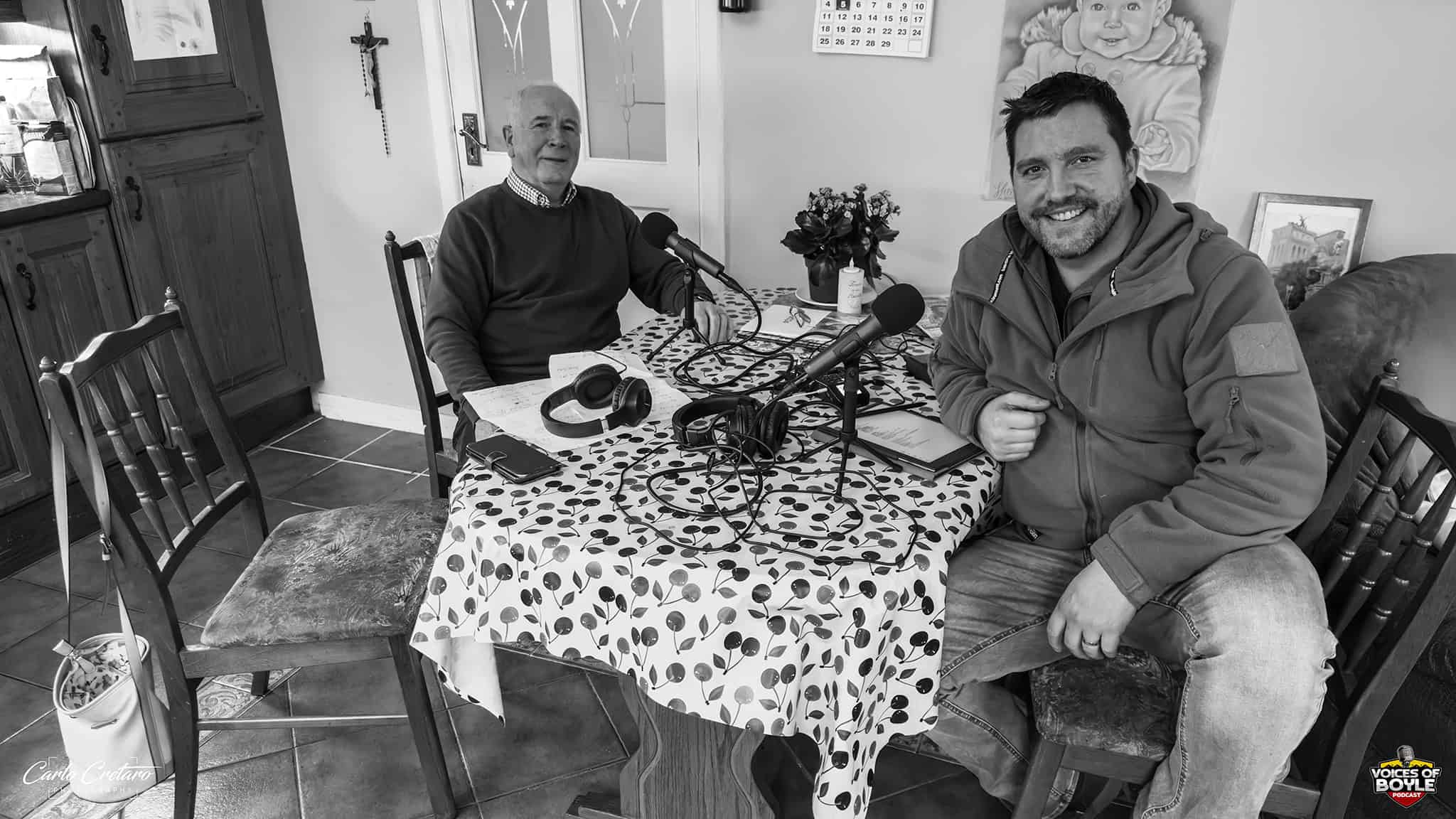
Thanks to Brendan O’ Dowd for creating and recording the musical piece for the podcast.
BE A GUEST ON THE SHOW!
If you’ve a story about Boyle, we’d love to hear it. You don’t need to have done anything remarkable, and you don’t need to prepare a thing. We sit down, have a chat, and you talk about whatever you want to. It usually takes about an hour.
Thinking of someone else? A parent, a grandparent, a neighbour who remembers how it used to be? Tell us about them. Some of our best episodes started because a son or daughter got in touch. You can find us at [email protected].