Episode 51
Greer Mac Keogh – The Royal Hotel Project
HOSTS & GUESTS
Carlo Cretaro
Greer Mac Keogh
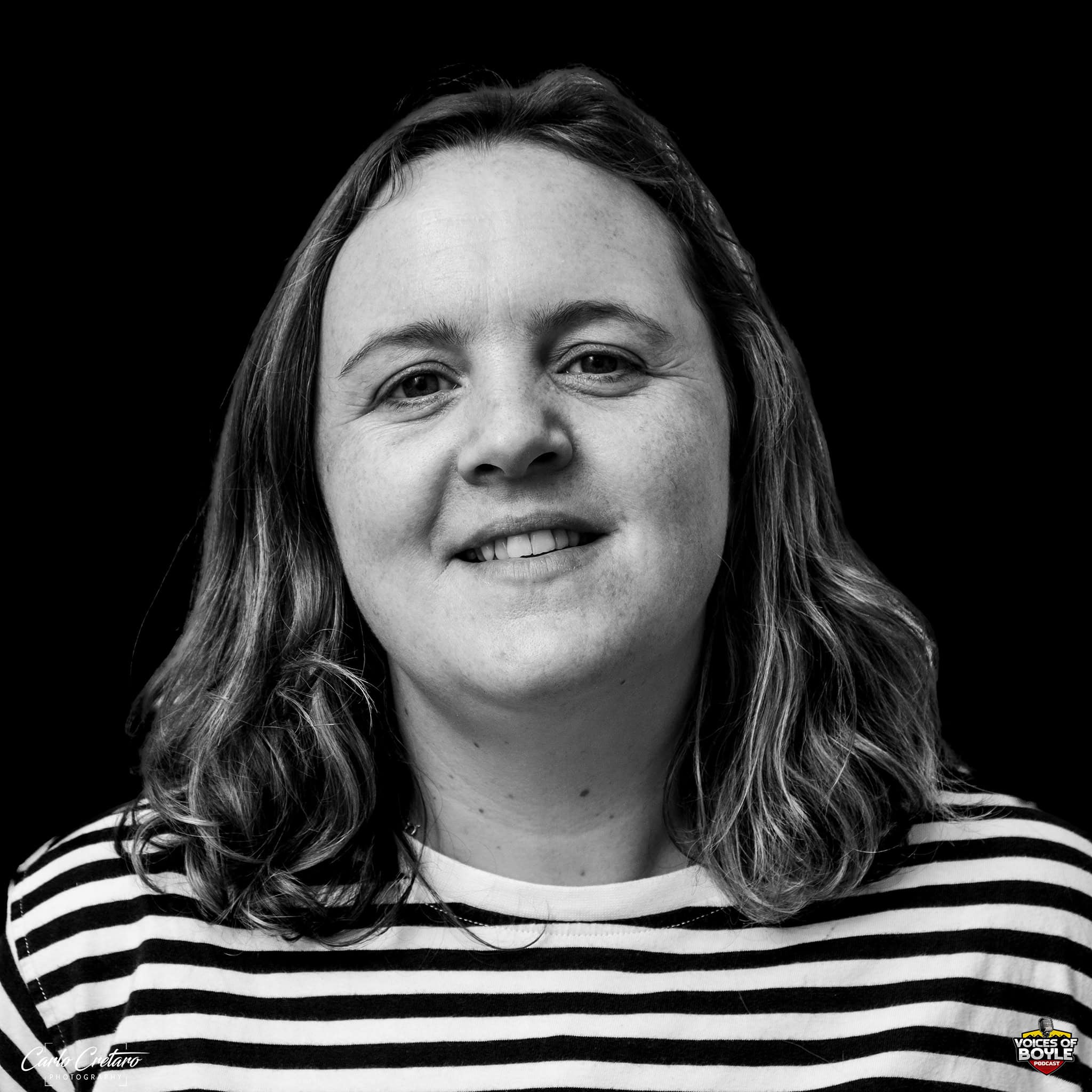
There was a blue safe in the Royal Hotel. Greer MacKeogh saw it while the building was still derelict, on one of the days the council let her in with a camera to collect dust and wallpaper and whatever else she could talk them into parting with. She looked at it. She assumed it was locked. She moved on to the next room.
It was probably not locked.
Eight years of work went into In These Rooms, her exhibition about the Royal, and when Carlo asked her what she would do differently she did not talk about method or funding or the two years COVID took out of the middle of it. She said she would open the safe.
A monument in the town
She came to Boyle for the first time at Christmas 2015. An uncle had bought a house the far side of Cootehall, on the way into Carrick, and she came in for lunch on a grey cold day and ate at Bruno’s, up at the top of the Crescent, which is not there anymore either.
The Royal caught her eye. It had been closed since 2012 and she describes it as a monument standing in the middle of town, though what really held her was the whole street rather than the one building: a run of old shop fronts with the signage still on them, uninterrupted, the way you almost never see. She went home to Dublin wondering whether people here would talk to her about it.
They would. An Arts Council research award under the Engaging with Architecture scheme brought her back the following summer for a fortnight, and it happened to be the summer of 2016, which anyone who was around will remember as two solid weeks of sun. Everybody told her she had brought the weather with her.
An open brief
She arrived with no questions, which was deliberate. An open brief is an idea that came out of a group of artists in Britain called the Artist Placement Group, who would put an artist inside an organisation with no gallery, no commission and no expected outcome, and see what they came back with.
So she listened. Christine walked her up to the dolmen at Drumanone. Barry drove her out to Lough Key. People gave her their afternoons. And every conversation she had, whatever it started as, ended up back at the same building.
“You didn’t have to think about where to hold something. It was always the Royal.”
That is the sentence the whole project hangs on, and it is a sentence only an outsider would notice. Greer grew up in Dublin, where you have a christening in one place, a wedding in another, a birthday somewhere else again. A single building that did all of it for everybody was a genuinely foreign idea to her. It still is, a bit. She talks about it in this episode like someone describing a custom from another country, which is exactly what it was.
The dust and the wallpaper
The research turned into a PhD, and then it turned into In These Rooms, and then it stalled, because for a long time there was nowhere for any of it to go. She says she did not want to make anything out of the material until she knew it had somewhere to end up. When Roscommon County Council bought the building, that changed.
She decided almost immediately that she was not going to do a chronology. There is a version of this exhibition that starts in 1782, when an innkeeper called John Freeman built the place, and runs forward in a straight line to the present day. That version would have needed an exact set of dates she knew she would never get, and she thought the anecdotes were better anyway.
“I’ve always really held on to this idea that buildings aren’t inert objects.”
She means it literally. She talks about the plaster and the wallpaper peeling off the walls of the Royal and about each layer of paper being a different story about Irish hospitality, about Boyle, about travel. The dilapidation was not a problem to be got around. It was the material.
Room by room
What she did instead was organise everything by room.
Reception took the stories of outsiders and arrivals. The bar took the local stories, the music, the men downstairs with their pints. The bedrooms and the back rooms took the staff, the people who kept the thing running. And upstairs, the Lough Key Room had more stories attached to it than the rest of the building put together, because that is where the discos were and people came from all over Roscommon for them.
One of the best stories in the episode belongs to reception. A commercial traveller who came regularly, and who was not feeling well one evening, asked to be woken in the morning because he had somewhere to be. They let him sleep. He came down late and annoyed, wanting to know why nobody had called him, and was told that he had looked so sick they thought he needed the lie in. Greer tells it as a story about being frustrated and charmed at the same time, which is probably how he felt.
The Royal had a commercial room with desks in it. Staff knew which travellers tipped and which did not, and six shillings, or whatever the going rate was, bought a man a reputation. That is the relationship she kept finding. Less a hotel and its customers, more a house and the people who kept coming back to it.
Steam out the windows
Two of the Lough Key Room stories have gone round Boyle since the episode aired.
The first is the fire that was not a fire. A cold night, the upstairs packed, the windows thrown open, and the steam of it billowing out over the street until somebody visiting the town ran into the hotel to report that the upstairs was burning.
The second is Brendan McGee, who lived up the street. On a Saturday evening with his windows open he could hear the sound of the Royal starting up, and knew exactly what kind of night was under way.
Underneath the discos, the men in the bar were having a quiet pint. Eighties tracks over their heads and the floor bouncing, and nobody thought anything of it. That mix is not something you can build into a hotel on purpose, and it is most of what people mean when they say the new ones have no atmosphere.
The law of hospitality
One thread in the research goes back a very long way. Greer got interested in the Brehon laws and in the fact that hospitality in early Ireland was not a courtesy but an obligation, and she wrote to Fergus Kelly, who has written on early Irish law, to get it straight.
It was not universal. Status came into it, and to claim hospitality you had to be a freeman. Which she found funny, because the man who built the Royal in 1782 was called John Freeman, and the place was originally Freeman’s Royal Hotel. Nobody knows what stood on that side of the river before it. There may well have been an inn there long before anyone thought to write it down.
The gap
The project lost two and a half years to COVID, and she thinks it would have been a different exhibition without that gap.
What she did instead was go into the archives. The Irish Film Institute holds Bord Fáilte’s old promotional films, and she spent a long time in them, watching the country describe itself to itself and to everybody else. She came out of it with a clearer sense of what tourism actually is in rural Ireland, which she admits she had not understood properly before, not being from a rural place.
That is where a lot of her thinking about the Royal’s closure comes from. Losing a hotel is an economic hit, but it is also a loss of standing. A hotel is something a town can be proud of. Her point, and she is careful about it, is not that Boyle is finished without one. It is that the draw used to be concentrated in a single building and now it is spread out, and towns all over Ireland are in the same position and are going to have to find another way of saying what they have.
“I really believe that history is within the dust.”
Only one person
Carlo makes a point in the episode that is worth repeating. The history of a building like the Royal could be told ten different ways by ten different people, and nobody has ever tried it before, and it was one woman doing it. Greer is straightforward about the limits of that. She never set out to run a formal oral history project and a lot of her recordings are just conversations. She did not know at the time that they would end up anywhere. And she had a young family, so she could not be in Boyle every day.
She names the people who made it possible, including Adrian at the council, who gave her the run of the derelict building and gave her a funny look when she asked whether she could take the mouldy wallpaper, and Rhona McGrath in the arts office. Frank Tarpey, Barry Feeley and Christy Wynn are among the voices in the twenty minute film she made for the exhibition.
“I’ve only got a little tip of the iceberg.”
The guest book she made for the show is named after the real one, the big ledger that sat on the reception desk, which came up again and again when she asked people what object they associated with the Royal. Nobody knows where those books went. She left blank pages at the back of hers so that people could add names she had missed.
What happens next
The exhibition ran at An Ríoga, in the building itself, and closed in the middle of September 2024. What Greer wants now is a home for the uncut interviews. She collected them as a community document and she says plainly that they are there to be shared, so that somebody in a few years can go back to them and make something else entirely.
Carlo’s suggestion in the episode is a good one: a corner of An Ríoga, a pair of headphones, a button to press, and the film running for anybody who wanders in.
“It still has so much time left now.”
She is talking about the building. It opened in 1782 and ran for two hundred and thirty years and there were people who wanted it turned into a car park. Instead it has a gallery in it, and a promenade along the river, and a century or two still ahead of it.

Thanks to Brendan O’ Dowd for creating and recording the musical piece for the podcast.
BE A GUEST ON THE SHOW!
If you’ve a story about Boyle, we’d love to hear it. You don’t need to have done anything remarkable, and you don’t need to prepare a thing. We sit down, have a chat, and you talk about whatever you want to. It usually takes about an hour.
Thinking of someone else? A parent, a grandparent, a neighbour who remembers how it used to be? Tell us about them. Some of our best episodes started because a son or daughter got in touch. You can find us at [email protected].