Episode 53
Michelle O’ Connor – Holistic Harmony and Healing
HOSTS & GUESTS
Carlo Cretaro
Michelle O’ Connor
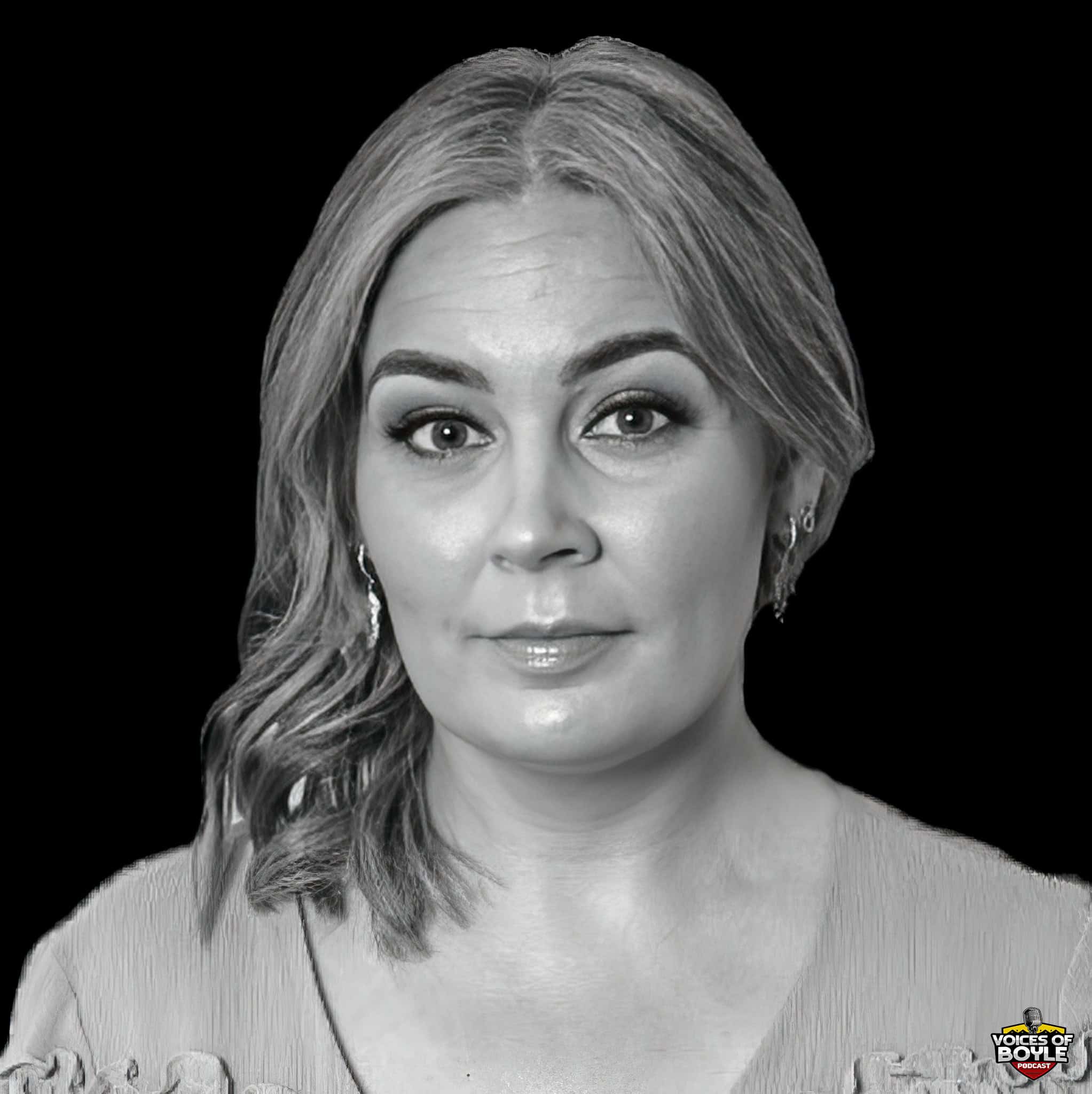
In one week, the youngest person Michelle O’Connor treated with reflexology was four days old. The oldest was 94. She mentions it halfway through the conversation, almost as an aside, and moves on to the next thing.
Michelle runs Saol Wellness Therapies at 5 Main Street in Elphin. A few years ago she was splitting her week between Boyle and Strokestown. Elphin is her permanent base now, and she says she is blessed to have it. Saol, she explains, is the Irish word for life.
How she got into this line of work was not by choice.
“There’s no catch. Life is quite simple. We just complicate it.”
One week in the whole month
It started, she thinks, in 2006. Michelle was diagnosed with endometriosis, which she describes plainly as painful and debilitating. She explains it for anyone who doesn’t know: tissue similar to the lining of the womb grows in other parts of the body and responds to hormones every month, but it has nowhere to go. “So it’s like internal bleeding,” she says. When she was newly diagnosed, she had maybe one week in the whole month without pain, and at the time, she says, not much was known about the condition.
The medical route meant the pill and painkillers, and after about 18 months of painkillers her stomach was paying for it. So she tried reflexology. She says the effect was immediate, and that she didn’t need painkillers for a good while afterwards. “That kind of sparked my interest in the holistic side of things.”
Around 2010 she went back training. Anatomy and physiology first, and massage at the same time, then reflexology, then one add-on after another: hormonal reflexology, lymphatic, pain relief, fertility. She says you never know where it is going to take you. “You meander down the route.” She uses the word meander so often in the conversation that at one point she stops to laugh at herself for it.
Not sticking the band aid
Carlo asks what holistic health means to her, and she answers with a sore foot. Plantar fasciitis is an inflamed sole of the foot, and in her experience the cause is often further up: tight calves, a weak lower back, tight hips. So she works back from the pain to find where it is coming from.
“You’re treating the person, not the injury or the pain,” she says. Carlo calls it plugging the hole. She puts it another way: not sticking the band aid.
Her everyday advice is so simple Carlo asks what the catch is. Breathe, she says, properly, into the belly rather than the chest. A few deep breaths in bed before you get up, a few more last thing at night, and whenever you think of it in between.
Your face doesn’t lie
Reflexology is her main therapy, but a good part of her week is spent on faces. She offers Japanese facelift massage, natural facelift massage, face reflexology, a zone facelift, TMJ massage for the jaw, and Indian head massage.
The Japanese facelift is all hands, no machines. She describes it as quite vigorous, working the tension out of the face and lifting the muscles, the way you would tone muscles in a gym. And yet, she says, everyone falls asleep. People melt into the bed and their minds stop racing. Afterwards she cools the skin with quartz crystals.
Because the face has its own reflexology map, she says she is working on the whole body at the same time. Carlo asks where the kidneys are, and she shows him: just above the lip, either side of the mouth, with the lungs up on the cheeks. She says she often feels a crunching over the lungs. She doesn’t read that as anything physical. In her view it is grief, and grief comes in all sorts of forms: a death, a friendship that has ended, somebody causing you grief.
Carlo asks the obvious question. How does any of this compare to Botox? Michelle is straightforward about it. The effects will not last as long as an injection, she says. But nothing is going into the body, and something else is happening.
“You’re ironing out the creases of life.”
“Your face doesn’t lie,” she says, “so your stresses and strains are in your face.”
Where’s the foot on the foot?
On the reflexology couch, all the work is on the feet. The idea, as Michelle explains it, is that the nerves of the body end in the feet, so pressure on one area of the foot stimulates a matching organ, joint or gland somewhere else. People come to her most for pain relief, hormone balancing and fertility.
It is for everyone, she says. That is when she mentions the week that ran from a four-day-old baby to a 94-year-old.
“Reflexology is for everyone.”
She remembers reading once that Native Americans said the day we put shoes on our feet was the day we started getting sick. “There’s something in it,” she says.
The big toe, on the maps she works from, holds the brain, the pituitary and pineal glands, the neck and the thyroid. “There’s a lot in a toe.”
So Carlo asks where the foot is on the foot. Michelle takes the question seriously. It is, she says, hotly debated. Different maps put it in different places.
For plantar fasciitis, she says, the relief did not come from working on the sole of the foot itself, even though that is where reflexology happens. It came from the parts of the foot that map to the lower back and hips. Back to the root again.
A raw chicken fillet
Of everything in her practice, the thing Michelle can hardly sit still about is Bowen therapy. It is named after an Australian man, Tom Bowen. She was nearly at the end of her training at the time of recording, with qualification due at the end of October, and she says she is completely blown away by it.
Bowen is very gentle work over pressure points in the body, aimed at the fascia. Carlo asks what fascia is. Michelle tells him to picture a raw chicken fillet. “You know the film? That’s fascia.” It covers the ligaments, the tendons, the joints and everything else, and it toughens in places. If your fascia is restricted, she says, everything is restricted. Bowen uses a gentle rolling technique to loosen it.
She has been doing her case studies, mostly on shoulders, because everyone seems to carry tension there, and she says the freedom people are getting in their bodies is incredible. An osteopath would use some Bowen techniques, she says. It is practised in 30 countries already, she says, though there are few people doing it locally.
Carlo wonders whether it might overtake reflexology as her main therapy. “It may,” she says.
“I’m just a facilitator”
Does she get pushback for doing what she does? Michelle says honestly she doesn’t, though she allows that her network is quite like-minded. People are getting results, and she thinks that is what matters. She is modest about her own part in it.
“I’m just a facilitator. I’m just facilitating the body to try and get back to balance.”
She shares a couple of stories from her practice. The week before recording, a man came in with vertigo so bad she wasn’t sure he would be able for the treatment. She says that by the end of one session the vertigo had gone and his eyesight was clearer. She has had other clients report clearer vision after lymphatic reflexology, and a woman who comes for lymphatic work has seen her calf and ankle measurements keep dropping. These are Michelle’s accounts of her own clients, and she says she doesn’t know for sure why the eyesight changed.
She likes to explain the body to people as she goes. Some arrive hesitant, and she sits them down, goes through their case history and their medications, shows them the map of the foot, and tailors the treatment to them. She is surprised by how little people know about how their own bodies work. The sceptics, she says, often come round once they get some relief. “Okay. So when can I see you again?”
She does get referrals from doctors now, which she says has not always been the case. She would call what she does complementary as much as alternative. “Doctors are fantastic too. Everyone has their place.”
When people needed it the most
Asked about the hardest part of being a holistic therapist, Michelle doesn’t hesitate. It was COVID. When you are self-employed, she says, there is always a niggle at the back of your mind that it could all finish. The lockdowns made that niggle real. By her memory, she was closed from March to July of the first year, again from October to December, and again in the new year until around April.
In her view, that was exactly when people needed treatments most. Since then, she says, she has never been as busy with anxiety.
“I didn’t know the word anxiety when I was a teenager.”
Teenagers now come to her with it. She worries about young people who started their first jobs working from home, without the tea breaks and the banter. She questions why vitamin D was not part of the public conversation at the time, remembers the €9 meal in the pub, and wonders what small children took from seeing masks on every face in the supermarket. She mentions reports from England that closing schools for younger children was not the right thing to do. She wants people to use their own discernment and ask questions, and she hopes lessons are learned. These are Michelle’s views. As Carlo says at the time, it is a sensitive topic.
The herb nearly looks like the problem it’ll fix
Herbalism is a road Michelle once thought of going down. She won’t say never, but for now she is too busy.
Her favourite is cleavers, the sticky weed, the one whose little balls cling to your jacket later in the year. In January and February it grows low in the hedgerow. She describes how it winds its way through the hedge, the way the lymphatic system winds through the body, and how its stickiness mirrors the way it catches the gunk in the lymph, as she sees it.
The lymphatic system is her fascination. It is such a simple system, she says, and the least understood. “If you can keep your lymphatic working well, you will be well.”
Eyebright comes up, which she and Carlo came across on a foraging walk. So does the nettle, growing right beside the dock leaf. She makes a nettle and cleaver tea by simmering the leaves in a pot, and she picks them only where she knows they haven’t been sprayed, or had dogs at them. Although, she adds, the dogs might be better than whatever was sprayed.
Until I’m 99
For anyone thinking of a career in holistic therapy, her advice is practical. Do your research. Check what qualification you will come out with. Ask your teachers what you can do afterwards, and whether you can get insurance at the end of it.
As for her own plans, there is Bowen to finish, and a Sculpt Pro facial due to start around October, a sculpting treatment with buccal massage inside the cheek that she says helps tight jaws. No website, just a Facebook page for Saol Wellness Therapies. No plans to move from Main Street. And no plans to stop.
“I really hope to be practicing until I’m 99 years of age.”
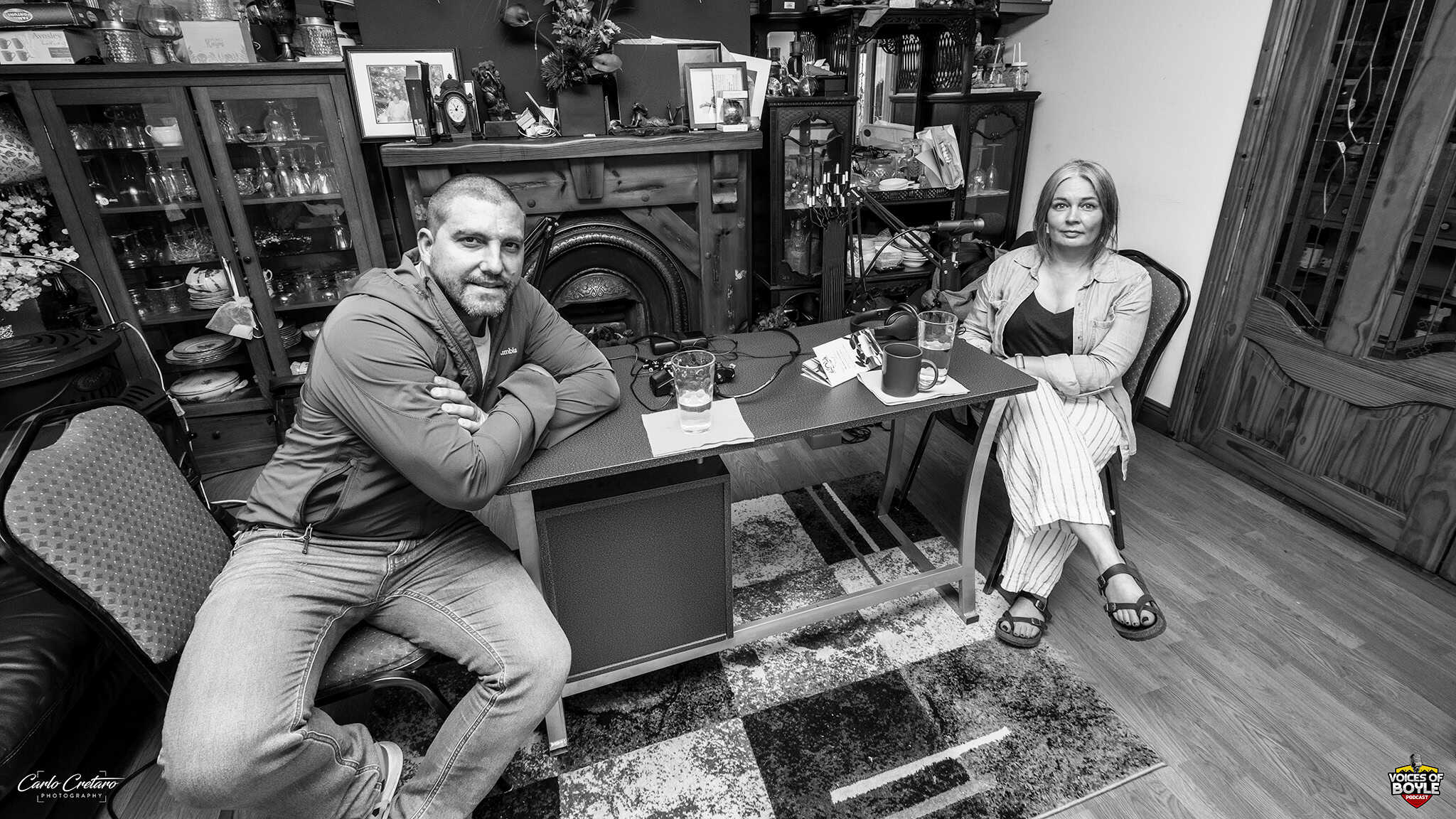
Thanks to Brendan O’ Dowd for creating and recording the musical piece for the podcast.
BE A GUEST ON THE SHOW!
If you’ve a story about Boyle, we’d love to hear it. You don’t need to have done anything remarkable, and you don’t need to prepare a thing. We sit down, have a chat, and you talk about whatever you want to. It usually takes about an hour.
Thinking of someone else? A parent, a grandparent, a neighbour who remembers how it used to be? Tell us about them. Some of our best episodes started because a son or daughter got in touch. You can find us at info@voicesofboyle.com.