
Episode 64
Gary Kealy & Mark Attwood – Live 5D Health Centre
HOSTS & GUESTS
Carlo Cretaro
Florence Cretaro
Gary Kealy
Mark Attwood
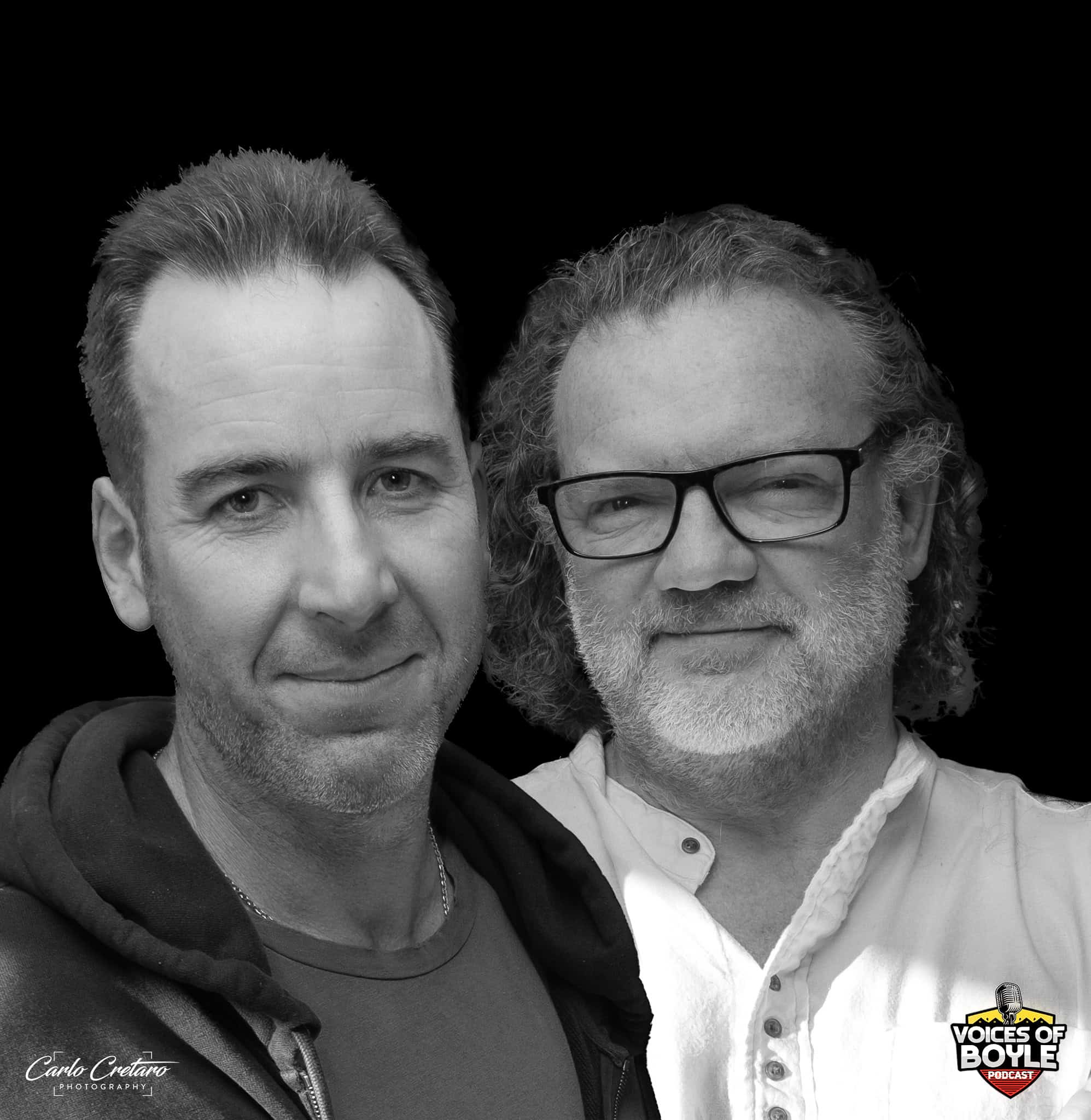
Two men move onto the same street in Boyle within a few weeks of each other. Neither knows the other exists. One has come from Dublin in a hurry. One has taken about twenty years to get here by way of a theatre company in Manchester.
Some years later they are running a wellness centre together on Bridge Street and fielding enquiries from Australia.
A finger on a map
Gary Keily’s version is the quicker of the two. He and his wife were living in Dublin. Their landlord died, and when they went looking for somewhere else they found what half the city was finding, which was queues around the corner at every viewing.
He was already working from home most of the week. His wife, a teacher, was on maternity leave. So they asked themselves the obvious question, which was why they were paying Dublin money to be in Dublin at all, and decided to go somewhere else for six months and see.
Then a house came up on a hill above Boyle, with the lake below it, in a photograph taken on a good day.
They were at a funeral in Abbeyleix when he saw it. On the drive home he turned the car around, went and met the landlord, and said yes.
Two days later a man walked past with a rake of small children. That was Mark. They waved at each other for a few weeks before they ever spoke.
A play in Manchester
Mark Attwood’s route runs the long way round and starts in the nineties, when he was running a theatre company in Manchester and cast a young woman in a play. Her mother, he says, was one of the Grehan sisters from Boyle.
Seven years later that same woman introduced him to the woman who became the mother of his five children. Then both sets of parents moved from Manchester back to Ireland.
He was coming to Boyle from 2002 on. He took a house here for six months in 2014. He moved over full time in 2017, onto a street where, within a few weeks, Gary Keily moved in three doors down.
They met properly in the Spool Factory. Gary was talking about crypto. Mark had done a bit of work in crypto. That was enough.
Stockport, 2001
Mark dates his own interest in health to a night in intensive care in Stockport, the night before 11 September 2001.
He had been admitted with a suspected heart event. A school friend of his died the following morning in New York. Mark woke up and found out that whatever had happened to him, it had not been his heart. He had nearly drowned swimming against the tide in Spain some time before and his bloods were reading strangely because of it.
The thing that stayed with him was asking the nurse the night before whether he was going to die, and being told that he probably was.
He discharged himself. He also started reading, which he has not stopped doing since. He was running a business in England at the time, and by his own account he was living on stress and drink, which he says goes with the territory for a lot of people in business. His ex wife’s line was that he was a heart attack waiting to happen.
What changed things, he says, was a seven day fast at a retreat in Devon. He remembers pulling into the car park and seriously considering driving home. He stayed the week, and he describes it as transformative.
The water
If you talk to Mark Attwood for an hour, you will end up talking about water.
He says he had already looked into Irish water before he ever moved here, and did not like what he found. He put reverse osmosis into the house he rented in 2014. His view of the result was that the water was clean but dead, which is roughly the beginning of a much longer road.
The system in the centre on Bridge Street runs the whole building. Gary describes it: a large carbon filter first, then a vortex spiraliser, then magnets, then a copper coil, and finally what he calls a reprogramming with the frequency of a hundred springs from around Europe. Members can fill their bottles from it for nothing.
Both men are firm about salt, and about electrolytes, and about the habit of drinking litres of water because somebody told you to. Gary’s point is that if you drink water with nothing in it, your body has to go looking for the electrolytes elsewhere.
Mark’s one piece of advice for anybody who never sets foot in the place is to sort out the water they are drinking, and if they can manage it, the water they are bathing in.
What is in the building
Live 5D Health is a members only centre on Bridge Street, above the river, and you cannot walk in off the street. The way in is the consultation form on live5dhealth.com, and somebody comes back to you.
What is in it, in their description: hyperbaric oxygen, red light therapy, UV light, PEMF, a roXiva light and sound unit hooked up to a sound table, a healing pod they call the Orinoco, a hydrogen bar, a members’ store, and the water system running through everything.
At the time of recording they were building a spa alongside it, with a dry sauna, a steam room and a cold plunge, which Mark expected to be open by April. Gary has since taken the rest of the first floor and wants a gym in it, on the basis that most of the people coming through the door are not lifting anything heavy and should be.
The dry sauna is a deliberate choice. Gary’s reasoning is that the traditional wood and coal sauna is the one with the longest research record behind it, and he points listeners at PubMed rather than asking anyone to take his word for it.
Their case, in their own words
It should be said plainly that Mark and Gary hold views about health and medicine that a lot of people will disagree with, and they do not soften them. Their central claim, repeated several times, is that people are not sick, they are toxic, and that the body will right itself if you give it the conditions.
They are careful about one thing. They say repeatedly that they do not cure anything and do not claim to. Their position is that everything in the building is there to cleanse, nourish or stimulate, and that the healing is the body’s own work.
Gary talks about it in terms of homeostasis, which he explains as simply holding your physiology at a good level, and argues that chronological age tells you far less than people assume. He points at the money going into longevity research in the States and at Brian Johnson’s numbers.
There is also a strand that is frankly esoteric, and they are not embarrassed by it. The memory of water. Masaru Emoto’s frozen crystals. Veda Austin’s photographs. The Orinoco pod, which is a chair between three poles and is not plugged into anything, and which Mark says has a strong effect on some people and none at all on others. Gary’s framing is that consciousness is doing at least as much of the work as the machinery, and that somebody who comes in closed off will not get far.
Both of them, more than once, tell listeners not to take their word for any of it and to go and read for themselves before they ever ring.
Two sessions, described
The most enjoyable part of the episode is Carlo and Florence talking about their own turns on the roXiva and the sound table.
Carlo went in for five minutes with headphones on, was told his eyes would fight it, and found that they did. After about thirty seconds he was seeing geometric shapes behind closed lids, like a kaleidoscope. That evening, just before sleep, he had a run of unusually vivid images while completely awake, which he had never had before.
Florence, who had gone in on the back of Carlo coming home raving about it, found herself somewhere else entirely. She was under water, lying down, with rain falling on the surface above her and a grey sky behind it, patterns spreading out where the drops landed. Halfway through the sky cleared and the light came through the water onto her. She came out and described all of it to Mark before he told her which programme he had put on.
It had been the anxiety one. Grey sky, then sun. She said it made total sense.
Boyle
The part that will interest people here most has nothing to do with machines.
“We’re already a tourist attraction for Boyle.”
Mark says most of their clients are not from Boyle at all. They are coming from across Ireland, and they have had people over from Australia, New Zealand, Europe and America to see what they are doing. His estimate is that this has already put hundreds of thousands of euros into local B and Bs, pubs and cafes. He says they have had close to 600 franchise enquiries from around the world and have held every one of them off while they get the place right.
He would like a car park, and is still sore about the spaces lost when they did the bridge. Gary points out there is plenty of parking behind the post office and it is a two minute walk.
What they would really like is a saltwater swimming pool, which Mark admits is well down the line.
Gary’s version of the future goes further out again. Regenerative agriculture feeding into the centre. A closed loop of energy, food, water. And both of them look out at the Boyle river and think about the turbines that now exist which plug into a riverbank, and what a town could do with its own power.
Mark also has a theory about the town itself, which involves ley lines, portals, Betty Meyler and the UFO Society, and a lifetime of seeing things in the sky. Take it or leave it. He has been here long enough to say it out loud in a Boyle sitting room, which counts for something.
Last word
Asked at the end whether there was anything else, Gary took it.
He said he came here seven years ago and is still here. That the town has its issues, like anywhere. That there is a phenomenal energy in it. And that people who are here should realise they are here for a reason and try to tap into it.
“Boyle is an amazing town. There is a phenomenal energy here.”
When Florence thanked them for choosing Boyle, Mark shook his head.
It chose us, he said.
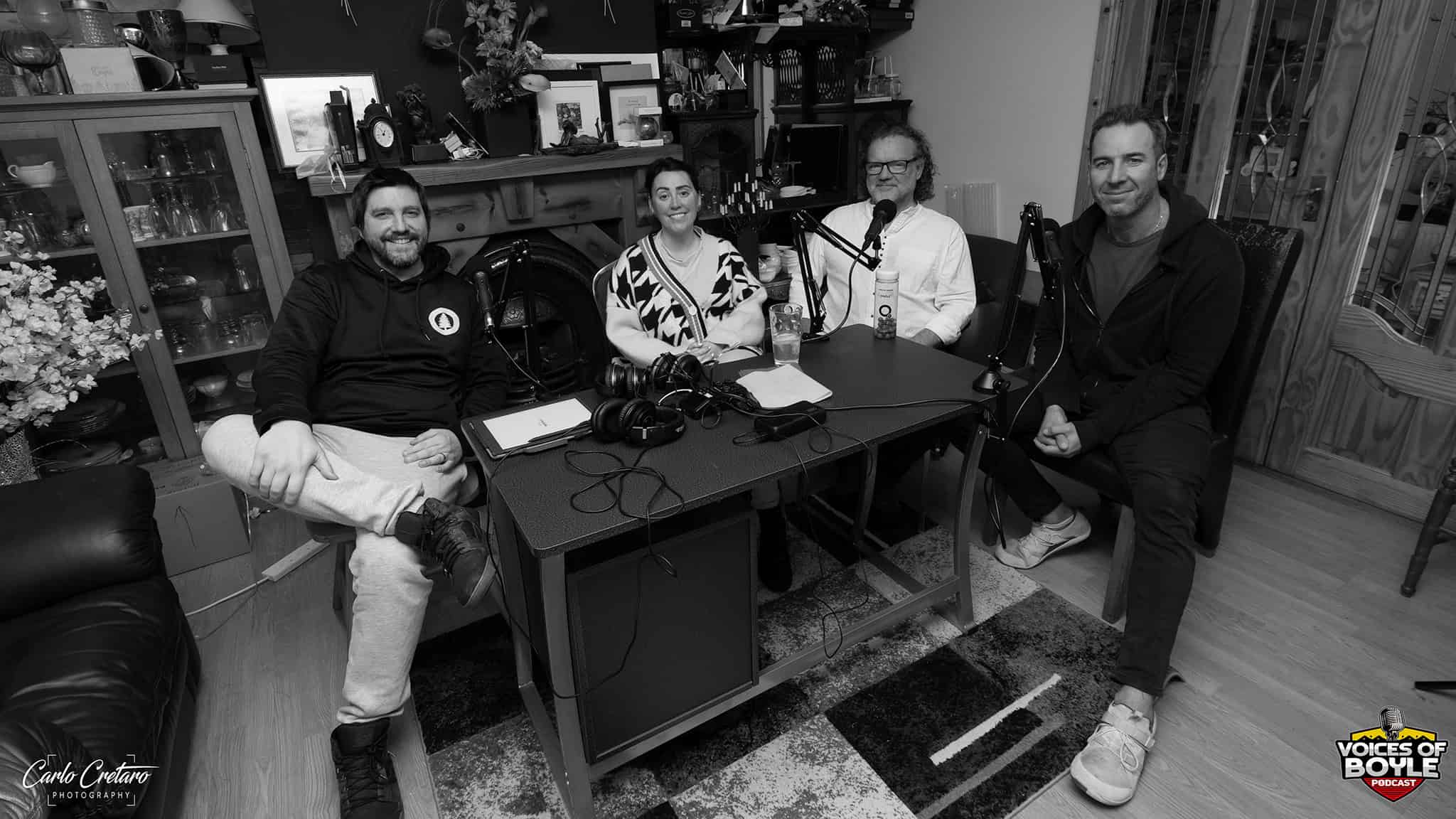
Thanks to Brendan O’ Dowd for creating and recording the musical piece for the podcast.
BE A GUEST ON THE SHOW!
If you’ve a story about Boyle, we’d love to hear it. You don’t need to have done anything remarkable, and you don’t need to prepare a thing. We sit down, have a chat, and you talk about whatever you want to. It usually takes about an hour.
Thinking of someone else? A parent, a grandparent, a neighbour who remembers how it used to be? Tell us about them. Some of our best episodes started because a son or daughter got in touch. You can find us at info@voicesofboyle.com.

So exciting to see what you’re doing guys. Makes me want to move there. It’s inevitable that all the shit we’ve been exposing will take a back seat eventually and to relearn and disengage from the matrix bulldag is this time we are engaging in to is so empowering that really lights me up. Thank you Mark and Gary. It’s epic where you are and I’m sending tons of love to you. ❤️❤️