Episode 92
Nicola Wynne – War Zones, Skyscrapers and the Road Back To Boyle
HOSTS & GUESTS
Carlo Cretaro
Nicola Wynne
RESOURCES
Most people in Boyle will know the Wynne name. From the legal practice on the way into SuperValu, run today by Paul and Jonathan Wynne.
From their late father Harry, the well-known solicitor who built it. From Lily Wynne’s newsagents on Main Street, a fixture for generations.
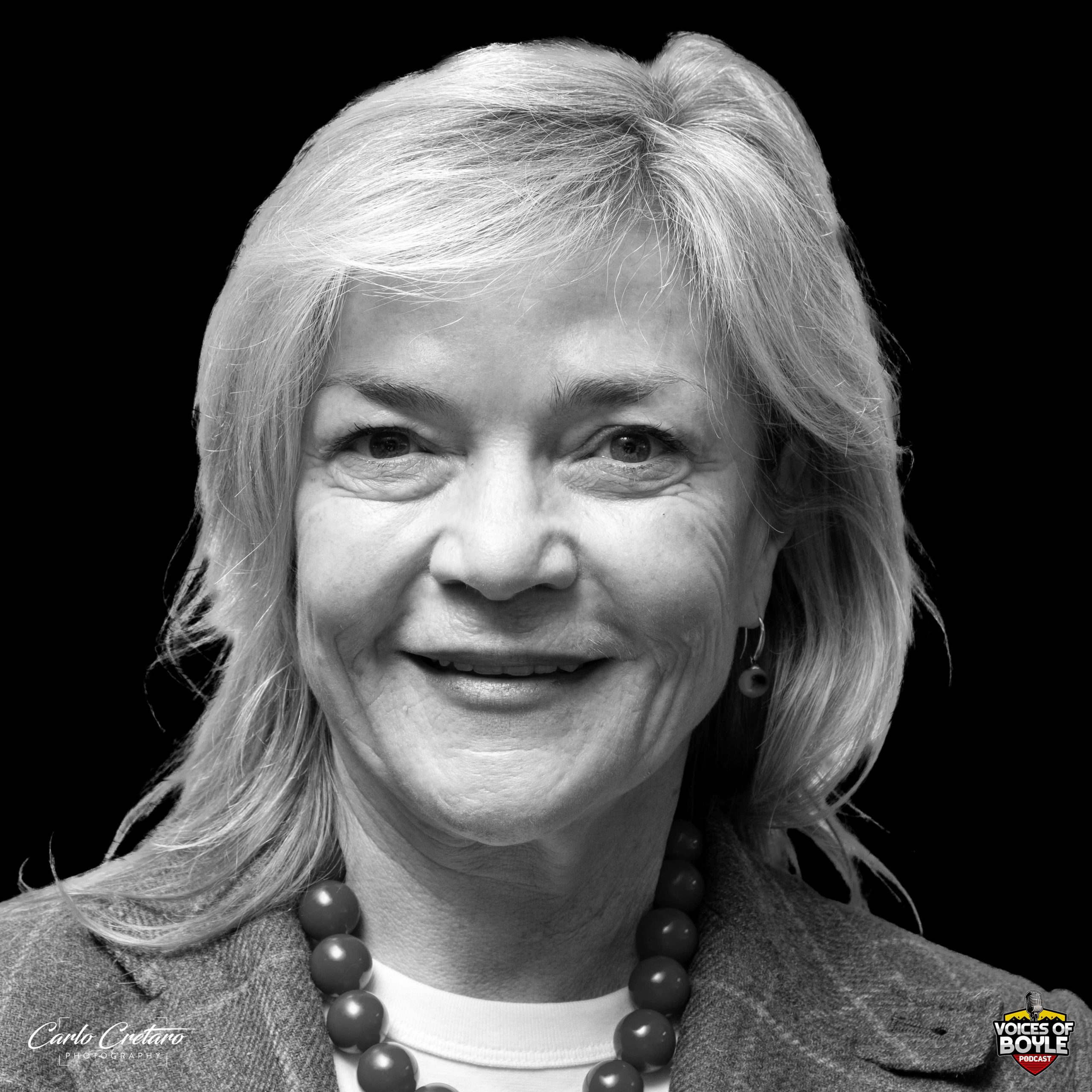
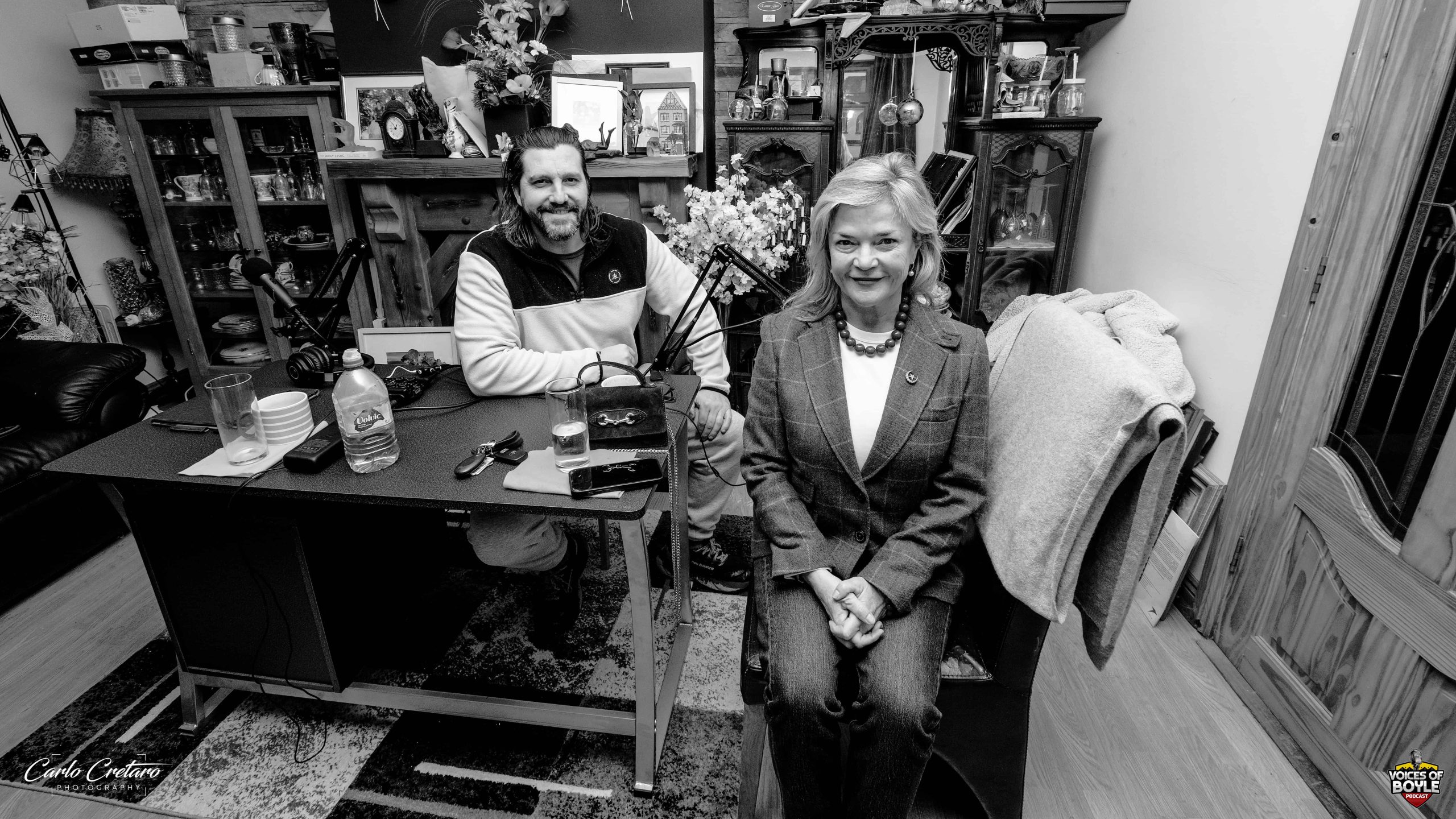
This week on Voices of Boyle, Carlo sits down with Harry’s daughter Nicola, who grew up on the Carrick Road and then went out into the world and lived a life it is hard to summarise in a single sentence.
A Town Life and a Country Life
Nicola’s parents built a house on the Carrick Road in the mid 1960s, and she grew up there as the eldest of three.
She describes a childhood that was, in the best way, two lives at once. There was the country life of the Carrick Road, surrounded by farms, playing in the fields with friends she is still close to today, collecting frogspawn and rose hips for some half-remembered initiative of the nuns.
And there was the town life, working summers in her grandmother Lily’s newsagents on Main Street, getting to know half of Boyle over cigarettes, newspapers and sweets, and at one point fishing tackle and guns kept by her uncle Christy.
“It was a very peaceful and a very joyful childhood,” she says. “Very unrushed, very natural. I had a really idyllic and very happy childhood.”
The town was full of characters. Clement Sheeran with his petrol pumps opposite the bank, where her father always bought his petrol.
Mr. Hanratty out the Roscommon Road, an Englishman nobody could quite place, walking his donkey and cart along the Carrick Road, his donkey named Marmaduke, his overcoat tied with a piece of string.
Granny Lily
One figure stands at the centre of the Wynne story: Nicola’s grandmother Lily.
Widowed young, with five children to raise after her husband died when Harry was just three, Lily ran the newsagents on Main Street and raised her family in the rooms above it, helped by her two sisters, Auntie Kathleen and Auntie May, who were the maternal figures upstairs.
Nicola is clear-eyed about what that took. Being a single woman in business in 1930s and 40s Ireland was not easy.
The banks, she notes drily, were not as favourable towards women, and the demands placed on them were more strenuous than they would have been for a man.
Lily was, by any measure, a formidable businesswoman in a time and place that made no allowances for her.
Being a Wynne in Boyle, Nicola says, always stood for something, because of the respect the town held for her father’s family and for the woman who held it together.
“My grandmother was a great business lady. In the 1930s and 40s it was difficult to be a single woman in business in Ireland.”
Harry Wynne and One Sod of Turf
Harry Wynne was not born into the legal profession. He chose it. Sent to St. Mel’s boarding school in Longford after his father’s death, he admired the lifestyle of a friend’s family who had been solicitors for generations, and he set out to build the same for himself.
He started on his own, above what was then Fred Perry’s supermarket on Main Street, right next door to where he had been born.
Nicola recounts the story he told at his 50-year celebration: his first client came in to find him sweeping the floor himself with a single sod of turf in the fireplace. The client looked at him and said, if you only have one sod of turf, what does that mean for me as your client?
He persevered. He was resilient. The practice grew, moved up Main Street, then to St. Patrick Street, and eventually became the established firm it is today.
His partner Vincent Harrington, also from Boyle and from the well-known Harrington and Taylor families, sadly died at just 42.
In time, Paul and Jonathan joined and now run the practice. The one Wynne who did not join was Nicola, who had, as she puts it, more interest in travel and the wider world.
Her father, she says, would have loved if she had joined, but supported every harebrained adventure she chose instead.
The Wild Child Who Left
Nicola describes herself as the wild child who took off as soon as she could. Sent to a strict convent boarding school in Dublin at 12, she discovered she loved the independence, even through the homesickness.
She studied at UCG, by her own admission more interested in the social life than academia, and spent her summers working abroad: picking grapes in France, working in canning factories in Germany, all ostensibly to earn money for the following college year, money that, she laughs, never quite made it back.
She found 1980s Ireland a repressive, church-dominated society with little room for stepping outside the mainline expectations of the time.
The moment she graduated, she moved to Germany, where she lived for three and a half years. It was the beginning of a life lived almost entirely outside Boyle.
Five and a Half Years in a War Zone
In 1993, Nicola went to work for the United Nations in former Yugoslavia. She had told her parents not to worry, that she would be somewhere safe.
In fact she was thrown into one of the defining conflicts of the era, living and working there for five and a half years during the period of the siege of Sarajevo.
She was one of very few women among roughly ten thousand civilians recruited worldwide to support a military mission of forty thousand.
She navigated intimidating checkpoints, the constant threat of hijackings, including of the ambulances near where she was based, and the freedom of movement that came with a white UN car.
She saw local colleagues who worked as interpreters lose their lives, murdered by the opposing side.
What stayed with her most was the nature of the conflict. This was not an external force invading.
This was neighbour against neighbour, people who had grown up together turning on one another as old tensions resurfaced with the collapse of Yugoslavia. Five new countries emerged from that war.
“It was an exposure to really how easy it is for humans to turn against each other,” she says. “War can happen really anywhere.”
It was there she met her husband Vladimir, from Slovakia. They married in Boyle.
“It was an exposure to how easy it is for humans to turn against each other. War can happen really anywhere.”
New York, and the Morning of September 11th
With a four-month-old baby and a home in a war zone, the family got a call to move to New York in 1998, where Vladimir worked in UN landmine peacekeeping. They settled across the river in Hoboken.
On the morning of September 11th, 2001, Nicola’s brother Paul had just left after a ten-day stay. Her younger son Marcus was eight weeks old.
It was her first day alone with both children. She had brought the baby to the gym creche and was in a workout class when a man ran in and said one of the Twin Towers had collapsed.
She describes the hours that followed with the clarity of someone who has never forgotten a second of them. Grabbing Marcus and running onto the street.
Telling a man waiting at a bus stop that he would not be going to New York that day. Running to a friend’s house whose husband worked in the towers, ringing the doorbell, and finding him there, having come up from the PATH station two stops from the World Trade Center moments before it fell.
She used to go to the World Trade Center almost every day to buy the Irish Times before Marcus was born.
To convey how close it all was, she reaches for a Boyle image: standing at the end of the pier at the Doon Shore, looking at the nearest island in Lough Key. That close. Close enough to reach out and touch.
She knew people who died. The first body identified was a relative of the Purcells, who worked for Cantor Fitzgerald on the 107th floor.
She went to his funeral. Her husband, evacuated from the UN Secretariat, could not get home for five days. She spent them alone with two tiny children, gripped by the terror that a plane would fall out of the sky, and by an eerie stillness in which no one knew what would happen next.
Twenty Years in Real Estate
After she and Vladimir separated, Nicola needed flexible work close to her children, especially in the anxious period after 9/11 when she did not want to be stuck in Manhattan unable to reach them.
She became a realtor in Jersey City, a place with deep Irish roots stretching back through Ellis Island, where an Irish accent and the gift of the gab opened doors.
She built a successful 20-year career, carrying her father’s values into a famously cutthroat industry: there is enough for everybody to go around, and never do anything you cannot sleep with at night.
Harry was always at the end of the phone for advice and encouragement.
Losing Everything in One Year, and Finding Home
Nicola’s American visa was tied to her marriage. When it expired, just before her older son turned 21, she faced having to leave the US for three years until her younger son, a US citizen, turned 21 and could sponsor her return.
In the middle of that looming deadline, her father got sick. She came home repeatedly over the ten months before he died in March 2019. By July, she had to leave America altogether.
She lost her father and her American life in the same few months. And then COVID arrived, and she found herself stuck in Boyle, unable to run anywhere for the first time in her life.
It became, unexpectedly, one of the happiest and most important periods of her life.
A woman named Mary Menton, since sadly passed away, met Nicola out walking one day and offered her a spare bicycle.
Nicola began cycling every morning: the Curlews, the Doon Shore, Rockingham. She took photographs and posted them on Facebook, slowly opening up, slowly being put back together by the familiar roads and faces of home.
“For the first time in my life, I felt grounded,” she says. “My foot nailed to the floor. And the fact that I couldn’t run away, I had to just be. It changed me.”
“For the first time in my life, I felt grounded. I couldn’t run away. I had to just be. It changed me.”
A Sign, and a New Life in Mallorca
After a brief and unhappy stint working in real estate in Dublin, Nicola flew to Mallorca for four days to think, where her older son had moved.
She came back and quit the Dublin job on the spot, with no plan, something she had never done in her life. Standing on the street, she looked up and asked her late father for a sign.
The next day, a phone call came from someone she knew, asking if she would be interested in a real estate opportunity in Mallorca.
She had been there the day before. The following Monday she flew back, met him, and has been in business there ever since.
She now lives in a small mountain town in the west of Mallorca, which she compares directly to the west of Ireland.
She plays in a Mallorcan carnival drumming group, is surrounded by nature, and both of her sons have moved there too.
She no longer wants to live in the States, though she remains grateful to it. Her goal now is to work and take three months off a year: one for Ireland, one for America, one for somewhere new.
What Home Really Means
Throughout the conversation, Nicola keeps returning to Boyle. To the friendships that have lasted across generations.
To the characters the town is steadily losing. To why things like Voices of Boyle matter so much to people living away: the old photos, the interviews, the connection to a place that made you.
She is honest about how the town has changed: the vacant buildings that pain her, the need for greater kindness and empathy, the steady drumbeat of people she grew up with passing away.
But she is firmly optimistic about Boyle’s future, and unequivocal that progress like the Aldi development is not just welcome but essential after decades of stagnation.
Asked what she would put on a billboard in the town, she does not hesitate: the west is the best.
Asked for the one memory she will carry forever, she chooses Assylinn cemetery, where she walks among the graves of her own people and all the people of Boyle, and looks back down over the town, the river and the mill, knowing it is the same view her father saw, and his family, and all who came before.
“At heart, I’m always going to be from Boyle. I’m proud to be from Boyle, County Roscommon.”
Key Timestamps
00:00 — Welcome, a fly-in visit to Boyle
00:32 — Growing up on the Carrick Road, the house built in the mid 1960s
00:50 — The Wynne family: Harry, Tom’s pub, Christy and Lily’s newsagents, Maura and Liam
01:30 — A town life and a country life: fields, frogspawn, rose hips for the nuns
02:22 — Working in Granny Lily’s shop, getting to know the town
02:52 — A privileged and very happy upbringing
03:30 — An affinity for nature carried through every country she has lived in
04:15 — Why being a Wynne in Boyle always stood for something
04:40 — Lily widowed young, raising five children above the shop with her sisters
05:46 — The challenges of being a single woman in business in 1930s and 40s Ireland
06:24 — Characters: Clement Sheeran and the petrol pumps
07:06 — Mr. Hanratty, the donkey and cart, and Marmaduke the donkey
08:35 — Early school days, Sister Philomena
09:10 — Happy, simple days with no social media
09:56 — Lifelong friendships, three generations of Boyle families connected
11:25 — Harry Wynne and the founding of the legal practice
11:44 — The early days above Fred Perry’s supermarket, the one sod of turf
13:50 — The hope that Nicola would join the practice
14:43 — Vincent Harrington, Harry’s partner, who died at 42
15:50 — Getting itchy feet: boarding school at 12, the taste for independence
16:51 — UCG, summers in Germany, picking grapes in France
18:01 — Finding 1980s Ireland repressive and church-dominated
18:30 — Three and a half years in Germany after graduating
19:27 — Five and a half years with the UN in former Yugoslavia from 1993
20:53 — One of few women, a huge military and civilian operation, the siege of Sarajevo
22:17 — Neighbour against neighbour, five new countries emerging from the war
23:18 — Checkpoints, intimidation and hijackings
24:21 — Was she ever truly in danger? The hijacked ambulances
25:06 — Looking back: did I really do that?
25:40 — Her sons: Harry born in Ballinasloe, Marcus born in the States
26:26 — Meeting Vladimir, marrying in Boyle, the call to move to New York in 1998
27:51 — September 11th: being in New York
28:02 — The morning it happened, the gym, the collapse, eight-week-old Marcus
30:06 — The friend whose husband was two subway stops from the towers
30:45 — The smell of death that lingered for weeks
31:51 — How close it was: the Doon Shore and Drummond Island analogy
32:45 — Buying the Irish Times at the World Trade Center most days
32:51 — Losing people: the Purcell cousin, the first body identified, Cantor Fitzgerald
34:22 — Five days before her husband could get home, the terror and the eerie stillness
34:58 — Becoming a realtor in Jersey City
35:19 — A saturated industry and cutting her own teeth
37:35 — A successful 20-year career and her father’s values
39:13 — Leaving America: the visa tied to her marriage, waiting for Marcus to turn 21
40:00 — Harry getting sick, dying in March 2019, leaving the US that July
41:14 — COVID and being stuck in Boyle
42:16 — The happiest, most amazing time: grounded for the first time
43:02 — Mary Menton and the gift of a bicycle
43:41 — Cycling the Curlews and the Doon Shore, the photographs on Facebook
44:40 — Healing through the familiar places and faces of home
45:21 — A brief, unhappy stint in real estate in Dublin
46:23 — Flying to Mallorca to think, quitting the Dublin job on return
47:16 — Asking her late father for a sign, the phone call the next day
48:04 — Starting a real estate business in Mallorca
48:21 — Life in the west of Mallorca, the parallels with the west of Ireland
49:50 — Both sons now living in Mallorca too
50:16 — The Mallorcan carnival drumming group
51:46 — Why she is happiest in small environments with older people
52:20 — Why Voices of Boyle and staying connected matters so much
54:43 — Not wanting to live in the States again, but grateful to it
55:44 — The goal: three months off a year, one each for Ireland, America and somewhere new
56:34 — What feels different about Boyle now: vacant buildings, the need for kindness
58:34 — Resilience, optimism and hope for the future
59:19 — The Aldi development and why progress is essential for Boyle
01:00:16 — The billboard question: the west is the best
01:00:56 — The forever memory: Assylinn cemetery and the view back over the town
01:02:27 — Closing: the goodness in Boyle and the pride in being from it
Guest Bio
Nicola Wynne grew up on the Carrick Road in Boyle, the eldest child of the late Harry Wynne, the well-known Boyle solicitor, and sister to Paul and Jonathan Wynne who run the family legal practice today.
After studying at UCG, she lived in Germany, then spent five and a half years working for the United Nations in former Yugoslavia during the war. She moved to New York in 1998 and built a 20-year real estate career in Jersey City.
After returning to Ireland for three years following her father’s death in 2019, she relocated to Mallorca, where she now runs a real estate business and lives in a small mountain town in the west of the island. She has two sons, Harry and Marcus, both of whom also live in Mallorca.
Thanks to Brendan O’ Dowd for creating and recording the musical piece for the podcast.
BE A GUEST ON THE SHOW!
If you’ve a story about Boyle, we’d love to hear it. You don’t need to have done anything remarkable, and you don’t need to prepare a thing. We sit down, have a chat, and you talk about whatever you want to. It usually takes about an hour.
Thinking of someone else? A parent, a grandparent, a neighbour who remembers how it used to be? Tell us about them. Some of our best episodes started because a son or daughter got in touch. You can find us at [email protected].