Episode 44
Thomas Mullaney – Historical Preservation & Economic Perspectives
HOSTS & GUESTS
Carlo Cretaro
Thomas Mullaney
RESOURCES
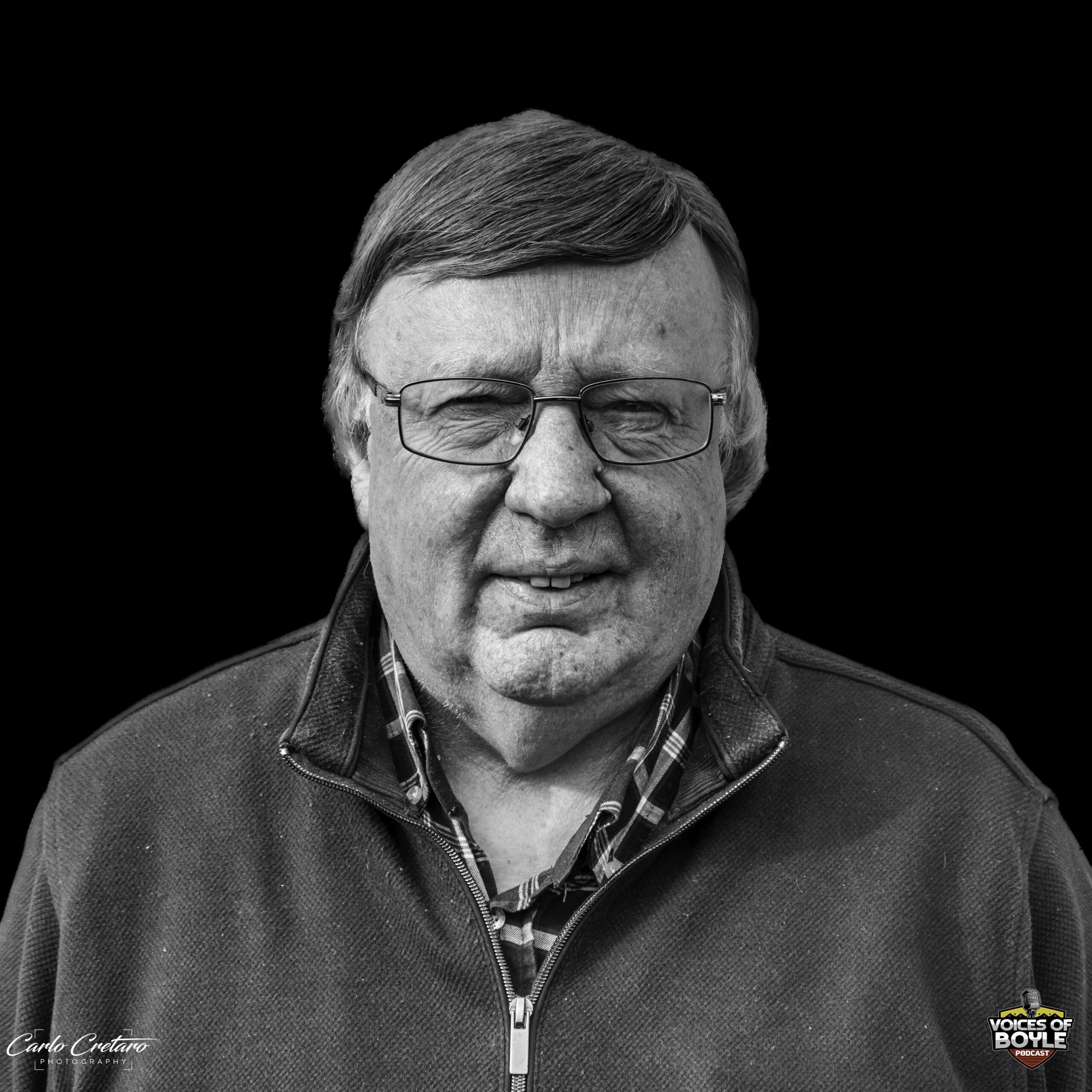
Raphoe, County Donegal, 1968. A young man from Croghan is three weeks into his first job in the Northern Bank. There is a referendum on. The sensible thing, in a new post in a strange town, is to keep the head down.
Tom Mullaney took an active part in the campaign.
“Not a wise decision,” he says, more than half a century on, and he says it the way a man says a thing he would do again.
Like a politician, there are two answers to that question
Asked whether he is a Boyle man, Tom gives the politician’s answer, because there are two of them. He was born in the town, in a nursing home beside Brogan’s that almost nobody remembers was there at all, and reared in Croghan. His father’s people were spread across towards Frenchpark, his mother Bridget came from the Boyle and South Sligo side, and the barony of Boyle, as he puts it, covers his background.
“So I’m a Boyle man, except when Shannon Gaels are playing.”
More smoke than fire
He caught the last year of the old school at Croghan, and it was a strange year. Five or six different teachers came and went, and it was only afterwards that people said there had been a strike. Sometimes the senior pupils took the class. There were mouse traps set upstairs. Everyone brought their road of turf to heat the place, some earlier than others, so by the end of the year the fresh turf was going on the fire wet. More smoke than fire, he says, and the steam rising off it.
The new school opened in 1955, and there have been three schools in Croghan in his lifetime. He names Mrs Faye and Danny Morton, but the teacher he remembers best is Master Callaghan. By the time that class left Croghan they were fit for the inter cert and, if that was the road, fit for the emigrant ship.
Hot tea in the basement
Secondary was Mrs Lynch’s Rosary High School in Carrick-on-Shannon, a family setup in the full sense. Coed at a time when that was unusual, hot tea in the basement at lunchtime rather than a cold lunch, and school tours the family arranged themselves, including one up north where he remembers police with revolvers on their hips. He says he was pampered. Michael Lynch taught him, Michael’s mother Mary Kathleen ran the school, and Michael’s son was buried in Carrick a week before this conversation was recorded.
The football was the other education. A small school taking on St Mary’s in Boyle and the CBS, and beating them a couple of times in the county colleges championship.
“Not that I was much of a footballer, but enthusiasm can get you everywhere.”
A whole new world
The Lynch family ran a guidance evening in the county hotel where past pupils came back and talked about five or six different jobs. Tom had never stood inside the door of the Northern Bank in his life. They introduced him to it, and that was that. Before it there was fencing for the Land Commission, which he calls hard labour, and six months of work study at Mountdillon. He sat the bank exam in Belfast in 1968.
The same instruments, different tunes
Raphoe surprised him. Very much a north of Ireland town although it sat in Donegal, with Church of Ireland, Presbyterian, Methodist and Catholic congregations in it and, by his account, a mixed community working well together. Three and a half happy years. It was also 1968. He watched the Apprentice Boys go into Derry on the twelfth of August and the Hibernians march on the fifteenth.
“They had the same instruments, but they were probably should be playing different tunes.”
On the fifth of October he took a lift to Letterkenny. That is the only reason he was not in Derry. He walked up Sandy Row in Belfast wearing a Pioneer pin and was approached by a missionary group who could not believe what had wandered in. One night in the Guildhall in Derry he went to a dance and worked out partway through that it was a fundraiser for the Ibrox disaster. No place for a southern accent. They came out of it alive.
Nine weeks, and four men against the government
The bank strike of 1970 lasted six months. Tom went to Dublin and worked as an attendant in St Kevin’s, on the site that became St James’s, talking to patients who had come through the War of Independence and to a man who had played for Kildare in the twenties. He was on hospital wages and strike pay at once, which Carlo puts to him was worth his while. He does not disagree.
From 1971 to 1977 he was Dublin based, on relief, working Mohill, Cork, Limerick and Galway, then three years in Grafton Street. He ran for union office in 1975, gathered the cronies from Leitrim and Roscommon, got in, and became assistant secretary of the bank officials’ association at national level.
In 1977 the government legislated to control their pay, with inflation running around twenty per cent, a word he admits he knew nothing about until then. He was one of four members who took a constitutional action against the state over it. He thinks the strike that year ran nine weeks. It petered out in the end.
The savage loves his native shore
He always meant to come home. The promotion that brought him back was Drumshanbo, assistant manager, in 1977, and he stayed ten good years, with Dowra following later. Thirty eight years in the bank altogether. In Boyle you can still walk in and talk to somebody, and he gives Bank of Ireland and its staff full credit. Outside the bank it is a different story. He spent a recent Sunday trying to buy a match ticket online while Ticketmaster tried to sell him insurance to protect him from buying it.
Forty votes, and twenty six counties
Tom ran for the Seanad twice, on the labour panel, nominated through the trade union movement on the strength of his industrial relations experience. That is the industrial relations panel, he is careful to say, not the Labour Party. The electorate is county councillors, senators and TDs, all hard nosed professionals. Writing to them was not going to do it, so he printed his own card and drove the twenty six counties.
Forty votes came back, which, from councillors who had never met him, he counts as respectable. He thinks if he had gone the second time rather than sitting one out he might have got in.
Microfilm at five o’clock
In 1983 he joined the GAA Centenary Commission, at a time when twelve members of Roscommon’s 1944 All Ireland winning team were still living, and from there he moved onto the history committee. He is dry about committees. There are working committees and there are talking committees. With Tony Campbell writing and Tom reading, the county history came out in 1990.
He had already written his own club’s history in 1985, and did not confine it to the football. Griffith’s Valuation went in, and the Books of Survey and Distribution of 1649, because the association came out of the National League and the Land League. Of all the names from that period he puts Michael Davitt first, the man who put ordinary people in possession of their land. Between Croghan and Boyle, he points out, four or five men once owned the whole lot of it.
The research was done in the National Library, reading handwritten documents off microfilm, three hours at a stretch after a day of union meetings. He was, he says, the worst writer that ever went to a school.
A rambling house
The interest was there long before the research was. The house he grew up in was a rambling house. Card players came in, and the children were upstairs listening to the row below, men hammering the table and still arguing over a trick played in 1925. A neighbour a few doors down had played for Roscommon.
One of the best inland towns in Ireland
Asked whether Boyle can get the good days back, he starts with what there was. Boyle in the fifties and sixties was probably one of the best inland towns in Ireland. In 1944, the last time Roscommon won an All Ireland, four championship matches were played in the Abbey Park. He has been told, and offers it as hearsay, that there were people in the town who did not want any more of that carry on, with the place pestered with bicycles.
The ploughing championship came to McGivney’s in the mid fifties. The Fleadh came in 1960 and again in 1966. He reckons two hundred thousand pounds was spent in the town that year and seventy thousand people came, and says himself he may be wrong on the figures. Then in 1972, on the strength of that record, Boyle was offered the Fleadh on a permanent basis. Ennis took it.
You never reject investment
On the present, he is impatient with the gloom. The narrowing of the streets he raises and then declines to be drawn on, beyond wondering aloud whether it is helicopters that will be getting through the town. The Royal is another matter. It has been restored, and he is glad of it, and he names Frank Feighan once in connection with the funding. But a restored building sitting idle is not the point of restoring it. He would put something in it. A coffee shop, even. Somewhere a visitor can sit down comfortably. Carlo is blunter about the art exhibitions and the bad taste they have left.
“You never reject investment.”
A stand alone library will be there for a century, and it frees up space in King House. As Carlo notes from an earlier episode with Kieran Sheeran of the Boyle Town Team, the money on the table was for a library and nothing else. Tom takes the money.
He is pleased to see the Stewart family’s development at St Patrick’s Keep, and pleased they gave the place back the name it had from when it was a church in 1822. He notes the planned twenty one bed boutique hotel and says anything with hotel written on it would be a boost. What made Boyle was the business people in it down the years, and there is nobody to blame for what came after.
More sense, less talk, more work
The most influential person in his life was his mother, and people still tell him he is like her. His father he remembers as an easygoing man who enjoyed life and worked hard without being a slave to it. His mother wanted the turf saved when it was fit to be saved and the potatoes in on time. On the Irish mother he makes a comparison with Margaret Thatcher that does not go in Thatcher’s favour.
He still farms, has cattle and keeps a few donkeys, and gives credit to his brother Francis in Croghan for keeping him on the straight and narrow. Asked what he would tell a twenty year old Tom Mullaney, he does not reach for anything grand.
“To have more sense, to say less, and to work more.”
“And if I know anything, it’s because I met smarter people than myself.”
He has two grandsons and would like them back playing for the Rossies. He is meeting a young woman from Arigna tomorrow who is starting out on a career, and he will try to give her some help. It matters, he says, that Boyle has a voice. Any time it had one, it was able to use it.
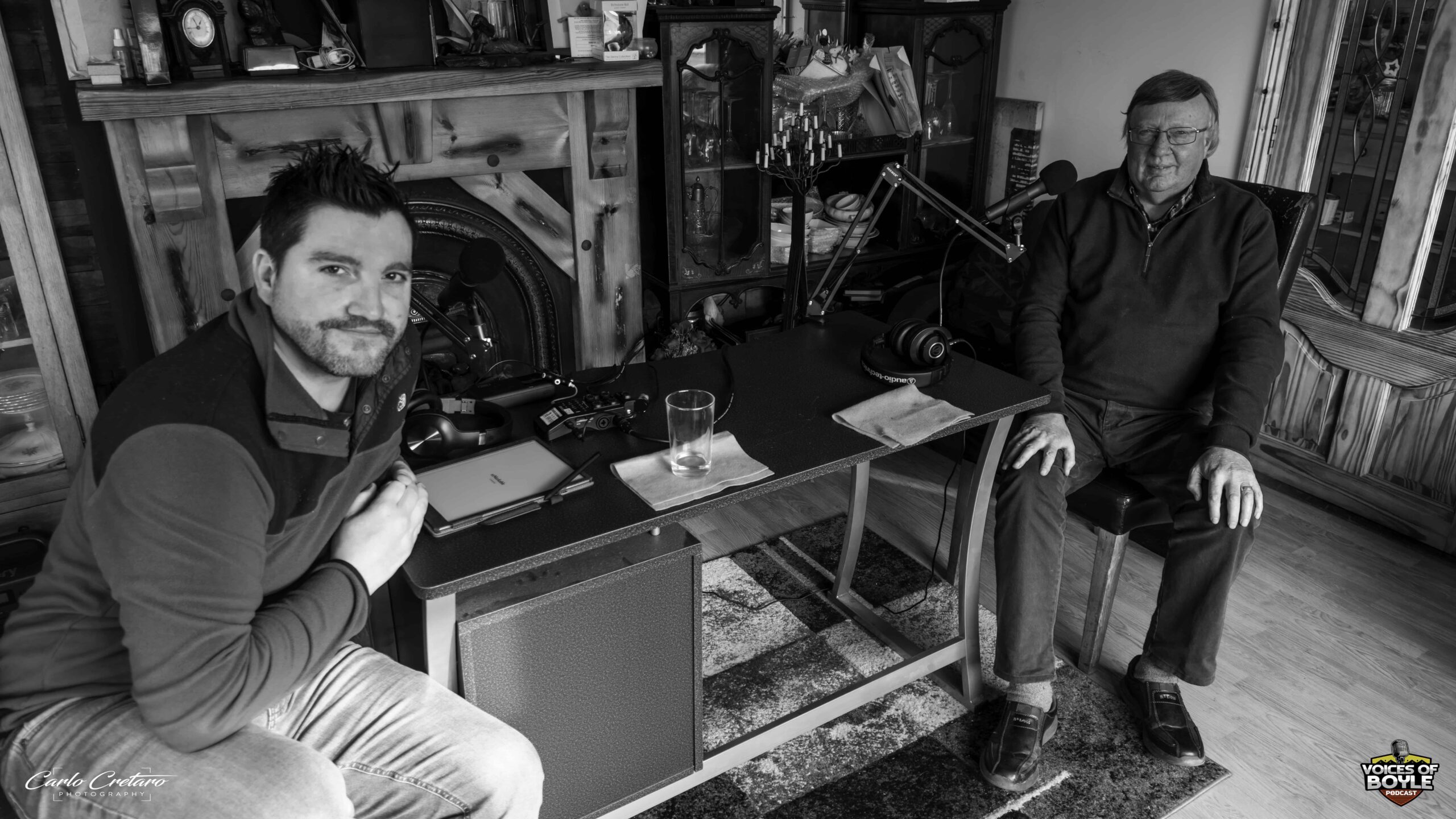
Thanks to Brendan O’ Dowd for creating and recording the musical piece for the podcast.
BE A GUEST ON THE SHOW!
If you’ve a story about Boyle, we’d love to hear it. You don’t need to have done anything remarkable, and you don’t need to prepare a thing. We sit down, have a chat, and you talk about whatever you want to. It usually takes about an hour.
Thinking of someone else? A parent, a grandparent, a neighbour who remembers how it used to be? Tell us about them. Some of our best episodes started because a son or daughter got in touch. You can find us at info@voicesofboyle.com.