Episode 58
Barry Cryan – From Chaotic Classrooms To Orderly Systems
HOSTS & GUESTS
Carlo Cretaro
Barry Cryan
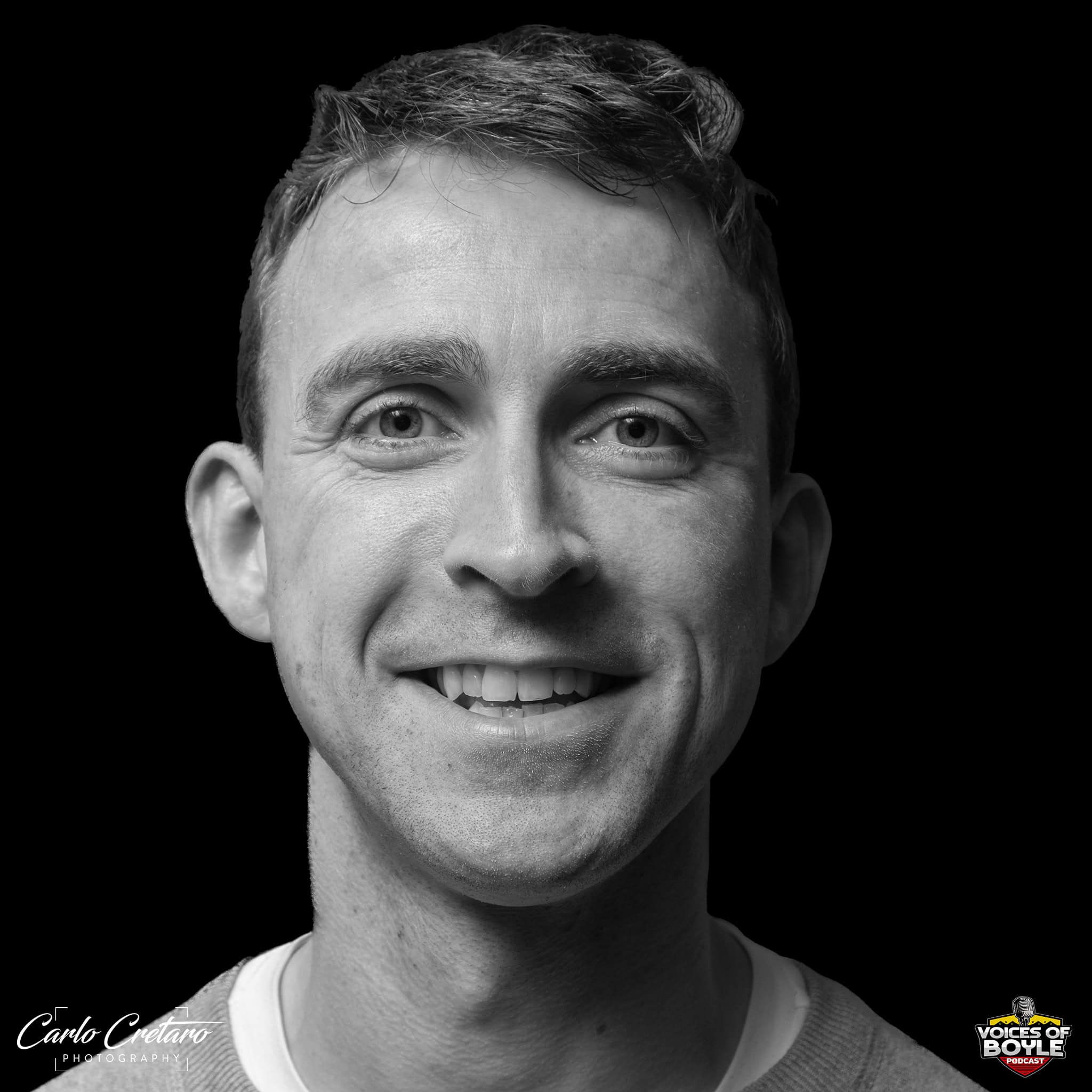
September 1998, and there were three lads in a class in a rural national school outside Boyle. Two of them went off to Ballymote. The third came in to St Mary’s on his own, twelve years of age, knowing nobody at all.
Barry Cryan had fought his corner all summer to be allowed go with his friends, and lost. So he landed into the annex on the first morning with a room full of strangers and a day of tests in front of him, sat down the back, and started taking in what was going on around him.
“This is mad, like, the place was. It was like a zoo. That was just day one.”
It was like a zoo, and that was just day one
Cheers going up, tables flying, and every time a supervisor stepped out the room went. He was twelve and the lads in fifth and sixth year were grown men. He would walk around the back of the school to find a teacher standing in an empty classroom, then walk around the front and find half the class outside the door having a smoke.
One classroom had a door that was, in his words, glorified cardboard. Roughly once a week somebody took a run at it and went straight through the middle.
“There’d be a big person size shape in the middle of the door where someone would have ran straight through the middle of the door.”
The school gave up patching it and left the hole there, and people walked in through the middle of the door rather than bother with the handle, until the money was found to replace it.
He is not proud of all of it. He says he feels bad now for the teachers who had to walk into that every day, and that at the time nobody thought about it from the other side.
There was an afternoon he and two other lads slipped off down the town. The principal Don Conlon came over to him at break the next day and asked where he had been. Barry is usually quick with an excuse. That day his mind went blank and he stood there saying nothing for what felt like ten minutes. In the end they told him to come back tomorrow with a good reason. He never went back to them. They never came back to him. Nothing was ever said about it again.
A race against the clock to get home before the postman
He had no interest in school. The number of times he did his homework, he says, you could count on two hands. There was a girl in his class whose handwriting was identical to his mother’s, so the diary went home unsigned and came back signed.
The report cards were harder. His father was farming at home and could be around the yard when the post came or could be off doing something, and it was fifty fifty either way. The bus landed at four.
“There’d be a race against the clock to get home before the postman.”
The verdict on the cards, when they got as far as being read, was could do better. He liked woodwork, engineering, maths and physics, the subjects where a thing was either right or wrong. English and French he had no time for at all.
Tony Conboy, and the wing forward disaster
Football was Gaelic, never soccer. He had played for the local club, Harps, in national school, and going in to St Mary’s he knew none of the teachers had ever seen him play, so he made a point of it at that first training session with Tony Conboy.
He made too good a point of it. He was up and down the field getting on more ball than he ever had in his life, and Conboy watched him and decided this fellow was a forward. Barry had spent his whole career in the full back line. He was stuck in at wing forward and it went badly.
The team never went far. The best group they had, he reckons, was the first year team, and they got to a county final against Garbally in Hyde Park and were well beaten. The real attraction was the day out. A match meant the whole day gone, and even a home game meant the rest of the afternoon was a write off.
Going up to the girls school for basketball one day in transition year, somebody turned right instead of left and the group ended up out at the wooden bridge, down the N4 and around the green. Four hours missing, an investigation, and a ban from PE.
One job advertised in Sligo
The CAO form was a way of putting a pin in the question. He put sound engineering in Limerick down first, mostly because two friends had the same plan, then changed it to health and safety in Sligo without telling either of them. Both of them had done exactly the same thing. None of the three said a word, and they all ended up in different places.
He got the exact points he needed and went to IT Sligo, now ATU. Five years in the end, partly because the recession was setting in and another year of college looked like a reasonable way to wait it out. It did not work. He did an ECDL course for 250 euro a week while he kept looking.
Then a health and safety job came up in Amcor in Sligo. He says he had never in his life seen one advertised there. He applied without much hope, did two interviews and an aptitude test, and heard nothing. By Christmas he had written it off. In January the phone rang and the job was his.
March 2014
He woke up one morning in March 2014 feeling like he had a dose of the flu. He pushed on, took a day off, came back, and it did not lift. Fatigue turned into brain fog and then into the loss of his short term memory.
“I’d be having a conversation with somebody, and I wouldn’t have even remembered what we had started talking about.”
He was bluffing his way through work. Every hour and a half he went into the bathroom, closed the door and rested his eyes for twenty minutes to get himself as far as the next hour and a half. He reckons he was getting about one day’s work done in every five, and he knew what that meant.
There had been odd things in the years before it. A week in hospital with crippling pain, told he had acute kidney failure, with nobody able to say why, and it corrected itself. The year before that, a week in hospital with his whole face swollen up, and no answer that time either.
“I went around to every doctor and consultant. I went down every rabbit hole I could find.”
Doctors, consultants, sleep studies, alternative treatments. Nothing made a dent. It ran to two and a half years before he had a name for it.
The woman on the front page
What broke it open was a newspaper. There was a woman on the front page talking about symptoms that sounded like his, and about treatment she was getting for an autoimmune condition. His wife knew her indirectly. They made contact, and the woman was in the Czech Republic at that moment being treated. She offered to get him tested with a consultant over there.
The tests came back with the same condition she had. Lyme disease.
He had been tested in Ireland and it had not shown up, so he had ticked that box off long before. His understanding, and he is careful to say this is what he was told, is that the test is only accurate inside a two week window after the bite. He thinks he was bitten years earlier on the farm at home and that it lay dormant until work and stress triggered it.
Six months of antibiotics did nothing. Then a solid month of intensive treatment in a place he describes as half clinic and half hotel, two and a half hours from the airport. He drove himself there in the snow, on the wrong side of the road, with Google Maps sending him down back roads barely the width of a car with grass up the middle of them.
Looking for a better way to work
The productivity business started here, out of necessity. He could not get an answer medically and he could not do five days of work in a week, so he went looking for a way to get more out of the little he had. He read the books, went to the seminars, tested everything on himself and threw out what did not work, all while still sick and still undiagnosed. He says that by the time he had it dialled in he was getting about five days of work done in one.
It was abroad, with time on his hands, that he started thinking about it as something other than his own problem. He pictured his own office back in Sligo. One person on sticky notes, one with a diary, nobody with anything you could call a system.
“We learn a lot of things in school and college and different things, but no one actually sits us down and shows us this stuff.”
He documented it, tried it on friends and family, and watched it work for them too. It stayed private until COVID. He had not changed his Facebook profile photo in ten years. He remembers making the business page live and wondering what people would make of a fellow in a normal day job announcing himself as a productivity coach, when nobody had any idea what had been going on in the background.
A hundred decisions boiled down to one
The core of it is what he calls a second brain time leverage system. You can shove a boulder off the top of a hill with enough time and effort, or you can put a lever under it. So the question is never how do I get through all of this. It is which of these things is worth five or ten times the rest.
The other half is taking decisions off the table. He uses the fridge as the example. If the sweet stuff is in there looking at him every time he opens the door, that is a decision every time, and eventually he loses one. If it is not in the house, there is one decision a week at the shop.
“It’s not about doing everything. It’s about doing what matters.”
That is his objection to traditional time management. A to do list is a list of decisions. Somebody sits down with a clear number one priority, dips into the inbox first, gets pulled into something, then a meeting, and by eleven o’clock the big thing is still sitting there. He describes running hundred year old time management principles at the pace of work now as putting an eighties processor into a new machine.
Perfectionism and procrastination come up constantly with the people he works with, and he treats neither as the problem. So the first step is made small enough to be embarrassing. Open the laptop. Open the document. Type anything.
“You can see the next 20 metres. When you get through that next 20 metres, you’ll see the next 20.”
He quotes numbers on what people get out of the eight week programme, and they are his figures rather than ours: two to three times the output, and about twelve hours a week back on average.
Rise Above
He has co-authored a book with Les Brown, the American motivational speaker, called Rise Above. It was days away from release when this was recorded, held up waiting on sign off from Amazon. It came out of a mastermind event in Miami where Brown was speaking. They got talking, and then, as Barry puts it, there were a few drinks and a very late night, and Brown heard the whole story. The book is a collection of chapters about coming through hard things, and he was asked for one.
There is a good deal in the last stretch of the conversation about Facebook and Instagram ads, if that is your area. He is well aware that half of Boyle is being followed around by his face, and he almost apologises for it.
And the business is called Do More Better, which, when Carlo points it out, lands neatly on top of every report card Barry ever intercepted at the front door.

Thanks to Brendan O’ Dowd for creating and recording the musical piece for the podcast.
BE A GUEST ON THE SHOW!
If you’ve a story about Boyle, we’d love to hear it. You don’t need to have done anything remarkable, and you don’t need to prepare a thing. We sit down, have a chat, and you talk about whatever you want to. It usually takes about an hour.
Thinking of someone else? A parent, a grandparent, a neighbour who remembers how it used to be? Tell us about them. Some of our best episodes started because a son or daughter got in touch. You can find us at info@voicesofboyle.com.