Episode 22
Barry Feely – Brothers In Stone And Longevity In Boyle
Hosts & Guests
Carlo Cretaro
Barry Feely
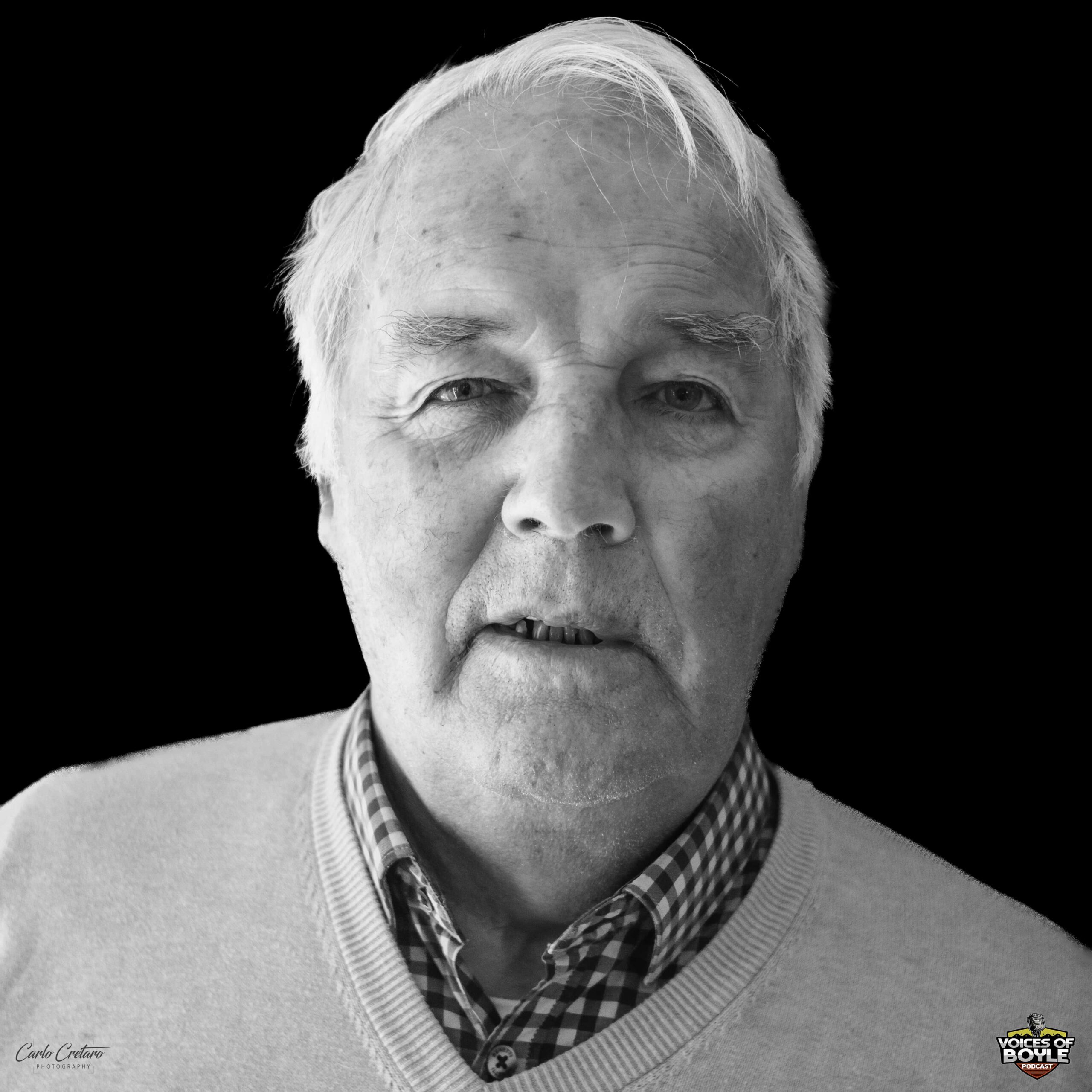
Below Stuart’s Mill in Termon, in the summers of the 1940s, the mill race took most of the river and left a big flat paving of rock showing, with pools in it. Barry Feely and his brother Michael spent their days there with jam jars, fishing for small fish. Nobody came looking for them. The one rule was the Angelus.
“Our signal to come home was the Angelus Bell.”
Barry was born in Boyle on 27 June 1940, to Henry and Una Feely. He has a long memory for this town, and he has spent years writing it down.
Dyslexic wasn’t known, it was just plain stupid
Barry went to St Joseph’s in Mocmoyne, under Master Tarpey, Master Kennedy and Master Mannion. He was dyslexic when there was no name for it. He was behind, and he made up for it by being loud.
Twice he was sent out to country schools short of numbers: once to Ballindoon, where his aunt taught, and later, with Michael, to a two-teacher school five miles out, where the only townies had to learn to defend themselves. The uncle teaching him was a De Valera man, and the Feelys were Collins people. The relief was the family lorries drawing gravel from Larry Henry’s sandpit. When the boys heard one coming, they threw the bikes on the back and got a lift home.
Barry thinks dyslexia gave him something too. People like him think outside the box, he says, and they notice things. Every book he has written is about Boyle, and he believes he was gathering it all as a child without knowing.
I started with him in 1955
Barry served his time with his father, a fine carver of Celtic interlacing and a very good letter cutter. Boyle ran on DC current from Stuart’s Mill, so the yard could power one small machine and the rest was done by hand.
Limestone came from a small quarry in Partry, Co. Mayo, and had to be worked on six sides. A base took Barry a week. Before the sander, three men smoothed the stone with a slab of Curlews sandstone hung between two poles, one on each pole and a third throwing in sand and water. A Celtic cross took a month.
A stonecutter also had to sharpen his own tools. His Uncle James, a retired Garda sergeant, worked in the yard and was fond of the forge, mostly because it was warm. Barry worked the bellows while James tempered the chisels in an old broken skillet pot, watching the colours run to blue and then grey.
“In those days, to be a monumental sculptor, you had to have a skill.”
Now, he says, headstones are a commodity, imported from China and India.
Pieces put together, and concrete blocks in the middle
The business goes back to 1780, and Barry is the ninth generation. In the early days the Feelys were journeymen, heading to Ballaghaderreen on a Sunday night to work on the cathedral, and building bridges at Rockingham. In his grandfather’s time, in a yard in Greatmeadow, they might make 20 headstones a year.
The break came after the Second Vatican Council, when priests were told to face the people and the altars had to come out from the wall. Barry had never done one, but he took a chance. The first was in Croghan, and he didn’t sleep the night before. He marked every piece. A day to take it down, two to put it back, and one piece went in upside down that nobody else would ever notice.
Then he took down the altar in Boyle he had looked up at all his life. It was a lot of pieces put together, with concrete blocks in the centre.
That work paid well, because it had to be done between Monday morning and Friday night, before the people came back on Sunday. It let the Feelys invest. Barry counts seven monumental businesses in their old area run by people who served their time with them.
Your house was gone, you were on the side of the road
In 1975 the Feelys bought a limestone quarry in Kilkenny. They had never borrowed money. They sold a house in Dublin to John Kelly of Londis, and the bank insisted they put up their homes for the rest. For a year Barry was badly with his nerves, a tape running in his head that always ended with the family on the side of the road.
His brother Pat took charge of the quarry and they made a success of it. Barry loved the stone: the beds of it, dark where the weather had been bad and bluey where it was good, and a fossil bed at the bottom from when Ireland was a tropical sea. A company in Ghent restoring the canal banks and bridges of Amsterdam bought its limestone from them.
“When you’re walking through Amsterdam, you’re very likely walking on Kilkenny limestone.”
Pat died of cancer at 47, and Barry took over as managing director. His wife Ursula did all the driving to and from Kilkenny, because some days he came out of a meeting not fit to. He calls her his brick. Years later, after a downturn and a winter of frost that closed the quarry for a fortnight, the bank took it over. Barry calls it a terrible blow, because he and Pat had sweated blood over it.
Brothers have great strength
Three of Barry’s sons are in stone. Colin has his own cladding business in Kilkenny. Finbar manages the Boyle business and his brother Shane works with him. Barry’s father worked with his brother Christy, his grandfather with his brother John, and Barry with Pat. He thinks that might be the secret.
When Pat died, Barry asked the Kilkenny sculptor Alan Counihan for a public monument to brothers. The smooth seed form is Pat, his cycle complete. The rough one, with a single segment cut out, is Barry, still maturing. Children love sitting into it.
Sonny worked with us for 30 years
Of everyone who worked in the yard, the one Barry cherishes most is Sonny Regan. Barry’s father met him at Assylin, sitting by the fire, brought him along one day and then handed him a shovel. Sonny stayed 30 years. Put him in front of a wheelbarrow and he’d wheel all day, and he always said the wrong word in the wrong place.
At matches Sonny was always in a row. Barry would run down to ask what was wrong, and it was always the same: the other man had called him a f**king bollocks. Barry suspects Sonny made it up himself.
We decided that we’d buy Abbey Park
Barry gave the GAA 25 years and was chairman when the club bought Abbey Park. The idea came on the way home from a funeral in Greatmeadow. Then the president of St Mary’s bought it first, which looked mad until he swapped it for a field by the school he couldn’t otherwise get. The club then bought Abbey Park for 6,000. Barry went on to chair the North Board for four years, and he says the club has never been as good as it is now.
There’ll be no Arts Festival
The first Boyle Arts Festival was run by the photographer David Knight, Bernadette Foley and a man from Carrick. The second general meeting, in the Royal Hotel, had nobody at it but themselves. Bernadette rang Barry and told him there would be no festival if they didn’t get organised. He went down and came out as treasurer.
Later he brought in Fergus Ahern, and soon it was Fergus’s festival. Barry says he was a powerhouse, and that Boyle had one of the best art exhibitions in Ireland. Barry chaired it and gave it 25 years. After Fergus died he selected and hung up to 140 pictures a year for three years, before deciding he hadn’t the flair.
“A lot of young people in Boyle have followed the arts as a result of the Boyle Arts Festival.”
Now it’s all busting out of me
Barry’s first writing was his family history, gathered at funerals and weddings. His first published book, Great Characters in 2010, sold 2,000 copies. In it is his neighbour Johnny Keaveney, a coal merchant from Arigna who once told a young fella he was driving a lorry before his father’s arse was the size of a dessert spoon. There is Ned Kelly the town crier, and Bessie Woods and a Mrs Conroy, bag women who walked the Frenchpark Road one week and the Roscommon Road the next, trading the news of the town for spuds and cabbage.
Other books followed, including We Are The Survivors, a book on the famine he considers his best, and one on the nuns, who came to Boyle in 1875. At the time of recording he was researching the Boyle River and its people, while being treated for a breathing problem that left him flat some days.
“I observed all that unknown to myself as a kid. And now it’s all busting out of me.”
Boyle will come back stronger than ever
Barry doesn’t pretend the town hasn’t gone down. Boyle had three hotels once and now has none. But he believes it will come back, and he wants its history shown off: the 12th century Abbey, the 250 or so crannogs exposed when Lough Gara was drained, and the Tinnecarra dolmen, which he says are older than the pyramids.
He also says he fears Ireland will be overwhelmed by people coming from Africa, India and the Middle East, and that the important thing is to educate them. That week he had spoken to fourth class in the Girls’ National School about the workhouse and the famine. There were around 20 children, from several backgrounds, and he says they were glued to every word.
The frying pan gang
On Sunday evenings it was the matinee, fourpence in, Hopalong Cassidy on the screen. Afterwards the gang acted it out in the field behind the yard, with a fire and a frying pan and sausages whipped from home. One of the chiefs later became a High Court judge.
There was a penny circus with a slack wire tied to a tree, and a museum of jam jars until Barry’s father emptied it. His eldest brother Joe set up a cinema in the hay loft over the cow house, with the projector run off a bicycle dynamo below, and Barry or Michael pedalling.
It’s all there, you don’t need to count it
One day an architect from Mullingar came into the yard wanting three big granite blocks as a base for a bronze, on a memorial in a cemetery in Andersonstown, Belfast. Barry and his son Finbar went up with the lorry. At lunch they were brought to the Andersonstown Social Centre, into a back room with pictures of the hunger strikers on the walls, and the woman serving soup told them the little slices of bread were British soldiers, so dip them well.
Going in, Finbar asked if it was kings buried there. No, he was told, they were all IRA. He said he thought they were the baddies, and Barry hushed him fast. When Barry suggested leaving a small gap between two stones, the man in charge said no, in case someone came along with gelignite. Then a black taxi pulled into the cemetery, a window came down, and a man handed out a brown paper bag.
“He says it’s all there you don’t need to count it.”
They lodged it in the bank before leaving town.
Listen to the full episode
Barry worried at the end that he hadn’t done justice to 60 years. He says he wrote his books for his children, so that when he isn’t around to answer their questions, they can look it up. This conversation was recorded with the same idea. It runs to about 68 minutes.
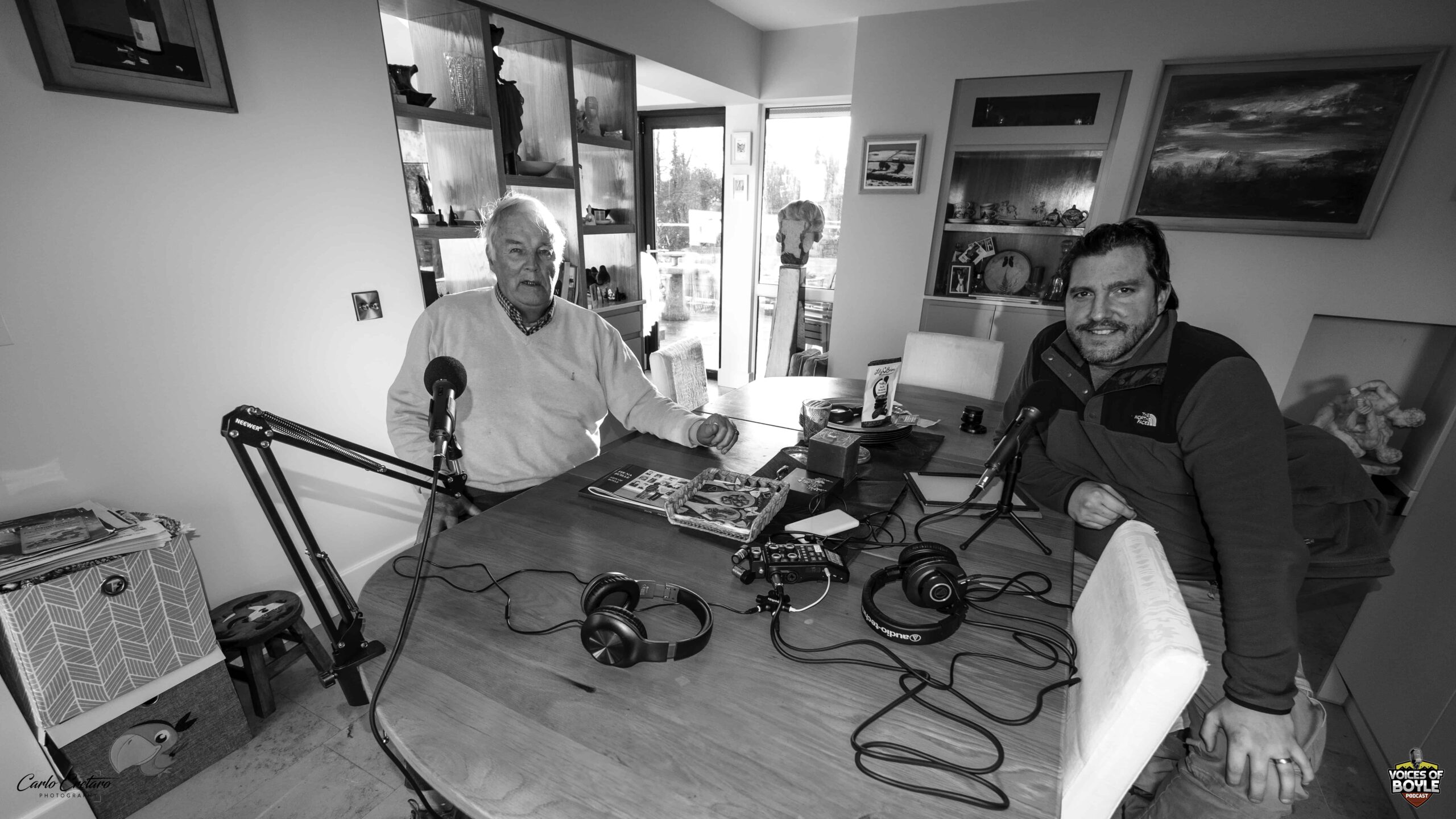
Thanks to Brendan O’ Dowd for creating and recording the musical piece for the podcast.
BE A GUEST ON THE SHOW!
If you’ve a story about Boyle, we’d love to hear it. You don’t need to have done anything remarkable, and you don’t need to prepare a thing. We sit down, have a chat, and you talk about whatever you want to. It usually takes about an hour.
Thinking of someone else? A parent, a grandparent, a neighbour who remembers how it used to be? Tell us about them. Some of our best episodes started because a son or daughter got in touch. You can find us at info@voicesofboyle.com.