Episode 40
Bernie Carty – His Life Story
HOSTS & GUESTS
Carlo Cretaro
Tony Conboy
Bernie Carty
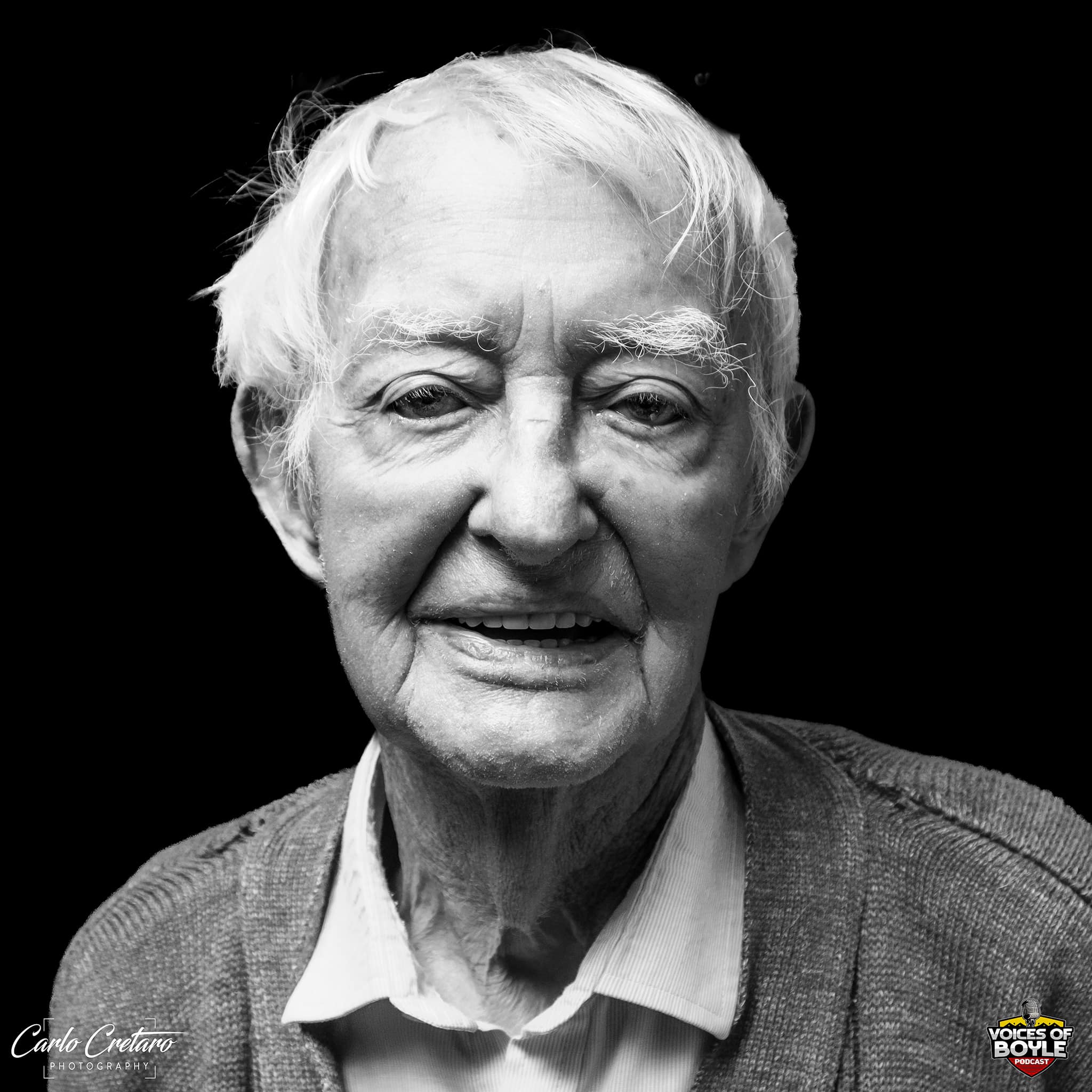
Bernie Carty was about fifteen, sitting in a hotel in Boyle late at night, when he found out where he was going. A priest in Armagh had put an ad in the paper for him, a man in Achill Sound had answered it, and Bernie had come down on the train from Dublin. He could have gone up to the Regans on Marion Road, and everyone asked him afterwards why he didn’t, but he took a room and went to the pictures.
There were brochures in the hotel. That’s how he learned Achill was an island.
The next day he took the Ballina bus from Frenchpark to Foxford and waited for the bus to Achill. Late that night a big white building came out of the dark. Sweeney’s. The generator had gone, the place was black, and the next day was fair day, so he was put behind the bar. He didn’t know a pint from a bottle. He stayed about fifteen years.
“Even though I left school at 14 and a half with no education, I wrote all the articles. I wrote every single scrap.”
A sod in and a sod out
Bernie was born in the parish of Croghan, in a house that went with his father’s job as a herd. At school in Croghan the master once had every pupil bring a stick for the fire. The sticks came out of the farmers’ hedges and were too long to cut, so he stood them up the chimney and let them burn down from the bottom. The children went home every day hoping the chimney would go on fire. When turf was delivered they’d be let out to put it in the shed, and they’d make it last, bringing a sod in and a sod out.
One of the older boys finishing up then was PJ Shanley, who passed away only recently.
Brought home on a donkey and cart
There wasn’t much in herding, so Bernie’s father went to England with McAlpine’s and Wimpey’s. He worked a year and came home for a month. One evening he walked across the fields to a neighbour’s, and as he was leaving they saw him fall. They found him dead in the field. He was brought home on a donkey and cart and laid out in the house, a house where one room had lost its roof and the family lived in the kitchen.
Bernie was ten and his brother eight. His mother went out cleaning, in Boyle and in the barracks, and cycled to all of it. By twelve or thirteen Bernie could milk, sow crops and save turf.
A priest from Whitecross
At fourteen he went to a farm at Knockvicar, near Oakport Lake, owned by Tom Griffith, an ex-vet people came to from all round for cures for their animals, all in bottles. All he asked was that you came back and told him how it went.
His mother was determined Bernie wouldn’t spend his life going from one farmer to the next. She answered an ad in the paper, and a Father Murphy drove all the way from Whitecross, Co. Armagh, to collect him. Bernie refused to go. The priest stayed the night in Boyle, and by morning Bernie had decided it wasn’t fair not to. He spent a few months travelling with him, serving Mass at the Pro-Cathedral in Dublin, and once sat alone in the back of a car with the bishop, a Claremorris man. Then the priest put an ad in for him too.
“It’s the same as my mother,” Bernie says. “You wanna get rid of me.”
Bothies and a tick of hay
Achill looked desolate the first morning, the tide out and hardly a bush. At Sweeney’s he worked the bar and the farm, learned to drive on the hackney car, and bottled stout in the shed, bringing the barrels into the kitchen to get a head on them. He drove cattle out along the railway line into Achill Sound, which people now cycle as the greenway. The woman of the house was connected to the singer James Kilbane, and Bernie knew the whole Kilbane family.
In the summers he went to Scotland with the gangs, to the early potatoes around Maybole, near Culzean Castle. They slept in bothies, sheds cleared out, on a tick filled with hay. His second season was hot and they slept outside, Bernie under a tent of sheets. By the time they reached Perthshire he had a bad pain in his side. It was wet pleurisy, and they took a pint of fluid off his lung while he sat up in the bed.
He spent three months confined to bed in Bridge of Earn Hospital outside Perth, unable to get up to wash or eat. Twenty-three or twenty-four of the men he worked with came to see him, and three young Irish trainee nurses, so he had more visitors than the Scottish patients. He made stools with the craft workers to pass the time. He lived through the TB years too, and would rather not go into that. He’s had spells in hospital since, but nothing like those three months. At home, the letter to say he was in hospital was a hard blow to his mother, who had never wanted him to go.
No radio, no television, 500 books
Back in Achill, he got work at the Achill Head Hotel in Keel, and the owner mentioned that Major Freyer up the mountain needed a driver. Was it worth going for? “Too bloody true,” Bernie was told.
The Major lived at Corrymore House, high on Croaghaun, within walking distance of Keem Bay. The son of Sir Peter Freyer, the surgeon, he was a poet and writer who had known Oliver Gogarty and Lady Gregory. He kept a guest house and four or five hundred books, and visitors would sit in the library for hours. There was no radio or television in the house. Bernie links it to Paul Henry, and says it was once home to Captain Boycott. He drove for the Major for seven years, and says he knows every inch of the island.
The week Kennedy was shot
He’d been going out with a girl who had gone to England, and he left Corrymore to follow her in November 1963, the week Kennedy was shot. It didn’t work out, and she went to America. “Maybe just as well,” he says.
His brother, who has since died, was already in London. Bernie filled barrels at Gordon’s gin, lived off the Holloway Road near the Gresham, and then went with the lads from the digs to Taylor Woodrow, putting jet engines into a power station in Hertfordshire. They were driven out every morning by Paddy McMahon from Clare, who put in exactly enough petrol for the mileage, and ran out when he drove faster than planned.
“If you went down to Piccadilly Circus and sat there, you’ve seen the whole world going by.”
“We know nothing about concerts”
At the Irish Centre in Camden Town he met John Healy from Achill, known as Seán O’Healy, and was drawn into the Pioneers and the Sunday coach socials. When Father Thomas Giblin wanted a branch of the Gaelic League in Camden Town, Bernie helped start it with céilí classes. Seán Adams taught, Tommy McGuire from Glenfarne played the accordion, and Henry Dwyer from Riverstown played the fiddle. A good céilí drew thirty or forty.
Bernie suggested concerts. The others said they knew nothing about concerts. Bernie knew musicians from the fleadhs, so he put one together, then four more, in a hall that held about two hundred. He had Margaret Barry and Michael Gorman, and he went down to a pub to ask the Grehan Sisters, then on the BBC’s Country Meets Folk with Wally Whyton. They did two concerts for him.
“I can’t play, sing, or dance,” he says.
A field turned into half an acre of flowers
He came home in 1970 to his mother, bought a car, and spent the last ten years of her life driving her to fleadhs, festivals and the Rose of Tralee. She’d stay up all night, he says.
Work was hard to find for a man back from England. After the ESB, years of shift work alone in the water treatment house at the Snia factory in Sligo, and a job with John McGrath, a neighbour told him about a porter’s job at the bank in Elphin. Collar and tie every day. He didn’t think he had a hope, but the manager, Don Shanahan, wrote within a week to say start. He stayed thirty years, and kept the manager’s vegetable garden too.
When the family moved to this house there was nothing but a field. His mother planted the flowers, and Bernie took it to half an acre. It has come third in the West of Ireland.
Recycled and used again
In the early 1980s Bernie and May Conway, from Gurteen, Co. Sligo, built a float for the Roscommon Easter Parade. It won a prize on its first day out.
“You see a float going through the town, a lovely thing, and you never see it again.”
Bernie’s would be used again. It won in Carrick-on-Shannon that same year, went to the St Patrick’s Day parade in Dublin in the mid 1980s, and to all four provinces after that. He got a photograph at the Rose of Tralee with all thirty-two Roses around the car, and put it all in a book, Parade Diary.
In September 1994 Paul Claffey of Midwest Radio took the bog to Yonkers Raceway in New York. A bank of turf was sealed and shipped in a container, David Carroll brought a thresher from the museum in Riverstown, and The Day on the Bog drew a crowd Bernie puts at about 25,000. He paid 2,000 of his own money to go and stood there with a Roscommon flag. “It was an awful gamble,” he says. “There’s no profit out of it.”
A dream to make Elphin a windmill town
Tours of Holland and Belgium gave Bernie an interest in windmills, and a working model in his garden used to stop cars on the road. In a field in Elphin, where he promoted Daffodil Day for thirty years, stood a stone tower built by the Protestant Bishop of Elphin to grind corn, a ruin since the 1800s. Bernie photographed it in 1992 and wrote an article, “A dream to create Elphin as a windmill town”.
“Everyone thought it was a mad idea.”
Dr Fred Hammond drew the plans, and men on a FÁS scheme, few of whom had held a saw, built it with wooden cogs rather than iron and a roof that turns to the wind. Bernie says it’s one of only about six in Ireland. Gabriel Byrne, whose mother came from just up the road, opened it in 1996. Anyone who arrived asking about it was sent down to Bernie in the bank, and he wrote every article for the Roscommon Herald, the Roscommon People, the Leitrim Observer and the Western People.
I’m building an airport, but don’t tell anyone
Bernie had taken the train to Dublin and the boat to Holyhead enough times to know what Knock Airport would mean. He has little time for what he calls the Dublin government, and counts Monsignor Horan among the few people who got things done for the west. He tells the story, as Michael Commins wrote it, of a stray goat at the shrine, a travelling man who knew where to take it, and the Monsignor seeing the open ground where it was let out and deciding that was the site. Tony adds the Monsignor’s answer to an RTÉ reporter: “I’m building an airport, but don’t tell anyone.”
From the day the first sod was turned, Bernie cut out every piece in the papers. When the airport museum went looking for material, his was the only full scrapbook. They kept it for months. He got it back.
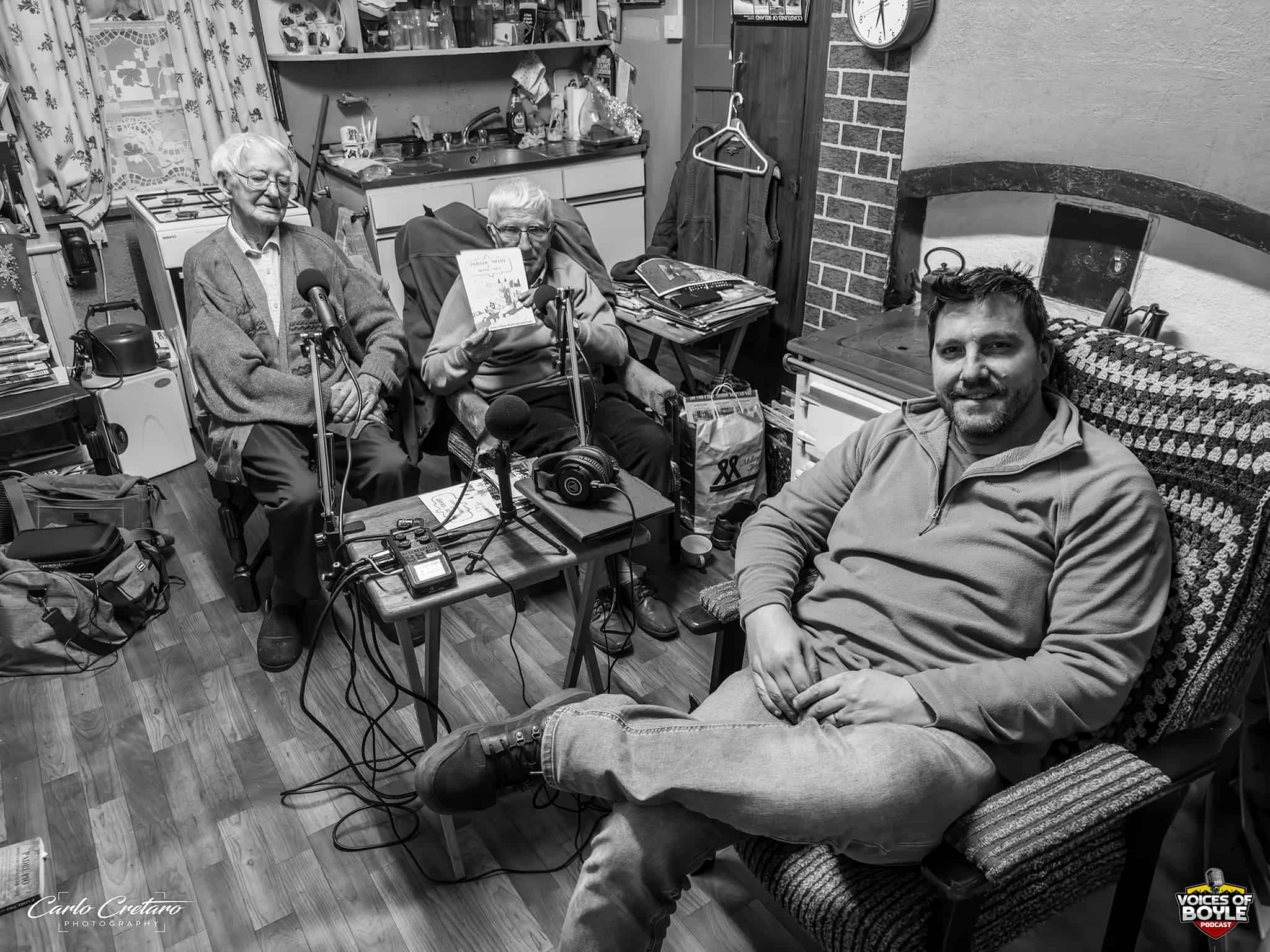
Thanks to Brendan O’ Dowd for creating and recording the musical piece for the podcast.
BE A GUEST ON THE SHOW!
If you’ve a story about Boyle, we’d love to hear it. You don’t need to have done anything remarkable, and you don’t need to prepare a thing. We sit down, have a chat, and you talk about whatever you want to. It usually takes about an hour.
Thinking of someone else? A parent, a grandparent, a neighbour who remembers how it used to be? Tell us about them. Some of our best episodes started because a son or daughter got in touch. You can find us at info@voicesofboyle.com.