Episode 98
Boyle Active Age
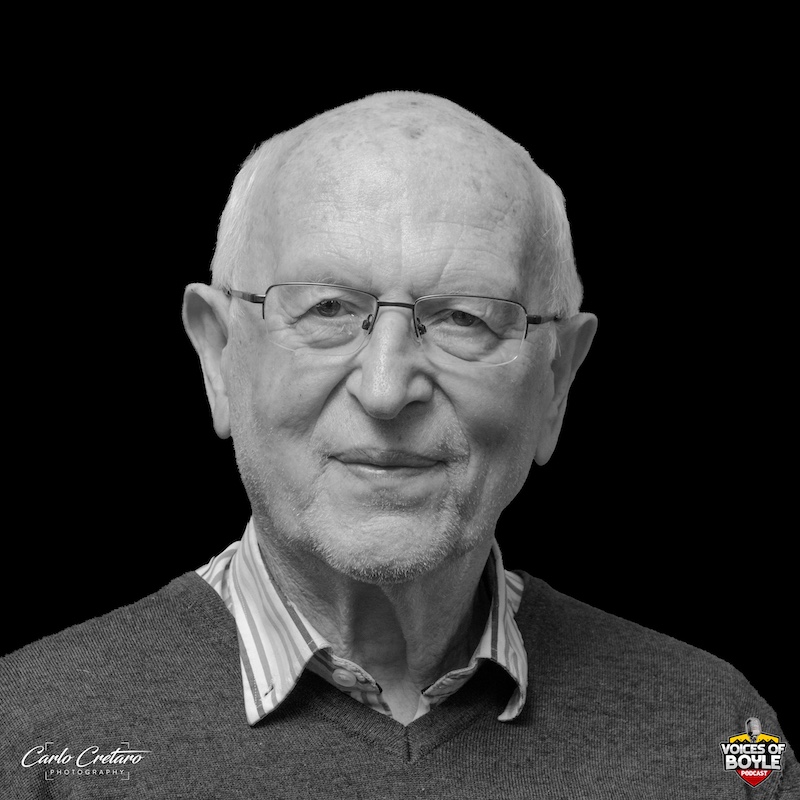
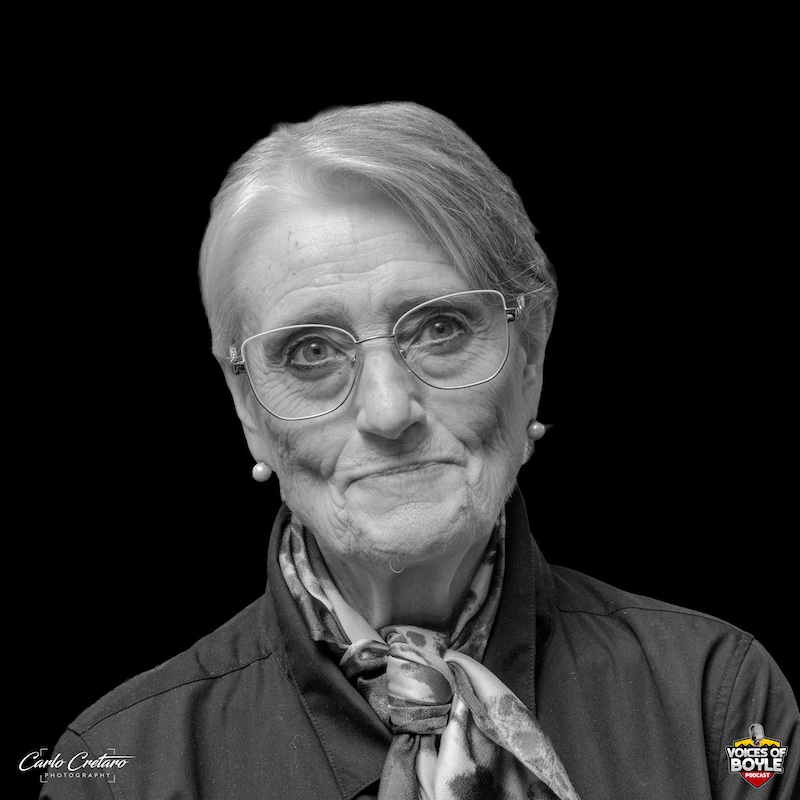
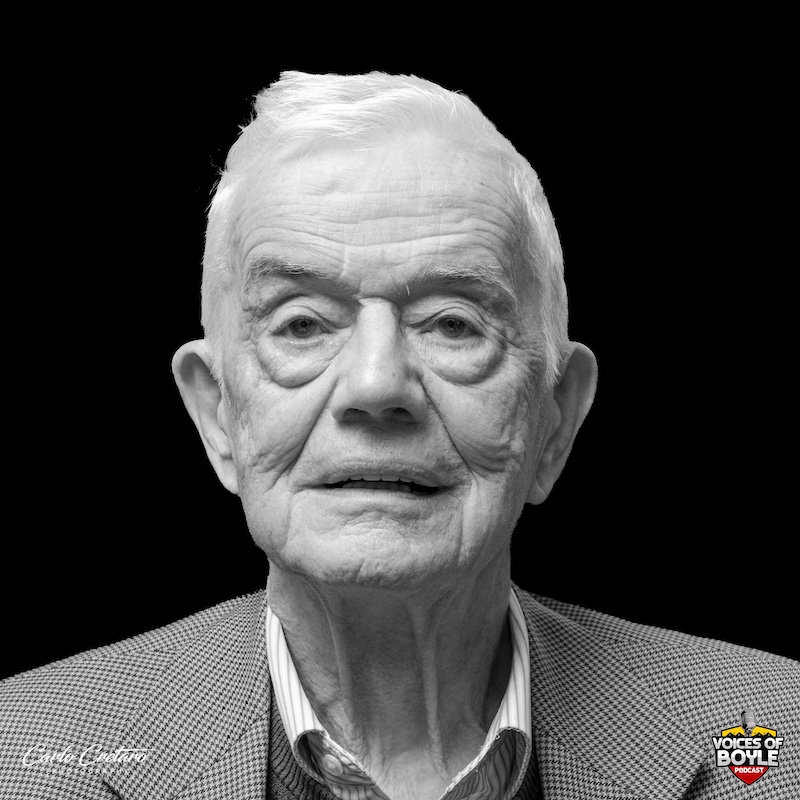
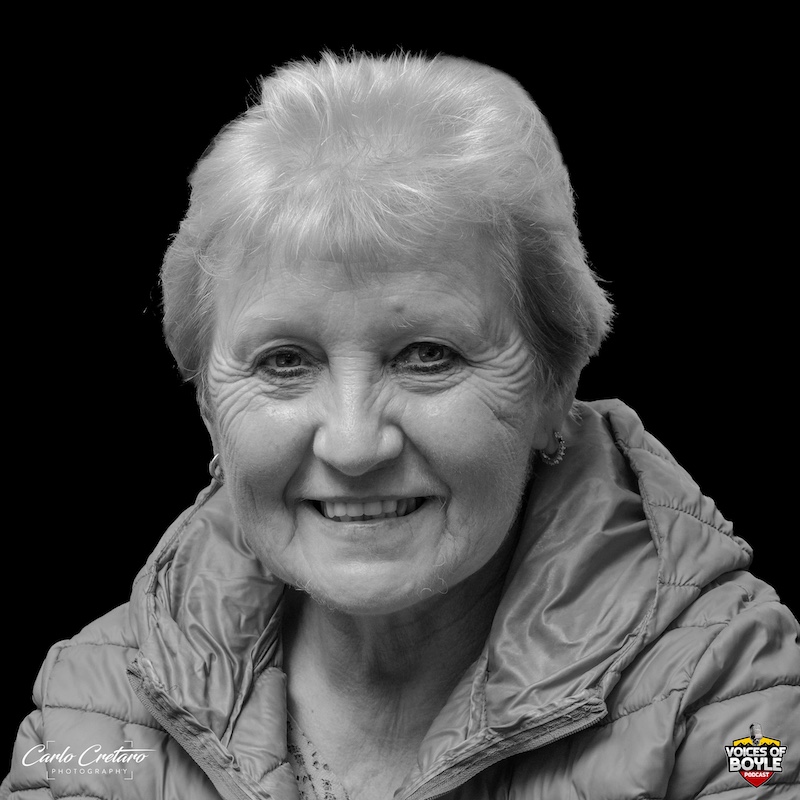
HOSTS & GUESTS
Florence Cretaro
Carlo Cretaro
Bernie Murphy
Margaret McCarthy
Tony McCarthy
Geraldine Corr
Edward Quinn
Imelda Brenna
RESOURCES
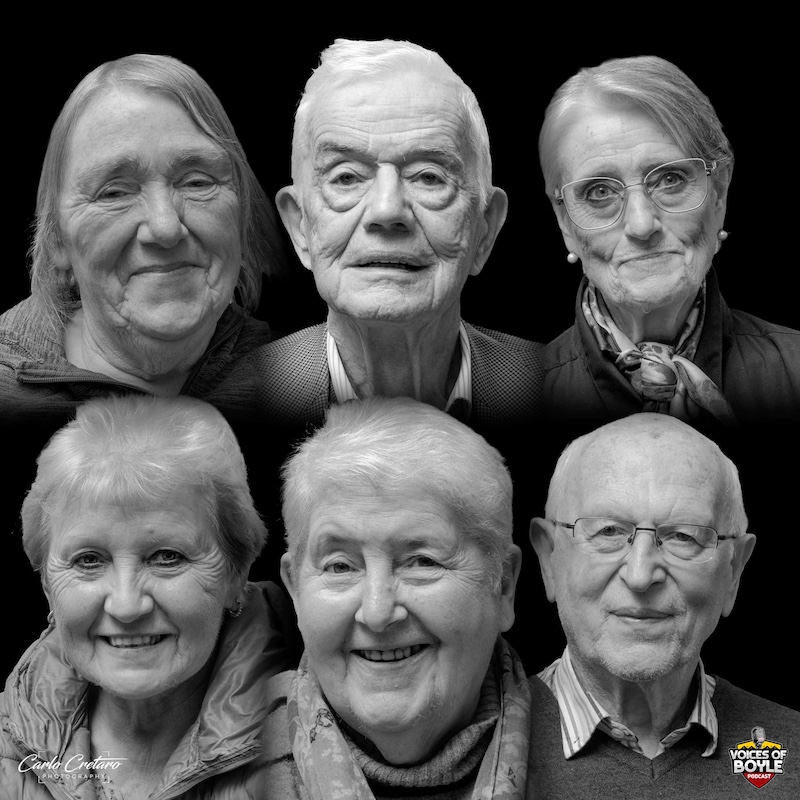
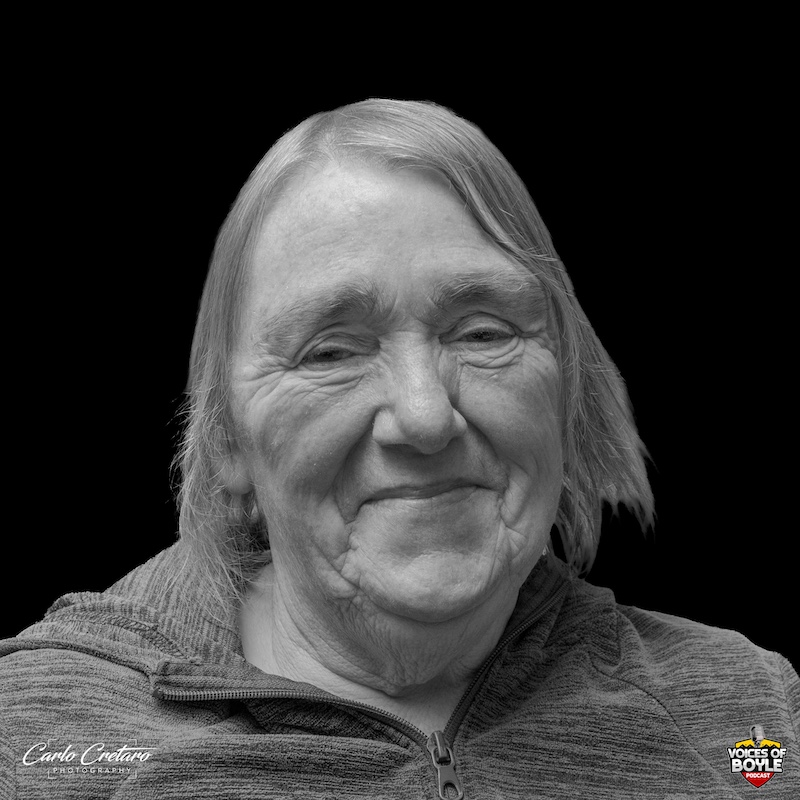
Margaret McCarthy was three years and nine months old on her first day at school, and she spent the whole of it facing the wrong way.
A neighbour girl brought her, holding her hand the whole way. Margaret put her bottle down by the fire with everyone else’s, sat into the desk with the little inkwell, and turned round in the seat. If she faced the teacher she could not see her lift home, and if the girl slipped out there would be nobody to bring her back. So she sat backwards all day, one eye on the girl and the other on her bottle in case it cracked by the fire.
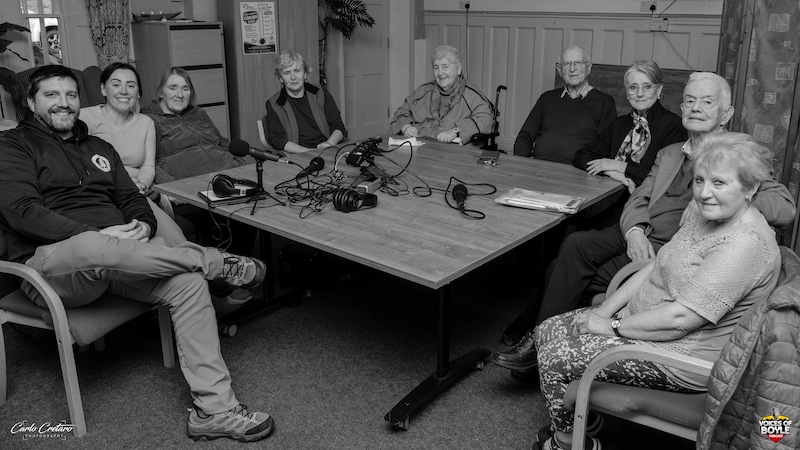
That was the start of an afternoon round a table at the Boyle Family Resource Centre with the Boyle Active Age Group. Two mics in the middle, tea and biscuits at half time, and stories that went from a country schoolroom to post-war Leeds to the snow of 1947.
“I was very young but very mature, as I am today.”
“I was very young but very mature”
By the second day Margaret was facing the teacher. It was a one-teacher school, Mrs Brennan taking everyone from the babies up to sixth class, and Margaret remembers her as brilliant with the children. Tony McCarthy added the detail she had left out: the walk, by his reckoning, was about four miles each way.
Tony’s own first day came with company. A neighbour, Sean Kearney, brought him, and his dog Rover came too. Rover waited at the school all day and followed him in every morning for about six months, until he worked out Tony was coming home anyway. Years later, Tony said, Sean was on holiday in Spain, thought his two sons were in trouble in the water, and went in after them. The boys were fine. Sean was lost.
Two lucky breaks
Tony’s main story was why it pays to break your arm. In first class, at about seven, he broke his collarbone in the schoolyard. There was no A&E then, so he was brought to a private clinic in Bandon, where Dr Whelpley set it and put it in a sling.
The doctor’s secretary, Josie Hurley, took a liking to him. That Christmas a book came in the post, The Children of the New Forest by Captain Marryat. It was the first book he ever got, and one came every Christmas for five or six years after.
The second break was his teacher, Mrs Collins. She knew he would be off for weeks and bored, so she came to the house that evening with an arithmetic book and told him she would bring another when he finished it. Soon she was bringing three or four a day. By the time he went back he was doing maths with sixth class. The love of figures never left him, and his career was built on accountancy.
“So I had two lucky breaks, a very kind secretary and a very good teacher.”
“Do you smoke, mate?”
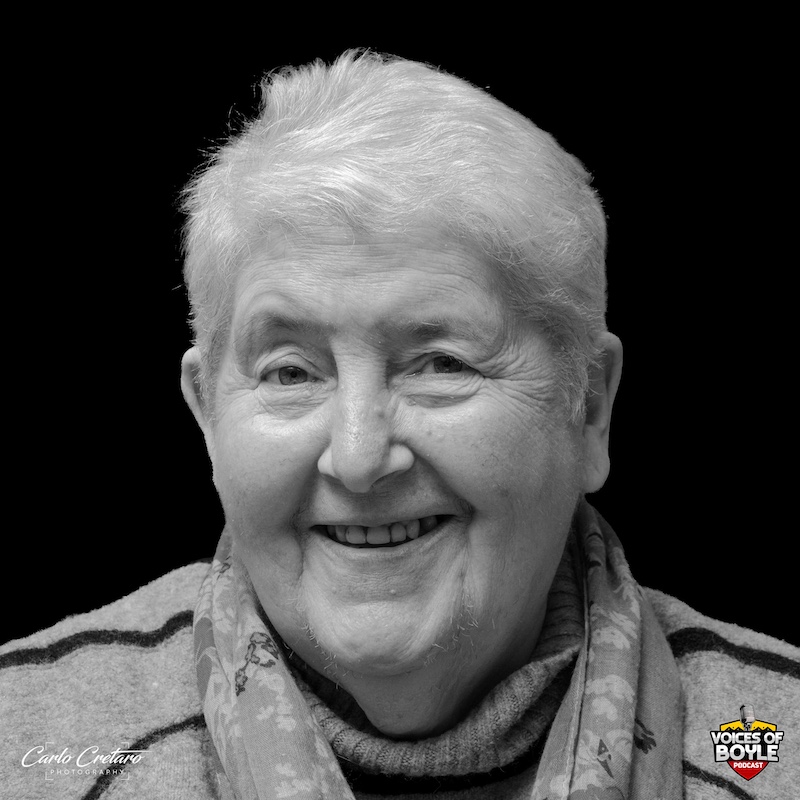
Geraldine Corr grew up in Leeds, among tall Victorian terraces with bomb sites in between. Her mother and aunts were in the house when it was bombed, and a girl and a 12-year-old boy at the back did not make it. The family rented further up the same street, and her mother choked up every time they walked past the gap.
They were not poor, Geraldine said, but everything was tight. Her mother was Catholic and her father was not, which had its own issues in the family.
One Saturday her mother was up in the attics spring cleaning and her father was in the chair with a cigarette behind the Daily Mirror. The children next door went quiet. Geraldine turned round and the bishop was standing in the garden in the full regalia, cassock, cross and zucchetto.
She knew what to do. She ran up, knelt, kissed his ring and brought him in. Then she called up the stairs: “Mummy, it’s the Bishop!” A silence, then: “Don’t tell your lies!” And a very serious voice from the hall: “Oh yes, I am.”
Her mother came down in a turban with her stockings rolled down. The bishop asked Geraldine her catechism and she got it right. Then her father, who did not know the protocol, warmly held out his packet of Woodbines.
“Do you smoke, mate?”
“I don’t think you offer bishops Woodbines.”
The bishop blessed them all, her father smiling and smoking through it. On his way out he looked at her torn skirt, gave her thighs a good slap and said, “By, you’ve a grand pair of legs, Geraldine.” Her mother was mortified and convinced Geraldine had known he was coming.
Her father gave up the cigarettes and got a job on the buses. The bishop gave Geraldine her First Communion a couple of months later at St Anne’s Cathedral and went on to become Cardinal John Carmel Heenan. If he had made Pope, she said, that would have been some story.
Four to a bed
Edward Quinn took the 1940s. He was born on Green Street. The boys went to the convent school until seven, where the nuns gave bread dipped in cocoa to anyone with nothing to eat, and the toilets were dry closets out the back.
The family moved to his father’s parents’ house on the Crescent. There was no running water, so it came from the pump across the road near St Joseph’s Hall. Then they got a council house at 19 Termon. There were nine of them, four to a bed, two at the top and two at the bottom.
As children they paddled on the flat stones by the bridge near Stewart’s Mill and tried to catch small fish in jam jars. They swam by the sluice bridge, deep as it was. They went out the Frenchpark Road for milk and helped on the farm, where Edward saw a calf born for the first time. His brother had told him how it worked, and he had not believed him.
The big snow came
Edward went to live with an elderly aunt and uncle near Elphin, who had no children, and went to Clonculane School, a little two-room school. The aunt was about 80 and the uncle 93. Edward shaved him with a very blunt blade and lit his pipe for him. When nobody was looking he tried chewing the plug tobacco. He was sick as a dog, and did not try it twice.
In 1947 the big snow came and filled in the lane to the main road. A neighbour in his seventies died, and everyone went out with shovels to dig a path wide enough to get the coffin down to Johnny Connellan’s horse-drawn hearse. Johnny had the pub in Elphin, and the groceries, and the funerals.
“I’ve had enough of Elphin”
At about 14, Edward decided he had had enough. The woman next door said James Candon’s lorry would give him a lift. There was no lorry. So he walked, along the Windmill Road as far as the Four Provinces, and as it got dark he went in a gate, lay down in the field and fell asleep.
He woke on Sunday morning to cattle sniffing round him, wondering what this thing in their field was. People were going to Mass, and a big sidecar stopped and took him all the way to Boyle, swaying side to side. His mother asked what he was doing home.
“I’ve had enough of Elphin and come back to town life again.”
“I’m shy, Mary Ellen”
Back in Boyle he went to the Technical School for shorthand, typing and carpentry. Once a week Cassie Turbot, the Irish teacher, took out her melodeon, the desks went to the side, and there was dancing. Edward sat on the bench dying to ask the girls up, and never did. He had been belted for arithmetic at school, which turned him against figures. In 1950, at 16 and a half, he left for England, and that, he said, is another story.
Tony asked how he got over the shyness. Children were taught to keep quiet in the corner when visitors came, Edward said, or they got a belt. His first girlfriend came along at about 21 or 22. Then he sang a line of the old song: “I’m shy, Mary Ellen, I’m shy.”
Chips up and down from the takeaway
Imelda Brennan’s first job was in Elphin too, at 17, in McNally’s garage. She lived in with the boss, a strict and very religious woman who wanted all the work done and nobody out at night. The girls practised on the typewriter in the back and often got caught.
Every Saturday night they stole out to the dance and had to be back before she was. Imelda met a boyfriend with a Honda, who brought her chips up and down from the takeaway every night. After Sunday Mass the garage was flat out. She stayed five or six years before Dublin, which is one for part two.
“Innocent times.”
Only for Dwyer Morris’s
Bernie Murphy, Florence’s mother, was 16 and living in the country when she bought the Roscommon Herald in Boyle and saw a job at the Royal Hotel. They took her on the spot, and she sent word home that she would not be back that night. She worked with Anne Maguire and Catherine Supple for £6.12 a week.
Staff came in September and were gone by December. One chef got paid on a Friday and was gone on the Saturday, and Mrs Regan had to come in and cook herself. Bernie enjoyed every bit of it. One night out, in Dwyer Morris’s, she was introduced to the man she married.
“Only for Dwyer Morris’s,” Florence said, “I’m sure I wouldn’t be here.”
Two priests noticed
After the tea, Edward explained how the group began. Eileen McDermott from the Roscommon Road, a retired nurse, was with the first Active Age in Boyle, and Tommy Murray of Roscommon VEC opened the first group in the county, around 1984 as Edward remembers it. It grew to 17 or 18 groups.
Tony went further back, to Dún Laoghaire in 1978. Two priests noticed that older people hung around after Mass and then were not seen for the rest of the week. A course for recently retired people followed, and the nine who stayed were challenged to start an organisation. The first meeting had 12 people. Within six months there were 500 members.
“We’re never turning people away”
Thursdays bring talks, first aid and CPR, flower arranging, a sports tutor and board games. There has been a boat trip on the Shannon, and the Christmas do is at the Shamrock Lodge on 16 December. With the Men’s Shed they made decorations from cones and sallies, and they are talking to Tidy Towns and the schools about planting trees around Boyle.
The idea, Tony said, is that people enjoy themselves while helping themselves and each other. If you have a skill, come in and show it.
“Well, we’ll always welcome people. We’re never turning people away.”
Rain or sun
Asked what they love about Boyle, Geraldine named Lough Key, the river, Clarendon Lock and the hot air balloons. Tony told us about a song the singing group wrote for the Arts Festival, in three-part harmony, with every member giving a thought about Boyle. We would love to hear it.
Edward finished with a poem written for the group by Monica, who runs the Family Resource Centre. One line holds the whole invitation: “If you’re over 50, come this way and join the fun each Thursday.”
Listen to the full episode
The conversation runs to about 54 minutes. Boyle Active Age Group meets every Thursday from 2 to 4 at the Boyle Family Resource Centre.
Thanks to Brendan O’ Dowd for creating and recording the musical piece for the podcast.
Keep Listening…

Ep 76: Seamus Carr
Episode 76 Seamus Carr - Growing Up In BoyleHOSTS & GUESTS Carlo Cretaro Seamus Carr RESOURCES Welcome to Episode 76 of the Voices Of Boyle Podcast! Some conversations start in a field on the edge of town and end up halfway across the...

Ep 75: Joe Ryan
Episode 75 Joe Ryan - Launching a Wedding Business After Last OrdersHOSTS & GUESTS Carlo Cretaro Joe Ryan RESOURCES Luxury Wedding Supplies Website Facebook Page Instagram Channel Welcome to Episode 75 of the Voices Of Boyle Podcast! Joe Ryan...

Ep 74: Kathleen Redmond
Episode 74 Kathleen Redmond - Boyle Is Home NowHOSTS & GUESTS Carlo Cretaro Kathleen Redmond RESOURCES Slugs & Snails Website Slugs & Snails Instagram Welcome to Episode 74 of the Voices Of Boyle Podcast! Kathleen Redmond was born in West...
BE A GUEST ON THE SHOW!
If you’ve a story about Boyle, we’d love to hear it. You don’t need to have done anything remarkable, and you don’t need to prepare a thing. We sit down, have a chat, and you talk about whatever you want to. It usually takes about an hour.
Thinking of someone else? A parent, a grandparent, a neighbour who remembers how it used to be? Tell us about them. Some of our best episodes started because a son or daughter got in touch. You can find us at info@voicesofboyle.com.