Episode 56
Callum Robertson – From Lockdowns to Stage Lights: The Show Must Go On
HOSTS & GUESTS
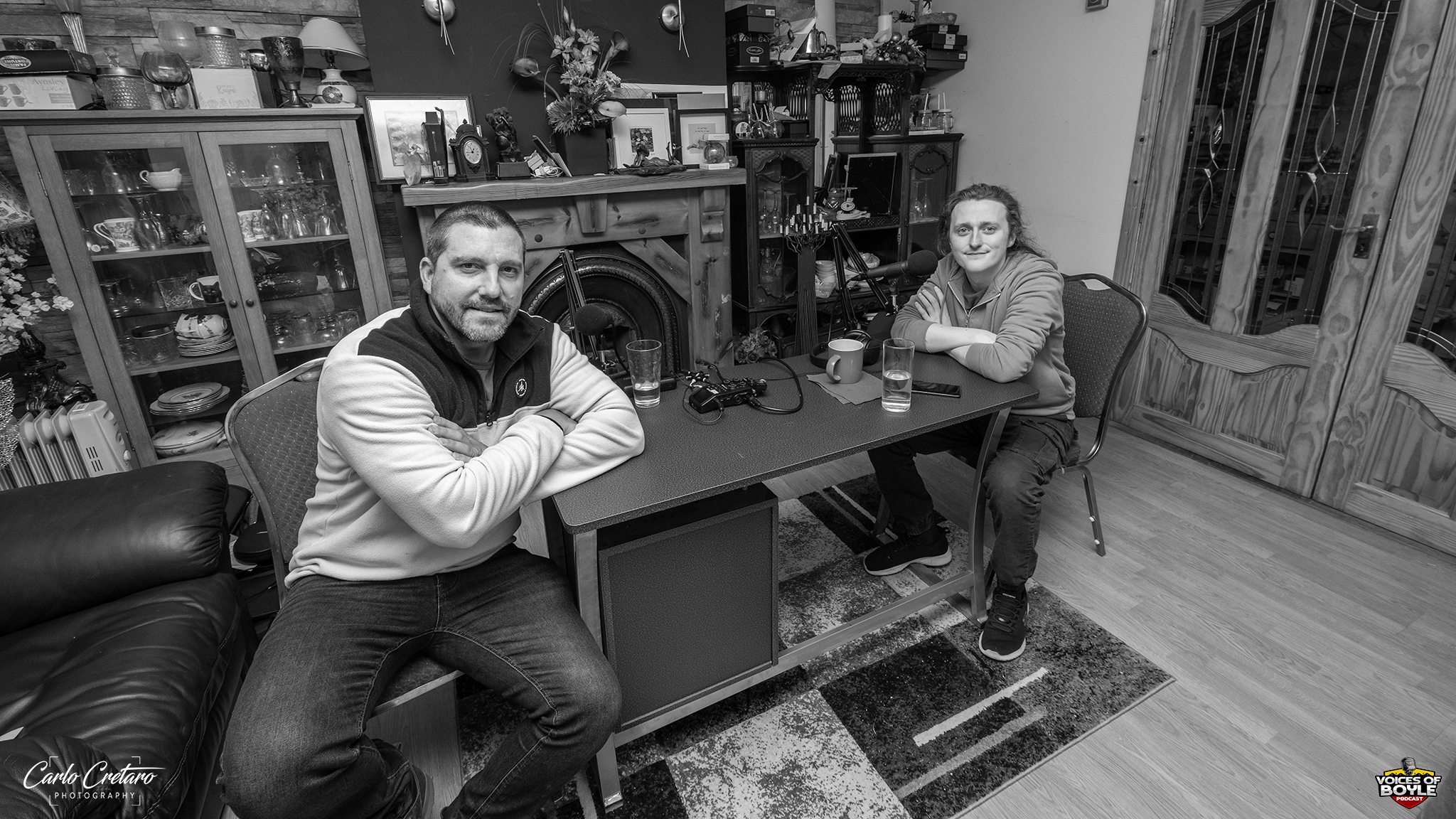
Carlo Cretaro
Callum Robertson

Callum Robertson had it planned. He knew the order they were shooting in, he knew who was needed where, he had the costumes and locations sorted, and he had one day to film the whole thing because that was what the grant covered. Then he walked into King House and there were thirty people standing around waiting for him to tell them what to do.
He says it is the most stress he has ever felt in his life. It was the first time he had been in charge of that many people, and he spent the day conscious that nobody wants to watch the person running the show sprinting around red in the face. A good part of the job was looking calmer than he was.
They got it done. The short film is called The Escape, some of it shot down in the dungeons, and it has been on show in Una Bhan. His mother, Anna Robertson, worked on the script with him and handled the grant and the hiring.
“I am so grateful for that experience because now I know exactly what I did wrong, and I can be better.”
A really pretty little town
Callum is 24 and spends a lot of his time on the Sligo train, so he sees Boyle the way people arriving into it see it. He rates it highly. The abbey and the ruins, the art around the place, the coffee shops, the bridge, the Crescent. There is a lot of history here that people do not immediately see.
His complaint is practical. When friends come down and say what a lovely spot it is, there is nowhere for them to stay. He mentions the Harry Potter House bed and breakfast and a few other small places, then the gap: no one address you can point somebody at. He thinks it makes it hard to hold on to people.
What he wants is more young people coming into the arts here, which he already rates as one of the town’s strongest things.
Twenty years old on a Zoom call
He was in his performing arts course at IT Sligo, now ATU, when COVID arrived. Acting on a Zoom call, he says, is soul destroying. It is not even acting to a camera. It is distant and disconnected.
He was luckier than most and says so repeatedly. He was in a house with six others, all on his course.
His best friend, another best friend, his girlfriend, a friend of his and her sister. So he was not lonely. What got him was the sameness. Roll out of bed, turn on the laptop, do the online acting class, down for coffee on the break, back up, sit in the sitting room until bed. Then the same tomorrow, and them fighting over who got to go to the shop. Carlo says out loud that it sounds like a form of prison, and Callum does not argue.
He talks about a friend, Cormac, who was in college elsewhere and had nobody for that whole stretch. Out to the shop, back to the computer, assignments on his own. Callum thinks it took a real toll.
Everybody had forgotten how to smile
Asked whether it left a mark, he takes the question seriously. For a long time afterwards it affected how he was with people, and going to the pub felt odd. He makes a point about the masks: for a couple of years the only part of a smile anyone could see was the eyes, and then they came off and nobody was sure what to do with their faces.
He says his own anxiety has got a lot worse since then, and that he is not certain of the explanation but suspects it comes out of that disconnect.
Two lads and a webcam
The course could not be done online and they knew it, but they tried. The best they managed was calling his friend Thomas down from his bedroom to stand in Callum’s bedroom in front of the webcam, the two of them playing a scene at each other in a box room, eyes flicking to the screen every few seconds to check they were still in frame. He calls it a nightmare, twice.
“It got easier to convince ourselves that the world was ending.”
What it left him with was appetite. It gave him a hunger for the work, he says, because it showed him the worst possible version of the thing he loves and he never wants it to look like that again.
A man named Frank and a room of bored boys
He was about 13, first year in secondary school, and the school did a musical every two years. This one was Oliver Twist. A group of boys were sat into a spare room with the script and a man came in to hear them read. Everybody ahead of him mumbled through it, so Callum decided to scream his head off, get a laugh and get out.
The man told him he could project, and that he was going to do it again, on the stage. He played two small parts. Then he stood on the boards and looked at the rectangle of seats with the heat of the lights on his back.
“It was gold dust for me.”
After that it was school shows and town shows. He got the lead in Back to the 80s, a jukebox musical full of jokes that landed with the parents and sailed over the cast. The Addams Family. Joseph and the Amazing Technicolor Dreamcoat.
The music started earlier. He was seven when he first picked up a guitar, at lessons with Matt Burke in the barbershop, a circle of children learning chords and Guns N’ Roses songs, then out to play for people in the pub. He taught himself the rest off YouTube and off pausing DVDs to see where the fingers went.
Knowing what the lighting tech is doing
The Sligo course ran four years, and in first year everyone covers both sides of it. Acting, which is voice and movement and a fair amount of studying old Russian men. Design, which is costume, lighting and sound. He took acting after first year, but what he rates is coming out knowing what everyone else in the building is doing. If you understand what the lighting technician is at during a tech rehearsal, you can stand where he needs you without being shouted at across the theatre. He is blunt about why that matters. It makes people like you more, and it makes more people hire you.
Spooky tours, an elf suit and the months in between
He found work quickly after the course, which he knows is not the norm. Most of it has been with Enchanted Croi Theatre in Strokestown, where the director is Anne Marie. Seasonal work mostly: Halloween tours around Strokestown House, an elf at Christmas bringing children round. The company has a musical in development called In the Midst of Plenty, set during the famine, which he rates for handling the subject properly without being a slog.
He is honest about the shape of the work. Three or four days, maybe a week, then a couple of months looking for the next thing. The hard part, he says, is holding on to the fact that you love it while you are nowhere near it. One of his lecturers used to say it to them at eight in the morning during warm ups. Remember, you love this.
Cosmo Brown
His favourite job so far was Sligo Musical Society’s Singin’ in the Rain, where he played Cosmo Brown, the best friend, the one who gives you straight advice in a jokey way and then falls over. Matthew Whitehead had the lead. The three of them turned into the characters over the run of it, staying over at each other’s places for extra rehearsals.
Dance was the thing he had always struggled with, and that show is where it shifted. The choreography was split between Melody Urquhart and Thomas Spratt, who gave them difficult material and did not condescend to them with it.
“I feel like I am an alright actor, I feel like I can sing serviceably and now I feel like I can dance serviceably too.”
Four shows a day and a van
Spain came out of a video game. Thomas got a message from someone he plays online with, a filmmaker getting into theatre abroad, asking if he wanted work. Thomas had a new house, a driving test and a steady job, so he said no, but told him he knew a fella who would go anywhere at short notice. Callum quit his job and went.
Six months based in Valencia. Sunday mornings they loaded the set and props into a van, himself, another actor and an assistant who drove, and went wherever they were booked. Schools, theatres, town halls, outdoors. Two shows a day if they were lucky, four if it was bad. Up at six, finished at ten. He calls the assistants who did all that driving absolute heroes, and Valencia one of his favourite places on the planet.
The part he keeps coming back to is the children. He has worked with every age from about one to seventeen, and calls it the most fulfilling work he has ever done. He goes out again in November, to Fribourg in Switzerland, for a fortnight of the same work in one place. He is learning French for it, which the job does not require.
Who writes the toothbrush advert
Carlo asks him about AI. Callum thinks the fear is largely justified, and that the worry is not the technology but what a big company does with it. He has listened to fake podcasts that sound as natural as two people talking in a room, and takes it as read that it only gets better from here.
He raises the ethics of likeness and voice, deceased actors recreated, the Star Wars films using a CGI Carrie Fisher. He does not much like it. He is not for throwing the whole thing out either. An outline, fine. The danger is it snowballing into the whole script.
The example that actually worries him is not the blockbuster. It is the advert.
“I don’t know what the toothbrush writer market looks like at the moment, but, you know, those people would lose their jobs.”
Just be a nice person
Asked what he would say to a young person in a small town who wants to do this, he says stop believing the place is barren. Theatre makers are everywhere. If you have to get a bus to watch a show or help at one, get the bus. Engage with it and you will meet somebody.
The next thing he says is the number one thing, and it is not about talent. Be nice. If people enjoy being around you and you are easy to work with, you will get work, even if you are not the best in the room. And say yes to what comes.
“If your best friend calls you at 2 am in the morning saying, hey, I’m sending you to Switzerland, say yes.”
Boyle is always going to be home
He would like to get back to Spain, back into those theatres, back working with children. He is in no doubt about the town though. This is where it all came from, he says, the passion and the drive and the people.
If it ever went well enough that he could put something back, he knows what it would be. A hotel. And a proper theatre. Saint Joseph’s Hall is a good space, he says, with a lighting rig and backstage and seating. But he wants a real theatre in Boyle, the kind people would travel to see something in.
Thanks to Brendan O’ Dowd for creating and recording the musical piece for the podcast.
BE A GUEST ON THE SHOW!
If you’ve a story about Boyle, we’d love to hear it. You don’t need to have done anything remarkable, and you don’t need to prepare a thing. We sit down, have a chat, and you talk about whatever you want to. It usually takes about an hour.
Thinking of someone else? A parent, a grandparent, a neighbour who remembers how it used to be? Tell us about them. Some of our best episodes started because a son or daughter got in touch. You can find us at [email protected].