Episode 73
Ciaran Casey – From The Streets of Boyle To American Highways
HOSTS & GUESTS
Carlo Cretaro
Ciaran Casey
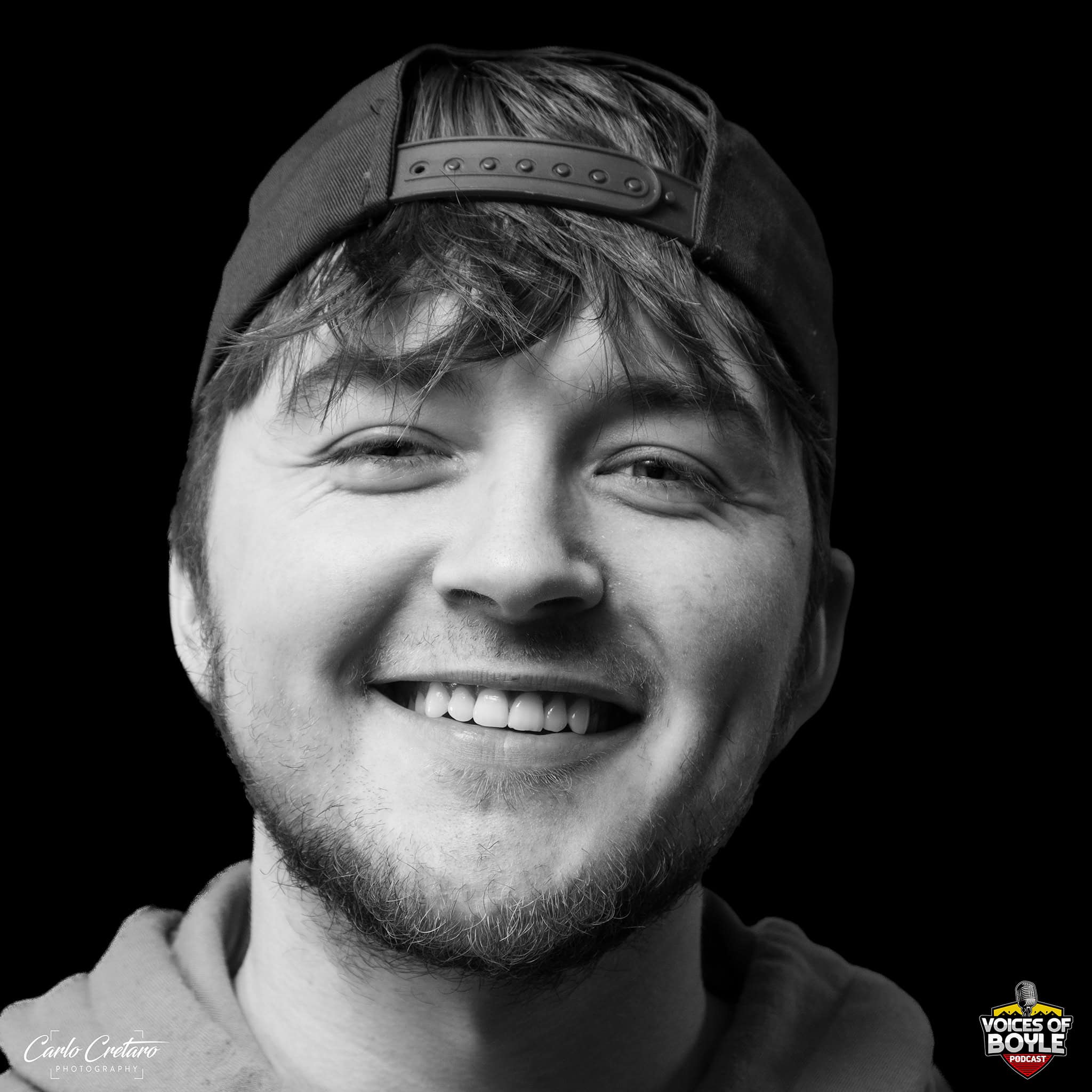
Welcome to Episode 73 of the Voices Of Boyle Podcast!
There is a version of this story where nothing happens at all. A mother buys her son a phone for his thirteenth birthday, purely so she can ring him and know he is alive. He uses it for texting, like everybody else, and gets on with his life.
Instead, Ciaran Casey pressed record, then pressed pause, then walked into another room and pressed record again. He watched the two clips play back as one, and he understood immediately what that meant.
Manchester, Annaduff, Boyle
He was born in Sligo and lived in Cootehall until he was three, then Carrick on Shannon until he was five. The family moved to Manchester after his younger brother was born in 1999 with homocystinuria, a metabolic condition requiring a diet of six to ten grams of protein a day. Ireland did not have the facilities at the time and his mother was making two or three trips a week to Temple Street. England had what they needed, so England is where they went.
Seven years later they came back, and Ciaran, aged twelve, found himself standing at a stop in Annaduff watching the bus disappear down the road.
“It’s just me, my mum, my brother and my sister. The bus goes away. I’m from Manchester, Mad City. And the next minute there’s cattle, a church, a shop and a school. And that was it.”
He went to school in Carrick and arrived in Boyle at eighteen, following his mother. He liked the town and still does. What he did not like was being treated as a blow in by people who did not know he was from a few miles up the road. Boyle, he says, will get behind you once you have proved you can do something. Before that, it wants to know what you are at.
The Pause Button
The Nokia came on his thirteenth birthday, along with a Facebook account and a Bebo account that his mother set up for him. The phone had no internet. It could record video, though, and it could stop and start.
“The day I found out you could record and pause and then move to the next location and record again, at 13, it blew my mind.”
He made short films with his little brother. He faked jumping out of windows by cutting between two positions. He did stop motion with Lego. When his parents went out for the night, he took his mother’s DSLR, the one he was expressly forbidden from touching, and shot with it until they came home, editing on Windows Movie Maker on the family computer.
At fifteen or sixteen he started rapping, mostly because he needed something to point a camera at. He was not going to film trees. Music gave him a subject, a tripod let him film himself, and by 2009 he and his brother were running one of the five or six most subscribed YouTube channels in Ireland, making parody videos that pulled between ten and a hundred thousand views each. At the time, hardly anyone in Ireland was doing this.
He had no proper editing software. Windows Movie Maker was not up to it, so he used a DVD burning programme called Nero, which let him cut a video but not export one. His solution was to play the finished edit on the screen and film the screen with his camera, then upload that.
A Sky Box and a Bag of Luas Tickets
His grandmother Margaret paid for him to go to a private film production college in Dublin. He was nineteen. Everyone else turned up with laptops and hard drives. Ciaran turned up with a 500 gigabyte drive he had ripped out of a dismantled Sky box, wired into a duct taped box, packed with every Luas ticket he had bought that year so it would not rattle around inside.
He liked the facilities. He liked the people who came in to speak. What he wanted was to direct, and he had written the scripts to do it. Sixteen students, nine projects made that year, and not one of them his. He did not stay for the second year.
Getting into the Royal
Wilsain Media started as a rap name, then a hip hop collective of six or seven lads doing gigs around Boyle, then a business. There was a poster for one of those gigs in the phone box outside Lowry’s for about six years.
Around then he and his partner got inside the Royal Hotel with a camera. He had been watching travel videos and had an idea about filming derelict buildings around Ireland. The Royal was on his doorstep.
He shot it, watched it back, and nearly binned it. By that point he had done work for the town, for Pride of Place with Chris O’Dowd, and he had built up enough of a name locally that he was certain the reaction would be immediate and bad.
“I was just afraid of being shunned by the community. How dare he, this guy comes in and starts breaking into our buildings and getting views off our name.”
He uploaded it anyway. Thousands of views. And underneath, comment after comment from older people in Boyle remembering dinner dates and nights out in that building. It is now probably among the last footage of the Royal’s interior before it fell fully derelict, though he is quick to say that was never the intention. He just liked run down buildings.
Two Hundred Euro and a Career
The first money came from the Alley Bar. He had brought a Dublin rapper called Craig Cooney down to Boyle for a video and asked the man behind the bar if he could shoot out the back. The man said yes. The man moving kegs in the background of that video turned out to be Michael Higgins, who owned the place.
Michael got in touch about an opening night. No money was mentioned and Ciaran did not ask for any. He shot it, edited it that night, and came in the next day to a hundred euro pressed into his hand. The day after that, having seen the reaction the video got, Michael gave him another hundred.
“He handed me a hundred quid. And then he saw the reception it got, came back up the next day and gave me another hundred. I knew exactly what I wanted to do.”
Michael also told everyone. Tattoo shops, cafés, the Stairs, the tourist board, Pride of Place. Then a first wedding for Johnny McLean at King House, with one camera, one gimbal and one battery, and a level of terror he does not try to hide. He is good at weddings and knows it. He does not advertise them, because he has watched what happens to people who become the wedding guy.
The First of July, 2020
Covid was the year Wilsain Media became an official business. He had been badgering the department for months while working at KFC in Carrick and picking up whatever else he could, saving to buy lenses.
Then March 2020 arrived, and with it lockdown and the news that he was going to be a father. Molly was not showing. It took four or five months before anyone realised she was pregnant, and when they did, the baby was not growing. At 32 weeks the hospital took him by section.
Ciaran had brought Molly in that morning and been sent home, because partners were not allowed to stay. He was barely in the door when the phone rang. He had no car and no licence, and by the time he got back to Sligo it was ten at night and his son had already been born.
“They were bringing him out of one room in one of those incubators, across the hallway to another room. And I sprinted. I saw him for two seconds. That’s my son. That’s Theo.”
Theo weighed two pounds five ounces. His fingers were smaller than Tic Tacs. Ciaran was not allowed to hold him for four or five days. The letter confirming Wilsain Media as an official business arrived on the first of July, the same day Theo was born, which means his son and his business are exactly the same age.
The day he was finally allowed to pick Theo up, he brought the camera. He filmed the train from Boyle to Sligo with nobody on it and the two metre notices on every seat. He filmed the empty streets, the empty corridors, the crowd of people standing outside the hospital because they were not allowed in. He says it felt apocalyptic and he could not not film it.
He nearly did not enter it into a national competition about how Covid had changed people’s lives, because it felt like using his son to win something. He entered on the deadline. Four thousand entries, and it made the top fifty on public vote, mostly because Boyle turned out and voted for it. It is still one of the pieces he is proudest of, and it is not flashy at all. It is just the story.
Twenty One Thousand Miles
He met the poet Mark Atwood in 2020 through Dale Vermin’s t-shirt shop in Boyle. Mark told him in a pub that he needed videos made. Ciaran took it with the pinch of salt he takes all pub offers with. Mark rang him a week later.
They filmed Kipling’s If during lockdown, rewritten for 2020, and it went to hundreds of thousands of views. Ciaran’s brother Joe recorded the audio in his bedroom. One of the poems Joe recorded in that room ended up as a boxer’s walkout track on Sky Sports on an Anthony Joshua undercard.
Then Mark said they were touring America.
Ciaran had been on a plane twice in his life. He arrived at LA airport with a suitcase of camera equipment and almost nothing else, and was pulled aside and put in a room for an hour while officials asked him who he was filming, what the poems were about, and what Mark’s YouTube channel was called. He sat there sweating, giving the shortest possible answers, convinced he was about to be sent home and banned.
They let him through. Eighteen shows, seventeen cities, seventeen states, 21,000 miles, thirty one days. One man, one camera, one hard drive and no backup. Sixty to a hundred hours of 4K log footage, data wrangled every single night in the back of an RV old enough to break down every second or third day, including once in the middle of Wyoming in the dark and the cold.
The standout, he says, was Devil’s Tower. They were near Mount Rushmore and never got there. Same with Niagara Falls. There was no time for anything that was not the tour.
Then nine months of editing, alone, with nobody to tell him what was working. The film runs an hour and forty.
The Thing He Is Not Saying Out Loud
Ciaran is honest about the awkward part. He is reluctant to show the Mark Atwood film as a portfolio piece, even the trailer, because of what people will assume about him from the subject matter. His job was to document. That is not always how it is read.
So he made the Ben Williams boxing film instead, unpaid, purely to have something to show. Because Ireland, he points out, has two television channels and a film industry you get into by knowing somebody. There is no green screen studio in the west. There is nowhere to apply.
His answer to that is to make himself necessary rather than available. He is teaching himself visual effects, motion tracking, putting 3D objects into scenes. He has passions for writing, animation, directing and editing, and no intention of choosing between them.
“I have never put myself in a box.”
The Film He Wants to Make
Near the end, the conversation turns to Betty. Ciaran has a draft written. He wants to make a comedy, action, science fiction film about her, quirky and funny, but grounded in what she genuinely believed. Carlo agrees it should be done, and points out that Betty enjoyed the joke herself, right down to the T-shirts she had printed.
Then Carlo tells him where they are sitting. Betty was laid out in this room, at this table, after she died.
Ciaran does not believe him at first.
Key Timestamps
00:00 — Welcome
00:13 — Born in Sligo, Cootehall, Carrick, and the move to Manchester
01:11 — Arriving in Annaduff at twelve, and the bus pulling away
02:04 — Coming to Boyle at eighteen
03:04 — Being treated as a blow in, and what Boyle does well
04:39 — The Nokia phone, and the day he found the pause button
06:03 — Sneaking his mother’s DSLR and editing on Windows Movie Maker
06:50 — Rapping at fifteen so he had something to film
07:31 — One of Ireland’s most subscribed YouTube channels in 2009
08:08 — Filming the screen because he could not export a video
08:52 — Film school, his grandmother Margaret, and the Sky box hard drive
11:01 — Nine class projects, none of them his
12:20 — Where the name Wilsain Media came from
13:41 — Getting inside the Royal Hotel with a camera
15:17 — The comments from people who remembered the Royal
17:00 — The first paid job: the Alley Bar and Michael Higgins
19:45 — Word gets around Boyle
21:15 — A first wedding at King House, and why he does not advertise weddings
22:53 — Editing and sound design
24:48 — Becoming an official business in 2020
26:33 — Lockdown, and finding out he was going to be a father
27:20 — Theo born at 32 weeks, and the race back to Sligo
29:25 — The first of July: a son and a business on the same day
30:13 — Filming an empty train and an empty Sligo
32:20 — The competition, and Boyle voting him into the top fifty
35:33 — Vultures: knife crime, a crew of ten, and locked car keys
37:09 — Meeting Mark Atwood through Dale Vermin’s shop
39:43 — A poem recorded in a Boyle bedroom, played on Sky Sports
40:34 — The invitation to film a month across America
41:35 — The second flight of his life
42:52 — An hour in a room at LA airport
48:06 — Eighteen shows, seventeen cities, 21,000 miles, thirty one days
49:25 — One hard drive and a hundred hours of footage
51:49 — Building a structure with no script
54:48 — Devil’s Tower, and what America looks like through a lens
56:38 — Twelve hours a day in an RV that kept breaking down
59:40 — Nine months of editing, on his own
01:01:39 — Long form, short form, and the trailer problem
01:03:28 — The Ben Williams film and the portfolio problem
01:05:02 — Trying to make films in Ireland
01:07:23 — Visual effects, motion tracking, and refusing to pick a niche
01:09:07 — The Betty film he wants to make
01:11:04 — Where Betty was laid out
01:12:48 — Where to find his work
Guest Bio
Ciaran Casey is a filmmaker, director and editor working under the name Wilsain Media. He has made music videos, documentaries and commercial work across the west of Ireland, including a feature length documentary shot solo across seventeen American states, the short film Vultures, and a recent boxing film following Ben Williams. He is currently moving into visual effects and motion tracking. He lived in Boyle for seven years and is now based near Knock in County Mayo.
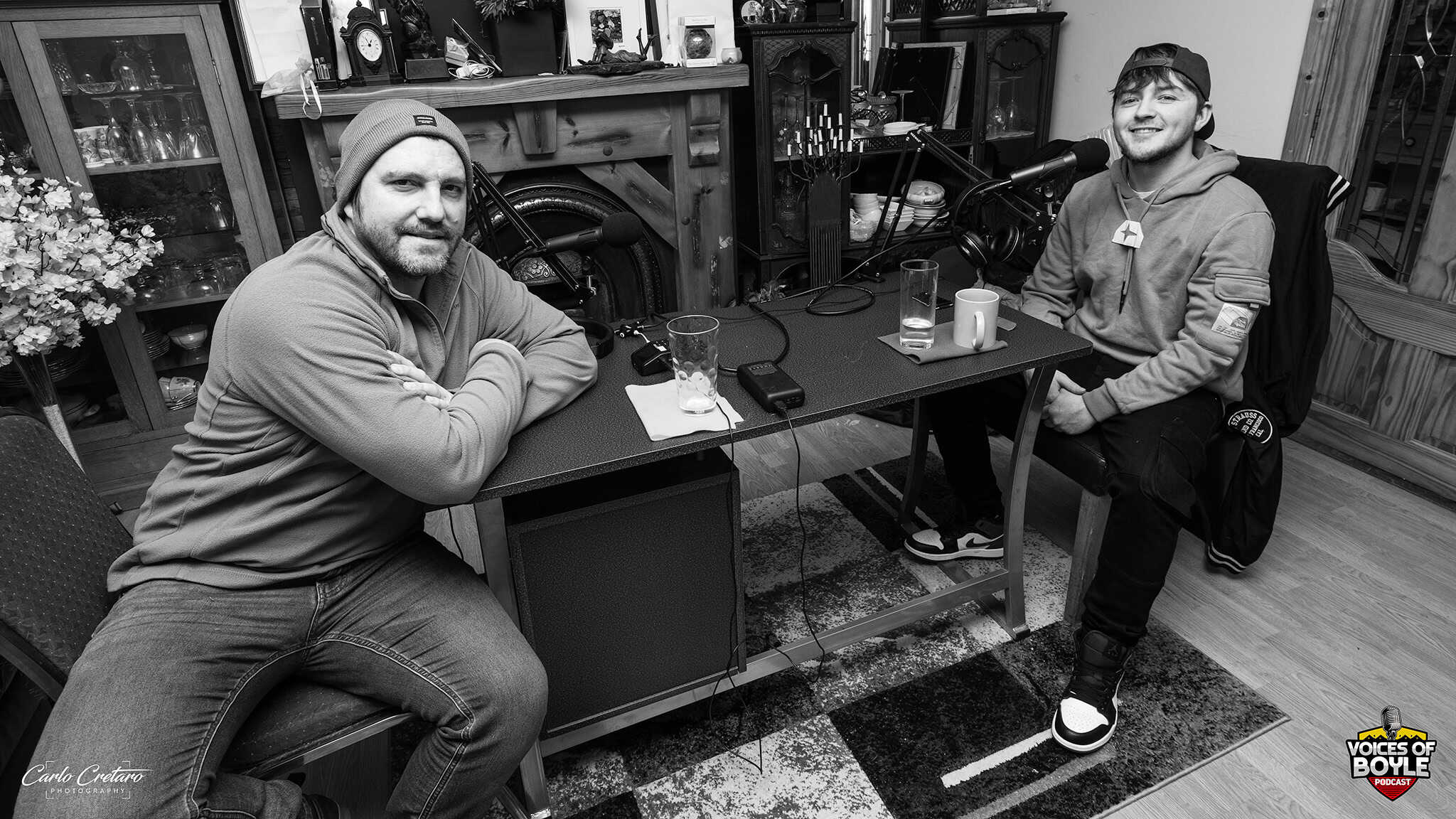
Thanks to Brendan O’ Dowd for creating and recording the musical piece for the podcast.
BE A GUEST ON THE SHOW!
If you’ve a story about Boyle, we’d love to hear it. You don’t need to have done anything remarkable, and you don’t need to prepare a thing. We sit down, have a chat, and you talk about whatever you want to. It usually takes about an hour.
Thinking of someone else? A parent, a grandparent, a neighbour who remembers how it used to be? Tell us about them. Some of our best episodes started because a son or daughter got in touch. You can find us at [email protected].