Episode 42
Danny Tiernan – Echoes of History
HOSTS & GUESTS
Carlo Cretaro
Danny Tiernan
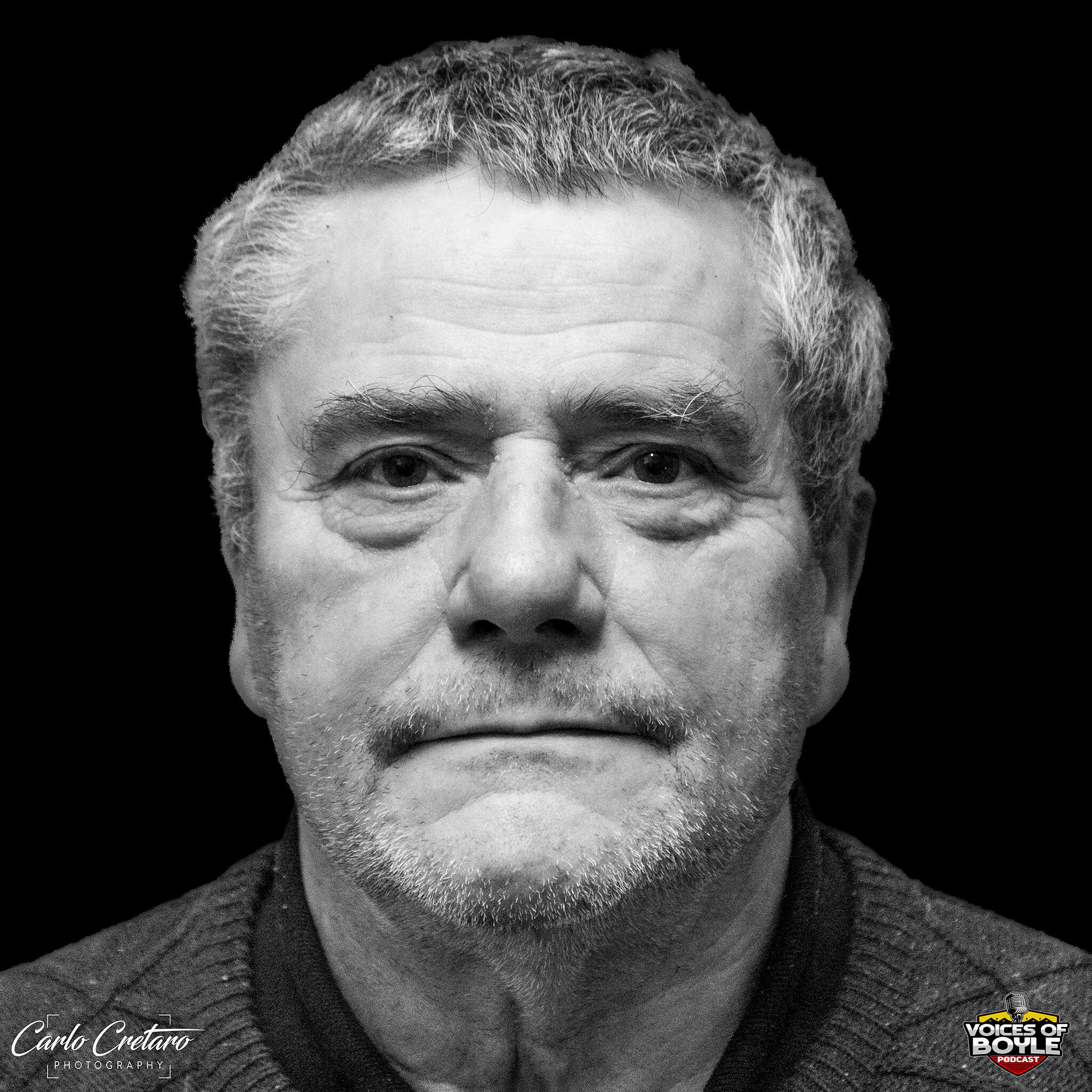
In the late fifties and early sixties, there were so few cars in Boyle that Danny Tiernan and his friends could play football on the street for an hour and a half before anything came along. He thinks the car that finally broke it up was the late Andrew Hopkins going home, in a Hillman or a Wolseley.
There was handball against the doors of the CIE stores, until the man on duty ran them off in case somebody chased a ball in front of a train. And when Santa came, he came by train, with the children running down the street behind him to Taylor’s Stores.
Ten shillings was a lot
The principal of St Joseph’s boys’ school was Master Kennedy. In spring and summer he would gather ten, fifteen or twenty lads into one of McKenna’s minibuses and drive them out to his brother-in-law’s farm, which Danny remembers as belonging to the retired Major General Costello, chairman of the sugar company. They thinned beet all Saturday for ten shillings, which, Danny says, “was a lot back in the sixties to a young lad growing up.”
Years later Danny met the old master and they got talking about school. “If I did today what I did back when you were small,” the master said, “I’d be arrested.” Danny agreed that he more than likely would.
Nursing them till one in the morning
Danny worked the bar at the Royal Hotel, under a man he calls Vincent. You did your work, there was never any hassle, and the money was there on a Friday. When Paddy Daly’s closed at eleven, some of its customers came across, and you could be there until one in the morning. The Royal did big sit-down weddings and smaller cold-meat-and-salad ones, and the discos upstairs left the floor heaving. He thinks there were about 30 bedrooms at one time, and about sixteen by the time it stopped being a hotel.
Of the characters, he names Jim Mahon, who always had a story, and the late Noel Conroy, “a humdinger”. One evening in Emmett’s the late Sean Kenny came in wrapped in a coat, scarf and hat, saying it was very cold out there. Next thing Noel walked in in his shirt and said it was a great night. Somebody suggested the pair of them go outside and make up their minds. Danny adds, gently, that Sean was not well at the time. Nobody knew it then.
You didn’t realise you were learning it
Danny joined the FCA in 1969. During the Troubles the reserve did real work. Before the 28th Battalion arrived it ran Finner Camp, and it guarded the power stations near Ballyshannon, Cathaleen’s Fall and Cliff, as well as Arigna and the RTÉ mast on Truskmore. “You were there as a visible deterrent,” he says.
He did his NCO course in 1971, and was on another course in August 1977 when Elvis died. In 1988 he resigned from the FCA one day and was commissioned into the Reserve of Officers the next. He retired in 2010 as a commandant, at 57, the same compulsory age as the regulars. What stayed with him was how to stand, how to lift, how to speak to people and how to pass on a skill.
“They taught you all that, but you didn’t realise you were learning it.”
Not taking my winning team to a chip shop
In his second year as an officer, Danny captained the rifle team that became the first unit from Boyle to win the overall Western Brigade championship. He names John Ward, Marty Higgins, Colm Gallagher and a young Nevin, whose first name he apologises for forgetting.
The PDF officer commanding, John Burke, originally from Carrick, was delighted. On the way home he asked Corporal William where the team was eating. A place in Tuam, he was told, kind of a chip shop, but you could sit down.
“You’re not taking my winning team to a chip shop.”
They were moved to the hotel and fed properly, with Burke putting his hand in his own pocket for the drink. Back in Boyle he sent them into the Royal for their tea and put up two more rounds.
Danny is honest about the hard side. “It’s not an easy life. It’s a tough life.” During the Troubles, he says, the gardaí on the border were on overtime while the soldiers behind them stayed on a day’s pay. He feels the Defence Forces have lost their voice, now that defence is a half portfolio held by the Tánaiste and the junior minister has no seat at the cabinet.
A cattle boat to Scotland
The Connaught Rangers were raised in 1793, when England was at war with France and short of men. Most recruits came off landlords’ estates or from towns with no work and no social welfare. The army was an income.
Danny’s grandfather, William Tiernan, was a Sligo man from around John Street. He took a cattle boat to Scotland and joined up in Paisley in 1897. Danny’s aunt and uncle were born in Pune, in India, while he was stationed there.
The 4th Battalion was based in Boyle, a reserve that fed men to the battalions at the front. At the end of the war the 5th were brought to Dover, told to ground arms, and then told to pick them up again as the 2nd Battalion, Connaught Rangers, replacing the one lost in 1914. The Rangers were disbanded in 1922. He is clear that the Free State did not cause it. The cuts were decided from 1920, and dropping the southern Irish regiments suited them.
They weren’t part of the family
The officers belonged to the crown, Danny says, and the men belonged to the regiment. He knows this from one conversation. As a young lad he had met some of the men involved in the 1920 mutiny in India, and he asked his grandfather about them. He can still see him in the armchair, with the cat on his shoulders, watching the horses.
“There were only blackguards. They weren’t part of the family.”
It made sense to Danny years later, when he found that many of the mutineers had not served with the regiment in the First World War.
His grandfather said very little about the war. He told of a march across a desert, which Danny thinks was in Iraq, meant to come in behind the Germans. The war ended before they got there, and the men were starving and thirsty. One lad climbed a telegraph pole to see ahead and was told to get down or lose his head. In an attack on a trench, a German soldier fell and his bayonet went through Danny’s grandfather’s shoulder, pinning him to the back of the trench. He ended up in hospital in Alexandria, Danny thinks. Beyond that, nothing.
“That’s dead. That’s gone. Leave it alone.”
Not the anger in me
Danny’s grandfather always wore the poppy, and ex-British soldiers sold it in Boyle until around 1962 or 1963. He wore it to remember the men from around the town who fought and died beside him. Danny says the poppy was started by two French women after the war and only taken up by the British years later. When he wears it, he is remembering his grandfather talking about his comrades.
“I don’t have that anger in me to run down the poppy.”
The Irish branch of the Royal British Legion, he points out, keeps its money here, helping ex-servicemen in trouble.
From 1897 until last November there was always a Tiernan in uniform. The run ended when David retired from the Air Corps, the last of the Tiernans in the Irish forces. Cousins still serve in the British Army.
Look after it for me
In 1999, Danny and King House curator Neil Armstrong started the Connaught Rangers display in King House. The Connaught Rangers Association followed in 2002, on the 80th anniversary of the disbandment. Tommy Egan asked to meet him in Matt Smith’s, and Danny’s terms were simple: he would give them the material if they put it in and looked after it. He held out for a glass cabinet, because the more a thing is handled, the more damage is done.
Three hundred men in the barracks, he says, was like a small factory, and they had nowhere to spend their pay but Boyle.
The barracks has its stories. During an attempt to break a man out, a Ranger named Larkin forced a lock with his bayonet and the tip snapped off in the door. At parade next morning the officer ordered fix bayonets, and the broken one gave him away. Larkin was court-martialled in England and jailed. When he came home, Danny says, de Valera gave him land that is now Boyle Golf Club.
Danny also met the actress Maureen O’Sullivan, born in Boyle, whose father, Captain O’Sullivan, served in the Rangers. She remembered old Mr Conroy, her father’s batman, and signed Danny’s programme. He carried the flag that day.
The cross by the road
In the nineties Danny went to Germany as a scout leader with Jim Canton and the troop. Coming down from the mountains, the boys stopped in a small village to cook. A woman came running down shouting at them, thinking they were English. Once she understood they were Irish, she brought them up to the tables at the back, and the village fed them.
Past a bend on the way out, Danny looked back and saw a cross with fresh flowers. It was 4 August, the anniversary of the start of the First World War, and the cross was a memorial to German soldiers. The boys turned round, formed a small guard of honour and left flowers they had picked. The people up above clapped them.
At Mass that Sunday the priest told the congregation these were lads from the poorest part of Ireland, and afterwards he handed one of them an envelope of money.
We have let it die
Boyle had Irish champions in handball. The late Paddy Kennedy ran competitions at the open alley on Patrick Street for every class in the school and bought the medals himself, so nearly everybody got one. The indoor court is now used by a dance group, and the country alleys at Monasteraden and outside Frenchpark are derelict. “We have let it die.”
Posed photographs don’t work for me
Danny does not go anywhere without his camera, and his one rule is that posed photographs never come out. Across the Decade of Centenaries he photographed commemorations with Ollie Breen from Enniskillen and Pat Clarke from Dublin, and the Department of Defence took over 3,000 of their photographs. At the Enniskillen memorial he caught the Irish minister sharing a programme with Arlene Foster. He captioned it “Ministers reading out of the one hymn sheet,” and it was published. His favourite recent shot is of his youngest grandson, Alfie, pulling the sword from the stone at Disneyland Paris at eight in the morning, with no crowds and the sun behind him.
A wicker basket on the road to Drumcliff
Danny started in Posts and Telegraphs in Boyle in 1971, moved to Sligo, went with Telecom when the service split, and stayed 28 years. He worked thirteen Christmases in a row on nights. One Christmas a man was sent from the parcel office in Sligo Town Hall down to the sorting office with a parcel for the Drumcliff delivery. An hour and a half later he had not arrived. A postman coming in off the Drumcliff run reported him halfway there, pushing the big wicker basket out the road.
“I had a good life. I still have a good life.”
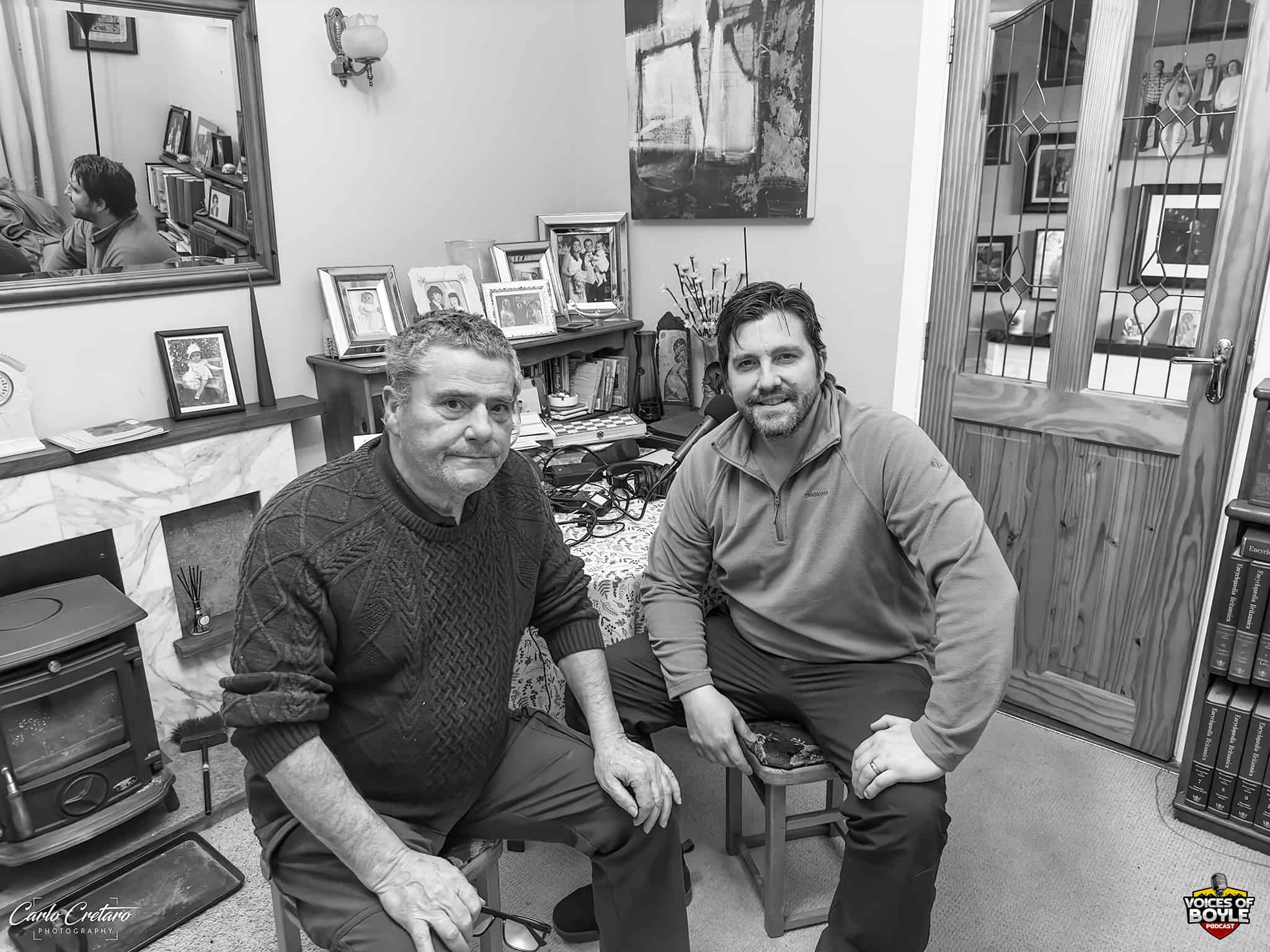
Thanks to Brendan O’ Dowd for creating and recording the musical piece for the podcast.
BE A GUEST ON THE SHOW!
If you’ve a story about Boyle, we’d love to hear it. You don’t need to have done anything remarkable, and you don’t need to prepare a thing. We sit down, have a chat, and you talk about whatever you want to. It usually takes about an hour.
Thinking of someone else? A parent, a grandparent, a neighbour who remembers how it used to be? Tell us about them. Some of our best episodes started because a son or daughter got in touch. You can find us at info@voicesofboyle.com.