Episode 85
David Cryan – Life Before and After
HOSTS & GUESTS
David Cryan
Carlo Cretaro
Florence Cretaro
RESOURCES
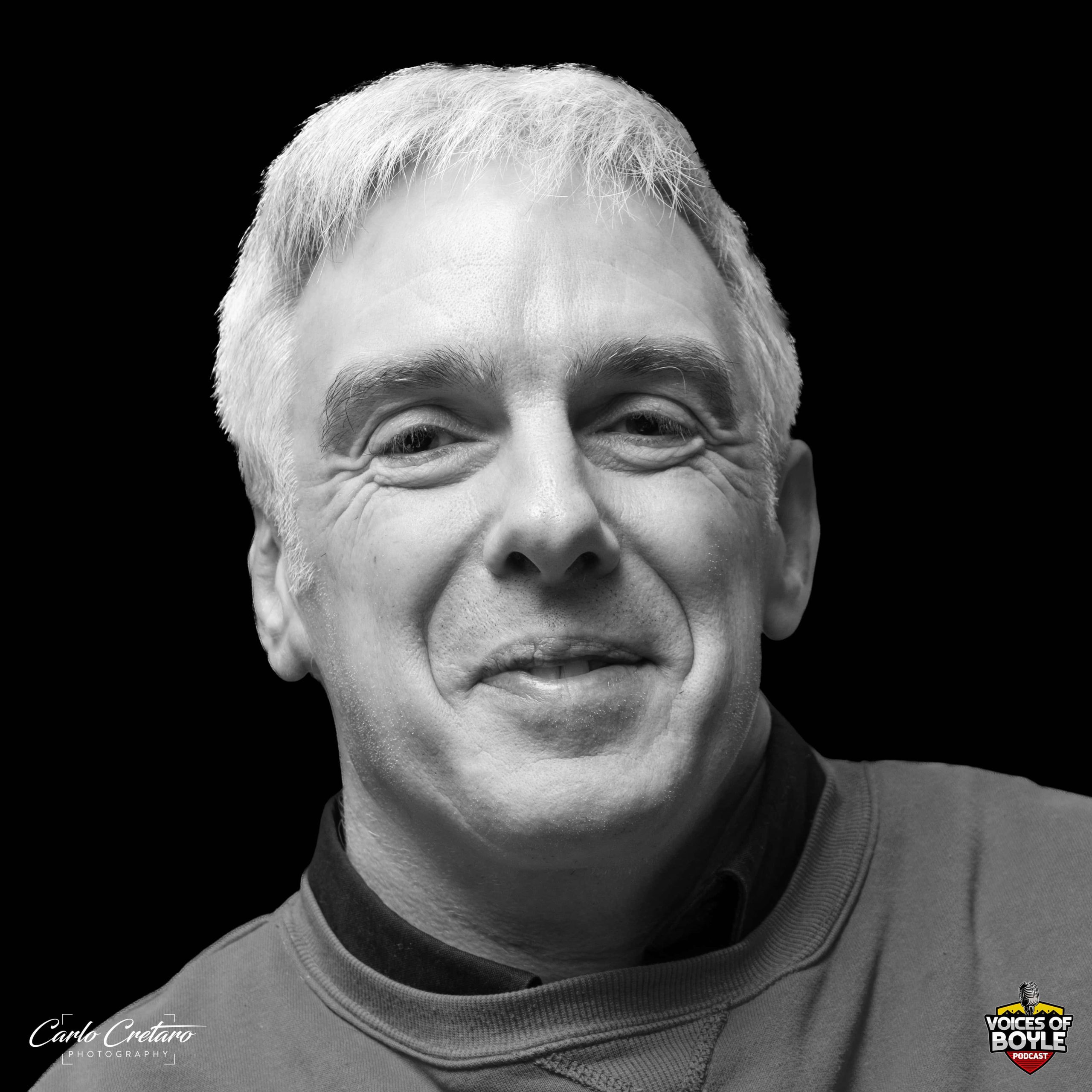
Welcome to Episode 85 of the Voices Of Boyle Podcast!
David Cryan did not grow up in Boyle town. He grew up just outside it, in Cloonloo, overlooking Lough Key, in a house where the evenings after school meant feeding cattle and mucking out sheds before anyone thought about homework. He says he would not change a thing about it.
That background sets the tone for one of the most wide-ranging and honest conversations we have had on Voices of Boyle. From his school days and teenage years working in Parkers nightclub, to an accident in 1992 that left him paralysed at 20 and the long road that followed, David Cryan covers a lot of ground and does not shy away from any of it.
A Different Kind of Boyle
Anyone who grew up in or around Boyle in the late 1980s and early 1990s will recognise the town David describes. At its peak, Boyle had somewhere between 28 and 32 pub licences. The Moylurg on a Saturday night was full before half nine. Parkers nightclub and Cleo’s were both running at the same time, and busloads of young people were coming over from Carrick-on-Shannon because, as David puts it, Boyle was the place to be.
“I think from my perception, years ago, Boyle was way ahead of Carrick,” he told us. “So the young ones in Carrick, Boyle was just the place to be.”
David started working behind the bar in Parkers at the age of 17, waiting tables at weddings during the day and pulling pints in the evening. He says a night working there was better than any night out.
“We just had so much fun. We just clicked and it was the craic. We knew all the gang as well, so you could spend a bit of time. And every night was jammed. It was out the door.”
“I think from my perception, years ago, Boyle was way ahead of Carrick. Boyle was just the place to be.”
School Days and the Familiar Faces of St. Mary’s
Before the nightclubs, there was St. Mary’s secondary school in Boyle, where David arrived after his primary years in a small country school with two or three teachers covering multiple classes at once.
He remembers the morning assemblies in the big hall, principal Don Conlon doing the roll call, and a teacher called Francie who was, in David’s words, entertaining. He mitched exactly once during his five years there. He got caught the first and only time, which he says was almost expected.
It is the kind of school memory that anyone who went through St. Mary’s in that era will find familiar, and Carlo and Florence both agree that it was one of those places that left a mark.
1992: The Accident
In 1992, David was involved in an accident that left him paralysed. He was 20 years old.
He remembers a doctor coming around within a week or two to tell him he would never walk again. He did not really believe it. None of the people around him did either. Staff at the spinal unit in Dun Laoghaire told patients that a cure was five or ten years away, that this was temporary. It gave people something to hold onto. After a few years, David figured out it was not temporary.
“After a few years, I kind of figured out that this was not going to be temporary after all. It was what it was. And I had to try and get on with it.”
The problem was that getting on with it, in the Ireland of the early 1990s, largely meant doing it alone. There was no counselling available. No support systems in place. Once he was home, he was home, and the demons were his to deal with.
“The wheelchair was the easiest part of the whole lot. It is all the invisible stuff. That is where the problems are.”
The Invisible Stuff
One of the things David is most clear about is how little people understand about life in a wheelchair. He says that when he was young himself and saw someone in a chair, all he saw was the chair. He had no idea what came with it.
Three weeks after his accident, he and the friends he had made in the spinal unit had already figured out that the wheelchair was the least of it. What came with it was everything else: the skin conditions, the pressure sores, the phantom pain, the medical complications that could put you in bed for months, the mental weight of a life that had taken a turn you had not planned for.
He spent a month and a half in bed at one point because of a pressure sore the size of the top of a biro. It had been misdiagnosed for three months. It eventually kept him off his feet from Christmas into late March.
“The chair is nothing compared to the rest of it,” he said. “It is all the invisible stuff.”
Self-Medicating and the Long Road to Getting Help
Without formal support, alcohol became the way David managed what he was carrying. He is candid about this and equally candid about the fact that it did not work. He calls it self-medication, because that is what it was. It helped him sleep. It helped him avoid dealing with things. It did not help him deal with them.
The turning point came when a close friend died. David made a decision. It was either drink or it was not going to end well. He gave up alcohol entirely. That was over 14 years ago.
Counselling followed, along with every other form of support he could find. He took it all. He says he needed it all.
He gets annoyed with himself sometimes when he thinks about the years before that decision. Not with bitterness, but with the clarity of someone who can now see what those years cost him.
“I get annoyed at times because after the accident, the way I did not deal with stuff. If I had dealt with it then, I felt I wasted all those years. And that is why if I was giving advice to anybody, it is to talk to somebody. Deal with it honestly. Without medicating yourself through drugs or alcohol.”
“You are not living your life when you are controlled by something. You have one life. Live it as yourself.”
Life Now
David is a familiar figure around Boyle today. He uses an electric drive-assist wheelchair, a piece of kit he has clearly put a lot of thought and tinkering into, including fixing a faulty axle using skills from his days doing tool making. He talks about the freedom it gives him, the 24 kilometres of range on a single charge, and the joy of getting out on a quiet road on a good day.
He had a brief stint in local politics, filling a council seat vacated by the death of a cousin. He loved it. He regrets not running for election when he had the chance, but says politics has changed and he is not sure he would go back now.
His social life these days involves coffee in Carrick, lunch out, watching his nieces play football on the new all-weather pitches, and enjoying the quiet. He is clear that the quiet suits him fine.
He does notice the changes in Boyle. The town is quieter than it was. Some of the buildings are run down. The streets that used to be full of people on a Sunday are mostly empty now. He sees positives too, the sports facilities in particular, but he does not dress things up.
The Message He Wants People to Hear
At the end of the episode, Florence asks David what advice he would give to younger people listening. He does not hesitate.
Stay away from cigarettes, drink and drugs. Talk to people. Keep a small, solid circle of friends you can be honest with. And live your life as yourself, not as whatever comes out of a bottle or a syringe.
He closes with something simple that lands hard after everything he has shared: “It is your life. Be in control of it.”
He came on the podcast, he said, because he hoped it might reach even one person. We think it will reach a lot more than that.
Listen to the Full Episode
This conversation runs to just over an hour and ten minutes and covers everything from the Boyle of the 1990s to the realities of living with paralysis in rural Ireland with no support, and what it took to find a way through.
If it helps someone, share it on.
CHAPTERS
0:00 Welcome
0:23 Growing up in Cloonloo
3:00 St. Mary’s and school memories
9:00 Early memories of Boyle town
10:50 The pub scene at its peak
15:45 Working in Parkers nightclub at 17
17:27 Boyle as the place to be
18:25 Cleo’s and accessibility
22:13 The factions and the fights
24:46 Boyle then and now
30:08 Boats on the lake and thumbing lifts home
34:59 Changes in Boyle, good and bad
38:23 GAA and soccer, new facilities
40:44 Local politics
47:43 Life now, coffee runs and quiet days
48:07 The electric drive-assist wheelchair
55:45 Accessibility in Boyle
57:47 The accident in 1992
59:27 No support available, alcohol as a coping mechanism
1:05:15 What he would say to his younger self
1:06:37 What people misunderstand about paralysis
1:10:50 Advice for younger listeners
Guest Bio
David Cryan is a native of Cloonloo, just outside Boyle in Co. Roscommon. He grew up on a farm, attended St. Mary’s secondary school in Boyle, and spent his late teens working behind the bar in Parkers nightclub.
In 1992, at the age of 20, he was involved in a serious accident that left him paralysed. In the years since, David has navigated life in a wheelchair with characteristic good humour, candour and resilience. He briefly served in local politics, filling a council seat vacated by the passing of a cousin, and is a familiar face around Boyle and the surrounding area.
He gave up alcohol over 14 years ago and is open about the role that counselling and honest conversation played in getting to where he is today.
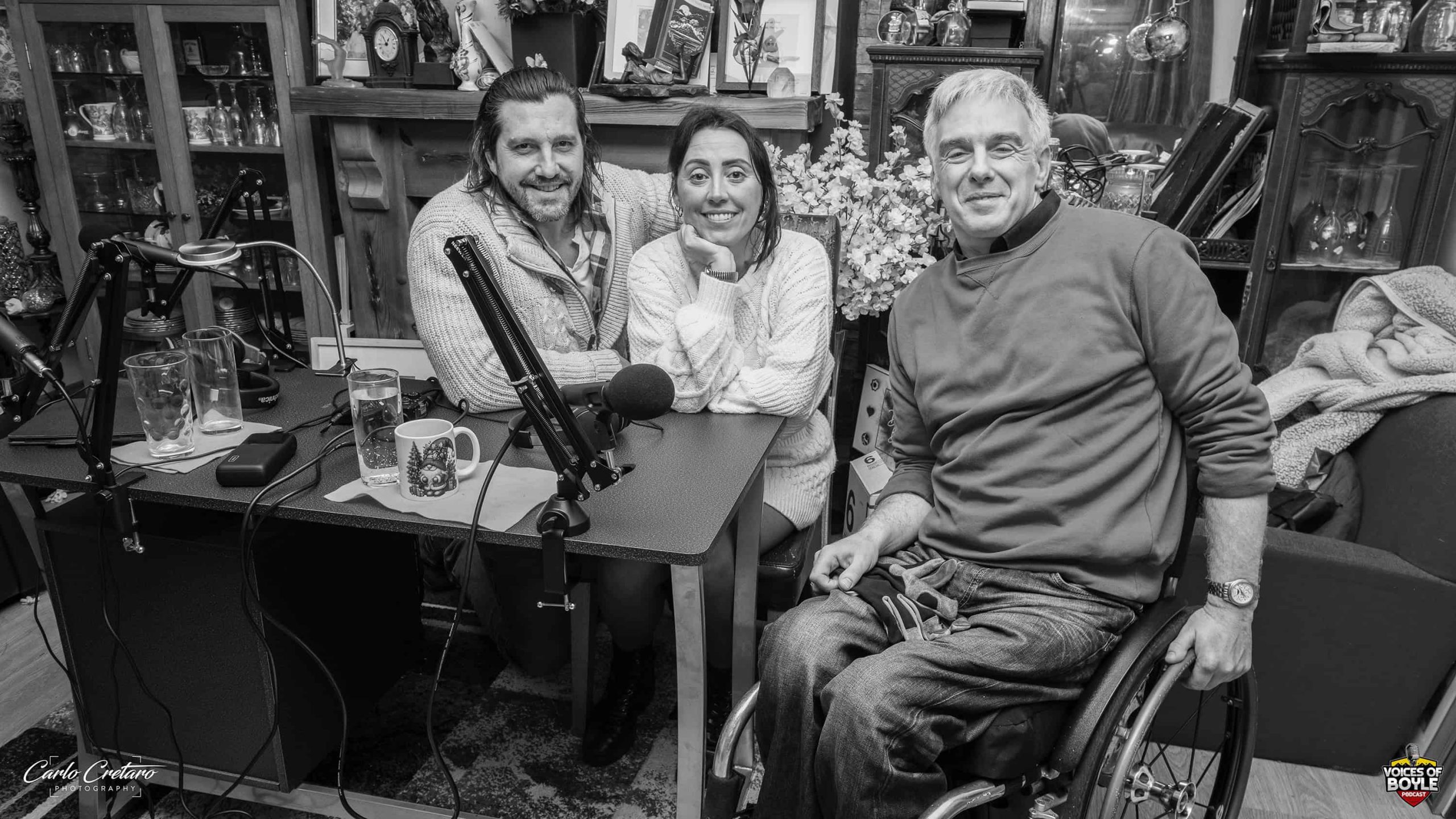
Thanks to Brendan O’ Dowd for creating and recording the musical piece for the podcast.
BE A GUEST ON THE SHOW!
If you’ve a story about Boyle, we’d love to hear it. You don’t need to have done anything remarkable, and you don’t need to prepare a thing. We sit down, have a chat, and you talk about whatever you want to. It usually takes about an hour.
Thinking of someone else? A parent, a grandparent, a neighbour who remembers how it used to be? Tell us about them. Some of our best episodes started because a son or daughter got in touch. You can find us at [email protected].