Episode 20
Dermot & Paula Lahiff – A Look Back With Two Former Locals
Hosts & Guests
Carlo Cretaro
Dermot Lahiff
Paula Lahiff
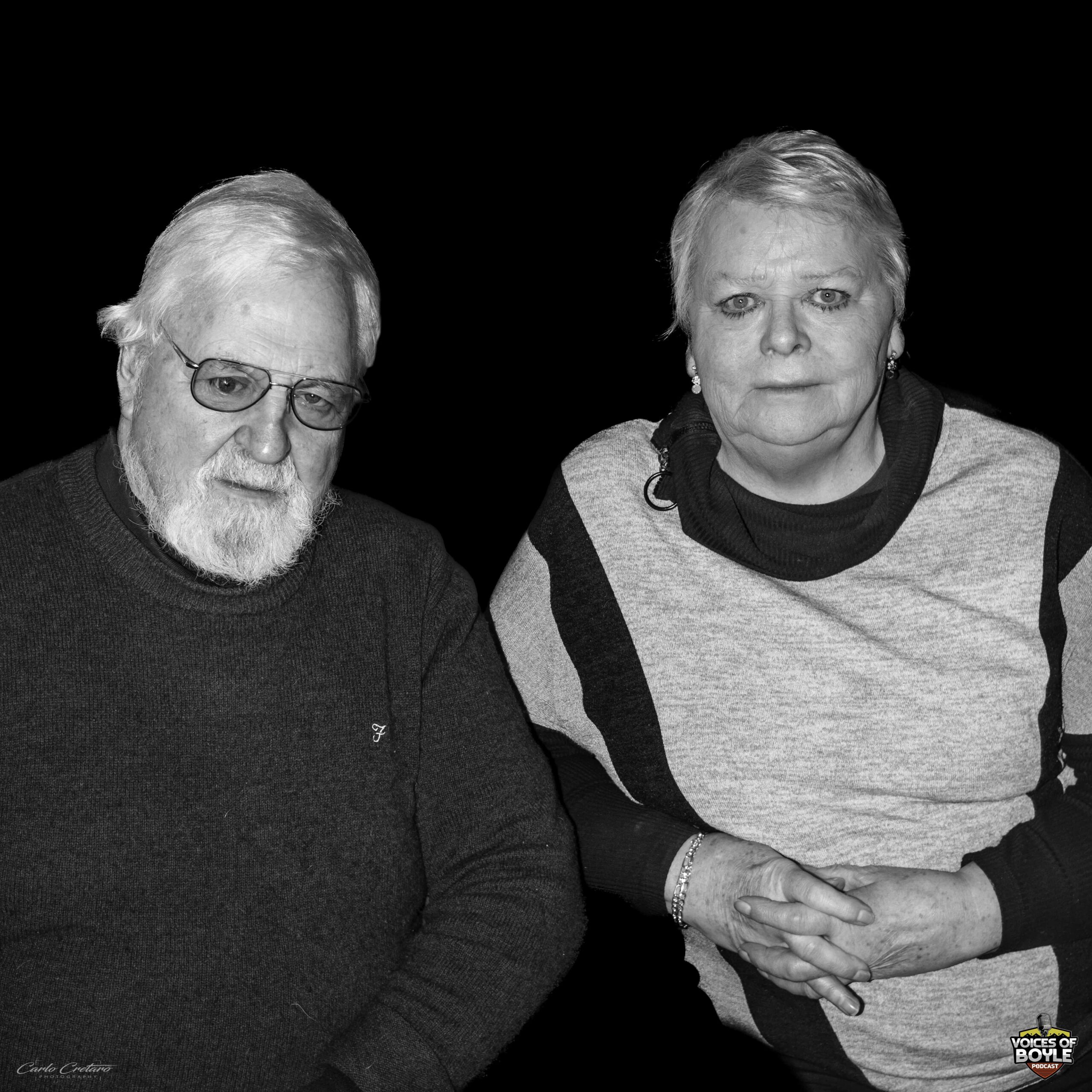
Once the season ended and the cars stopped coming, Lough Key Forest Park belonged to Paula and Dermot Lahiff. They lived in a small bungalow behind the Lakeshore Restaurant that came with the franchise. They brought the children out to see the bats under Drum Bridge. They heard badgers grunting at night. Their dog chased the deer down the tunnel, which was open to everyone back then.
They ran the Lakeshore from 1985 to 1995. Carlo went to see them at their home in Sligo for the first Voices of Boyle episode with two guests.
“From September each year until March, it was yours. The whole park was yours.”
Crèche, work, collect, feed
Dermot came up through hotel management and catering in England, France and Ireland, then ran a restaurant in the Wicklow Mountains and another in Dalkey through the late seventies and early eighties. Then the recession came. The coalition government removed the tax concession on business entertainment, and by around 1984 or 1985 the upmarket trade had flopped. They were working sixty hours a week and never seeing the children. Dermot describes the routine as crèche, work, collect, feed, with Paula doing most of the toing and froing. It wasn’t worth it, he says, from any point of view.
They had been to Lough Key with a caravan a few years earlier, and Dermot had said to himself he had to come back. He never imagined it would be as a business.
“Do you have a car?”
They met at a Church of Ireland dance in Greystones. Paula and her friends had to make the last bus home at half eleven, so anyone who asked them up to dance was asked whether he had a car. When Paula brought Dermot home, her father gave him the third degree. Dermot said he was from a little village called Peterswell, between Loughrea and Gort, that he wouldn’t know. Her father asked was he Josephine Hayes’s son. He had gone out with Dermot’s mother years before. They had lived within two miles of each other.
Hit the ground running
In January 1985 a note came from the Forestry about their application for the franchise. They got it, and then things stalled. The Roscommon Herald was saying the park wouldn’t open for Easter. Dermot says political influence was brought to bear on the Forestry, who wanted their own candidate, and the Lahiffs were put through hoops on financial bonds before they could take over. They arrived just before Easter and, in Paula’s words, hit the ground running.
There was a shop, a tourist facility and a restaurant. They trained fifth year students as waiting staff with help from a woman from CERT, the catering training body. Bernie Regan and Kate ran the shop. Gerry Sweeney ran the boat, Pete Walsh and his family the smaller boats, and Michael Costello was head forester. There was the odd conflict between the business and Michael’s love of nature, Dermot says, but they got on extremely well, because they both loved the place.
That first summer had nine or ten dry days in it, by his count, and he and Gerry Sweeney wondered had they been sold a pup. Paula remembers the other extreme, a hot day when she emptied four freezers of ice cream in an hour. Dermot says it was quoted at the time that Lough Key was second only to Dublin Zoo for visitor numbers.
Not everyone was warm to the park at first. As Dermot understood it, the park had been given to the community, who couldn’t run it, and passed to the Forestry. Some previous operators, he says, weren’t exactly community-minded, and they had to work at rebuilding that contact.
If you can’t get it in Boyle, you don’t need it
The first time Paula went into town, people kept coming over to wish her luck. In the city, she says, nobody talks to anybody. Carlo mentions Christy Wynne once calling Boyle a stranger’s paradise. Paula quotes Gerry Dodd: if you can’t get it in Boyle, you don’t need it.
Vincent Regan, who ran the hotel with Angela, came into the shop soon after they arrived. He’d had a notion of applying himself.
“If you make a bags of it, you’ll hear about it, but if you succeed, the best of luck to you.”
Dermot ended up minding the hotel in the winters when the Regans wanted a holiday. Boyle, he says, had three religions that got on well, two strong political persuasions, and a habit of putting Boyle first when it mattered.
Children draw you into the community
Within a week there were children at the house to play. Their son Peter got his love of literature from Master Fallon, Jack Fallon, and runs his own language school today. May Moran, a teacher in the girls’ school, offered to take one of their children for an hour after school, after a hard start at a previous school. A month later she said the girl was doing great.
Brida Dodd knocked on the door with a lemon cake, having heard they needed a babysitter, and she and three year old Avril were inseparable. Margaret Smith, who babysat Timmy Sloane, would call for Avril and they’d all head off to the park, where Avril offered to show visitors around. Dermot remembers Margaret as “a very upright, good Protestant lady” who only mentioned after a long time that she had nursed in the Second World War.
“Whatever you give back to the community, you get it back 110%.”
The whoosh of the gas
Ronan rang from Ardcarne to say the national ballooning body was looking for a venue, and that Dermot should try to bring it to Boyle. The balloonists had been to the town years before with a handful of balloons. They came back in the autumn of 1989.
Paula remembers getting up at six to have croissants and pots of coffee ready for the crews at seven. Two or three hundred people needed beds in Boyle for a week. There was a treasure hunt around the pubs that took a few days, and a children’s painting competition that filled a corridor.
It depended on the farmers. The burners spooked Simmental cattle, horses and sheep, and the first year needed some gentle persuasion. In time the farmers sent their stock to the mart a week early, and sold the food to the B&Bs and restaurants full of balloonists.
Paula went up herself. When they landed they had to call into the nearest house to say where they were, and an elderly man asked did they speak English. Other balloonists landed in a field and the woman of the house came out with tea and scones.
In the splash and dash a balloon would dip low enough to touch Lough Key and climb again. Carlo remembers watching from the tower as one tried to lift a set of raffle car keys off a float near MacDermot’s Castle. They missed. The week ended with the survivors’ night in a packed Forest Park Hotel.
“I can almost to this day hear the whoosh of the gas.”
A basket of shamrock
Boyle was twinned with Saint-Witz, an affluent town outside Paris. The Lahiffs hosted French students and their children went over, and Paula says the family can still talk in French around the table because of it. One St Patrick’s weekend they brought a mushroom basket of shamrock over as a gift, and that evening it was on the dinner table as a salad. Another year Clive Roe carried a miniature Celtic cross from Feely’s in a duffel bag, and airport security took them into a back room. Genuine Celtic crosses were being smuggled out of the country, and they needed a receipt to get through. Paula chaired the committee in its final years.
This is the Scouts
Peter joined the Scouts and Dermot was asked onto the committee straight away, alongside people like Mary Ryan, Maura Clarke and Anne Clarke. When Seamus Flynn stepped back, Dermot became scout leader. It was CBSI then, and he would have preferred it interdenominational, but he went with the flow. He believed in adventure. Carlo remembers asking could they play football, and Dermot telling them to join Boys Celtic if they wanted football. He was right, Carlo says.
There were trips to Ballintrillick under Benwiskin, to the road where a car seems to roll uphill. James Candon started the Venture Scouts and took them cycling to Paris and Saint-Witz. When Dermot took them on, one frosty night in the middle of Roscommon a shopkeeper sent them to a house her family had left two years before. Dermot slept downstairs in a cupboard laid flat on the floor. When the local lads came after the disco with torches to frighten them, he raised one hand slowly into the light, and they were gone. Later they went to Kandersteg in Switzerland, where the boys discovered rosti, fondue and some Portuguese Scouts.
Years later Ciarán O’Reilly organised a Venture Scout reunion, postponed once for Covid. Adrian Regan made a video of old photographs, and the leaders were each given a plaque. Dermot treasures his.
A lot of hot air
In January 1995 Dermot was managing a winter CERT training centre in Dingle, getting McGowan’s bus down every Sunday. That winter Paula stood outside the Lakeshore at six one morning waiting on the bus, and a squad car pulled up. The Gardaí didn’t believe her until the big headlights came round.
Consultants rang Dermot in Dingle about a development at Lough Key with hotels and chalets. He knew it would be the end of the franchise and wouldn’t cooperate. The plans dragged on in the Herald, visitor numbers dropped, and people asked the Lahiffs why they were destroying the park, as if it was them. The grass stopped being cut.
Dermot took a catering job in Sligo and Paula worked with LEADER, but they held the franchise until 1995. With Tom Callan’s help, Dermot took on the Forest and Wildlife Service and they were compensated for the money lost in the last couple of years. The official he dealt with turned out to be related to a CERT student they had worked hard with in Dalkey fifteen years before. The family had never forgotten it.
Maturing like a good wine
They built a house in Co. Sligo, close to the water. Paula uses an electric chair now, and the house is accessible inside and out, which she is proud of. She has the most beautiful view.
They keep in touch with Boyle through Kathleen Candon and old friends. Dermot remembers Ronan ringing from Ardcarne to say he’d opened a good bottle of Côtes du Rhône. He and James Candon rowed an open boat from Boyle to Enniskillen and to Portumna, and later took a cruiser out off season with a crew including Brian Kelly, Barry Feely and Ronan. He also remembers the Nissan Classic coming through the park and a canoe race from Boyle to Carrick-on-Shannon.
“Boy, was it a fabulous place to live.”
There is also a story about Connie Fallon, who stood for Labour, and Tom Gallagher, who told her he’d voted for her. Dermot admits it is only the story as he heard it. You’ll have to listen for the punchline.
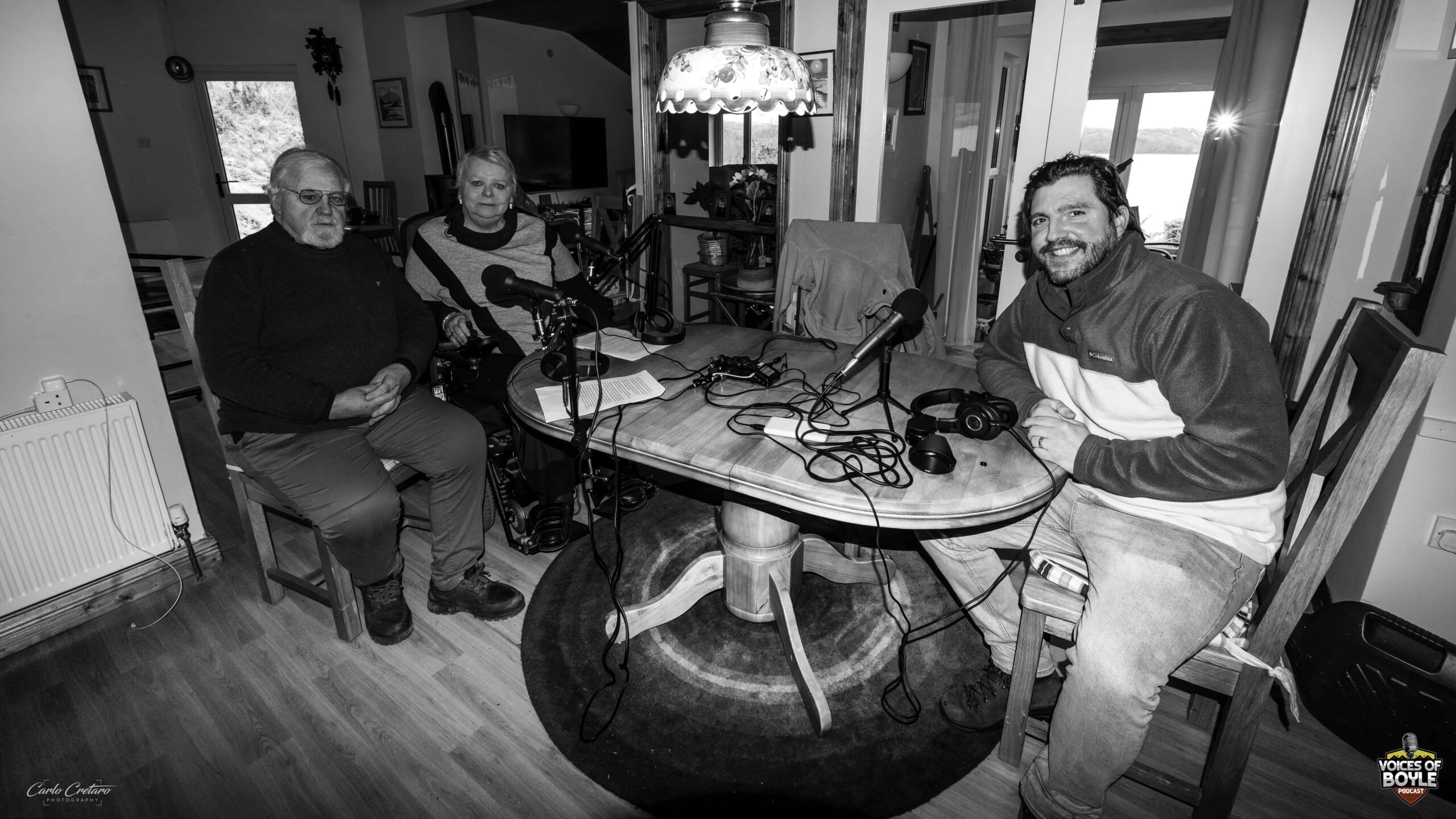
Thanks to Brendan O’ Dowd for creating and recording the musical piece for the podcast.
BE A GUEST ON THE SHOW!
If you’ve a story about Boyle, we’d love to hear it. You don’t need to have done anything remarkable, and you don’t need to prepare a thing. We sit down, have a chat, and you talk about whatever you want to. It usually takes about an hour.
Thinking of someone else? A parent, a grandparent, a neighbour who remembers how it used to be? Tell us about them. Some of our best episodes started because a son or daughter got in touch. You can find us at info@voicesofboyle.com.