Episode 90
Dolores Sheerin – You Leave With A Tale To Tell
HOSTS & GUESTS
Florence Cretaro
Carlo Cretaro
Dolores Sheerin
RESOURCES
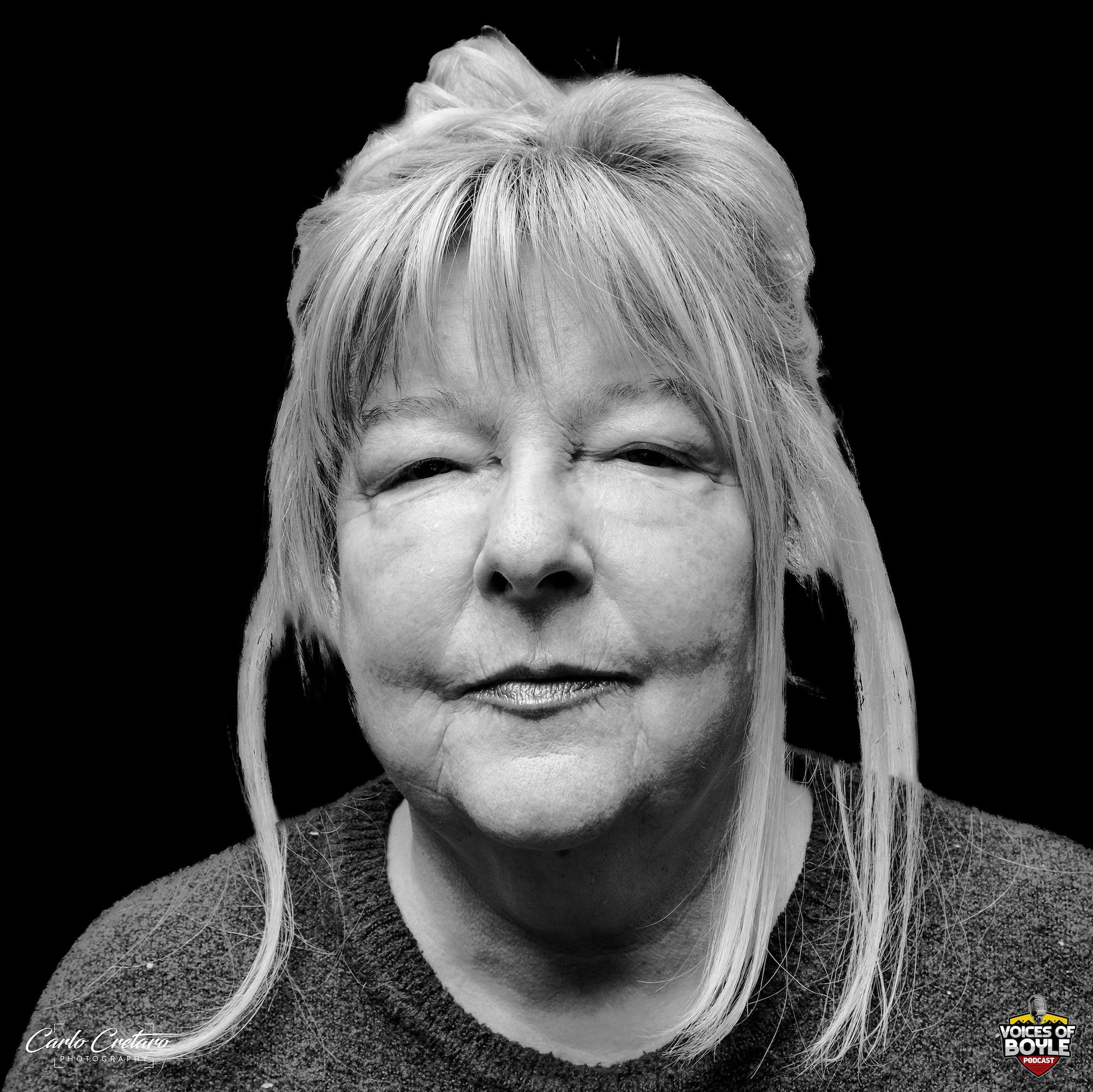
Welcome to Episode 90 of the Voices Of Boyle Podcast!
Dolores Sheerin grew up in Termon in Boyle, raised by her grandparents in a community where nobody knocked before walking in and the neighbours came without being asked. She has lived a lot of life since then: a telephone exchange in Galway with 150 women and the crack was mighty, a bomb threat during the Troubles, a papal blessing from a helicopter roof, a trip to Bosnia with 26 suitcases of aid, a poem that turned out to be a song. She joined Carlo and Florence on the Voices of Boyle and gave them everything.
The Telephone Exchange in Galway
Dolores sat her Leaving Certificate in 1975 at a time when failing maths meant the whole result counted for nothing. She applied for the civil service, trained as a telephonist, and after postings in Mullingar, Gort and Clifden, settled in Galway. It was a culture shock. The city felt enormous. But she loved it.
There were 150 women working in the Galway telephone exchange. The work required precision and calm. When someone called in an emergency, you had to stay steady, keep them talking, and be making the connection at the same time. When callers were rude or contrary, they sometimes found themselves put through to the AI, the Agricultural Institute, instead of their doctor.
In 1979, the Pope’s visit to Ireland sent Benny out to Ballybrit to help with the technical preparations. Dolores was told she was needed in the exchange. A supervisor rang during the day and told seven of them to climb out onto the roof. The papal helicopter would be passing over.
“We looked over and here it was,” Dolores said. “And it came right over us. He was looking out the window and he blessed us. And of course, all of us were crying our eyes out. But we didn’t know why we were crying. It was just the emotion of it.”
Benny, out at Ballybrit with the crowds, could barely see a dot. The seven women on the roof had him in the window looking straight at them.
“He was looking out the window and he smiled and he blessed us. We were all crying. We didn’t know why. It was just the emotion of it.”
The Day It All Went Silent
After Galway, Dolores spent nine months at the Carrick-on-Shannon telephone exchange, arriving just before it was due to go automatic. She was there on the last day. When the switch was flipped and the calls no longer needed to be connected by hand, the women sat at their switchboards and cried.
“End of an era,” she said. “And end of friendships, really. You say you keep in touch, but it doesn’t always happen.”
She and Benny moved back to Boyle. Bought a house in Low Parks. Had three sons, Brendan, Colm and Ciaran, who she describes as vastly outnumbering her until she introduced them to the Hoover and explained to Benny that the washing machine was not a television, even if it moved.
The Moylurg Writers and a Poem That Was Actually a Song
Dolores had always been a reader. She had never thought of herself as a writer. Then Veronica O’Connor, a founder member of the Moylurg Writers Group in Boyle, invited her along one Tuesday night in the back room of Una Bhán. She went to say she would try it.
“I thought I was in heaven,” she said. “I could not believe that I could write bits and pieces. Prose and poetry. I used to leave the group at night excited about the next meeting.”
The group met weekly, critiqued each other’s work constructively, and ran writing workshops where something as simple as a bottle on a table could produce eight completely different responses. One piece she brought to a session was examined by the celebrated Galway poet Rita Ann Higgins, who had come to give a workshop. Rita Ann told her plainly: that is not a poem. That is a song.
The piece went to her brother-in-law John Costello, then to his friend Charlie McGettigan, who tweaked two words with Dolores’s approval. The song, called Be Free My Inner Child, was set to music and recorded by a tenor from Kilkenny.
“I got it on CD,” she said simply.
The Characters of the Green
Dolores’s memories of old Boyle are drawn with the eye of a writer who learned to see things young. Walking up the Green after school to visit her aunt, she passed Rosie and Vera Cox’s little confectionery shop where the white penny mice sat in the window and Rosie, in her long skirt and button boots with her hair up, would give you extra if she liked you. She passed Egan’s Bakery, where the bread came out wrapped in gold tissue paper, and where it was not possible to walk home without taking a swipe out of the warm loaf.
She remembers Mr. Moran, a tall man who owned the Princess Hotel on the Green, now the Credit Union. He came to houses in Termon with parcels wrapped in brown paper and twine, quiet deliveries of provisions to people who needed them, with money too. He housed down-and-outs in the hotel for nothing and wanted no recognition for any of it.
“It teaches you not to pass a homeless person on the street,” Dolores said. “I just think, that could be me. Keep your head close to the ground and you won’t have far to fall. That is if you look down on anyone.”
And then there was Tommy Egan, who had a wooden leg, and who was standing outside the bakery one morning when the two of them looked up the Green at the same time to see a man they both knew coming down, wearing a wig that had never been fitted right, with a woman on his arm that neither of them had ever seen before. Tommy said: she was a mail order bride. He got her the same place as he got the wig.
“You couldn’t write that one,” Dolores said.
“The town was full of characters. Absolutely full of them.”
Bosnia 1994: 26 Suitcases of Aid
In 1994 Dolores travelled to Bosnia and Medjugorje with a prayer group from Boyle led by Irene Montgomery. The group gathered 26 suitcases of aid through local generosity. Dan and Olive Kennedy supplied all the baby items. Paddy Ryan the pharmacist filled a full suitcase with medical supplies. At Dublin Airport, a girl on the desk listened to what they were doing and let them through.
They flew to Montenegro, were left outside the airport in the dark with security guards and dogs and guns, and eventually found their way to a minibus whose driver decided to nod off on mountain roads above steep drops. A forceful poke to the ribs was administered whenever necessary.
The visit to the bombed-out hospital in Mostar required getting on the floor of the taxi as gunfire sounded nearby. Three doctors met them, were told there was medicine and a thousand pounds for a baby incubator, and cried. Then they brought the group underground to the kitchen for coffee so strong you could trot a mouse on it and cakes whose sugar nearly made your teeth hop.
A soldier leaving for the front from the farmhouse where they were staying stood in the kitchen in full uniform while his mother wept. Dolores shook his hand and promised all the group’s prayers. She found out years later through a contact that he came back safely.
One night Irene announced they were going out. Dolores assumed it was a shop. It was a bar, full of Croatian soldiers. The Irish took out their instruments and started playing. By the end of the night the soldiers knew how to say what’s the craic. They all had to walk home through dark fields with flashlights.
The Birds Fell Silent
Medjugorje in 1994 was still largely undeveloped, a farming community with families who rented rooms to pilgrims. Dolores visited four times in total. On one visit a guide told the group that during any apparition of Our Lady, the birds always fall completely silent and begin to sing again the moment it ends. Standing outside a tent that morning, Dolores heard exactly that happen.
She touched a statue of Our Lady in the tent afterwards and was told by the man beside her that he had been sitting there when the apparition occurred and that Our Lady had come through that very statue. She had not known that when she put her hand into the statue’s hand.
“You’d be going, why am I crying?” she said. “And Irene would say, Our Lady’s taking care of that. It was the most amazing experience ever.”
The Poem
The episode ends with Dolores reading the poem she wrote for the Moylurg writers, called simply Boyle. It describes the Curlew Mountains and the lakes, the abbey against the sky, the forest park, the fishing and the cycling. It ends with an invitation: please do come and visit, you will be treated well, the locals are all friendly, you leave with a tale to tell.
She has lived that poem. She has left a tale to tell.
Key Timestamps
00:00 — Welcome from Florence and Carlo
00:25 — Growing up in Termon with grandparents, aunts and cousins
00:50 — Leaving Cert in 1975, failing maths, applying for the civil service
01:15 — Training as a telephonist, Mullingar then Galway
01:39 — The culture shock of Galway city
01:55 — Meeting Benny in the post office, him downstairs, her upstairs
02:29 — 150 women in the exchange, the crack was mighty
02:29 — Answering a bomb threat during the Troubles
03:10 — Redirecting difficult callers to the AI
03:38 — Benny sent to Ballybrit for the Pope’s visit preparations
04:35 — Seven women on the roof of the Galway telephone exchange
04:43 — Pope John Paul II looks from the helicopter and blesses them
05:14 — Everyone comes back in shaking and crying
06:03 — The telephonist role: emergencies, lonely callers, keeping calm
07:27 — Was it possible to listen in on calls?
07:48 — Free phone calls: the bookshees
08:08 — Supervisors listening in, strict postmasters
08:52 — Nine months in Carrick-on-Shannon before it went automatic
09:07 — The day the exchange went automatic: sitting at the boards and crying
09:40 — Moving back to Boyle, Low Parks, three sons vastly outnumbering her
10:47 — Faith and spirituality, the influence of her grandmother
11:00 — St. Martin, Murray’s Carnival and the grandfather who nearly left the chair
12:35 — Her grandmother’s values: treat everyone well, pay your debts
13:13 — Losing her grandmother at eleven
13:31 — The Moylurg Writers Group: Veronica O’Connor’s invitation
14:21 — Discovering she could write
15:08 — How inspiration finds her: characters, conversations, corners of the town
16:01 — Rita Ann Higgins tells her the poem is actually a song
19:00 — Be Free My Inner Child recorded by a Kilkenny tenor via Charlie McGettigan
20:45 — Rosie and Vera Cox’s shop on the Green, the penny mice, the aniseed balls
22:17 — Egan’s Bakery and the bread wrapped in gold tissue paper
23:24 — The Slated Halls on the Green, near tenements
24:25 — Tommy Egan, the wooden leg, and the man with the wig and the woman on his arm
27:02 — The outline of houses where Dolores’s great grandparents lived
27:24 — The pump on the Green as the original water cooler
27:43 — Memory Lane: the Moylurg writers piece on Boyle
28:12 — Termon as a community: looking out for each other, playing out until ten
29:07 — Pitch and toss at the back of the cinema
30:12 — The togetherness of the town then
30:30 — DJ Brendan O’Dowd at the Pavilion, white lights and white T-shirts
31:18 — When the big flag came to Boyle in the 1960s, the GAA teams billeted in Termon
32:38 — Mr. Moran of the Princess Hotel: parcels of provisions, feeding and housing the down and outs
35:43 — Passing on memories to the grandchildren
37:18 — Bosnia 1994: the prayer group, 26 suitcases of aid
39:00 — The generosity of Boyle people: Dan and Olive Kennedy, Paddy Ryan
40:14 — Dublin Airport: 26 suitcases and the girl on the desk who let them through
41:07 — Landing in Montenegro, left outside the airport with dogs and guns
41:55 — The checkpoint: passports taken, held for two hours, soldiers laughing outside
42:26 — The driver who fell asleep on the mountain roads
42:58 — Arriving in Medjugorje in the middle of the night, staying in farmhouses
43:38 — Getting on the floor of the taxi as they drove to Mostar
44:00 — The hospital in Mostar: shell marks on the walls, three doctors crying
44:58 — Underground in the kitchen: coffee you could trot a mouse on
45:48 — A soldier going to war from the farmhouse, his mother crying
46:17 — The night in the bar: Croatian soldiers taught to say what’s the craic
47:00 — The displaced persons in the railway carriages
47:50 — The orphanage
48:51 — The grandmother of visionary Vishka, the decade of the rosary in Croatian
50:17 — The apparition: the birds stop singing, then go bananas when it ends
52:15 — Touching the statue of Our Lady after the apparition
53:56 — Good versus evil: Medjugorje and Mostar side by side
56:17 — Coming home changed
57:26 — Ukraine, Gaza, the affinity with people at war
58:06 — Going back to education as an adult: FETAC Level 5 in childcare, caring for the elderly, business studies and maths
59:38 — Working for agencies caring for the elderly in their homes
59:57 — The elderly as living history
01:00:51 — Why Voices of Boyle matters
01:01:04 — The poem: Boyle
Guest Bio
Dolores Sheerin grew up in Termon in Boyle, raised by her grandparents. She trained as a telephonist in the late 1970s and worked in the telephone exchanges in Galway and Carrick-on-Shannon before returning to Boyle with her husband Benny. She was a member of the Moylurg Writers Group and her work, including a piece called Memory Lane and a poem called Boyle, appeared in the Moylurg writers’ publication Writers of the Plain in 1999. A lyric she wrote called Be Free My Inner Child was set to music by John Costello and Charlie McGettigan and recorded by a Kilkenny tenor. In 1994 she travelled to Bosnia and Medjugorje with a prayer group from Boyle, carrying 26 suitcases of aid. As an adult she returned to education and completed FETAC Level 5 qualifications in childcare, caring for the elderly and business studies. She has three sons, three daughters-in-law and grandchildren, and lives in Low Parks in Boyle.
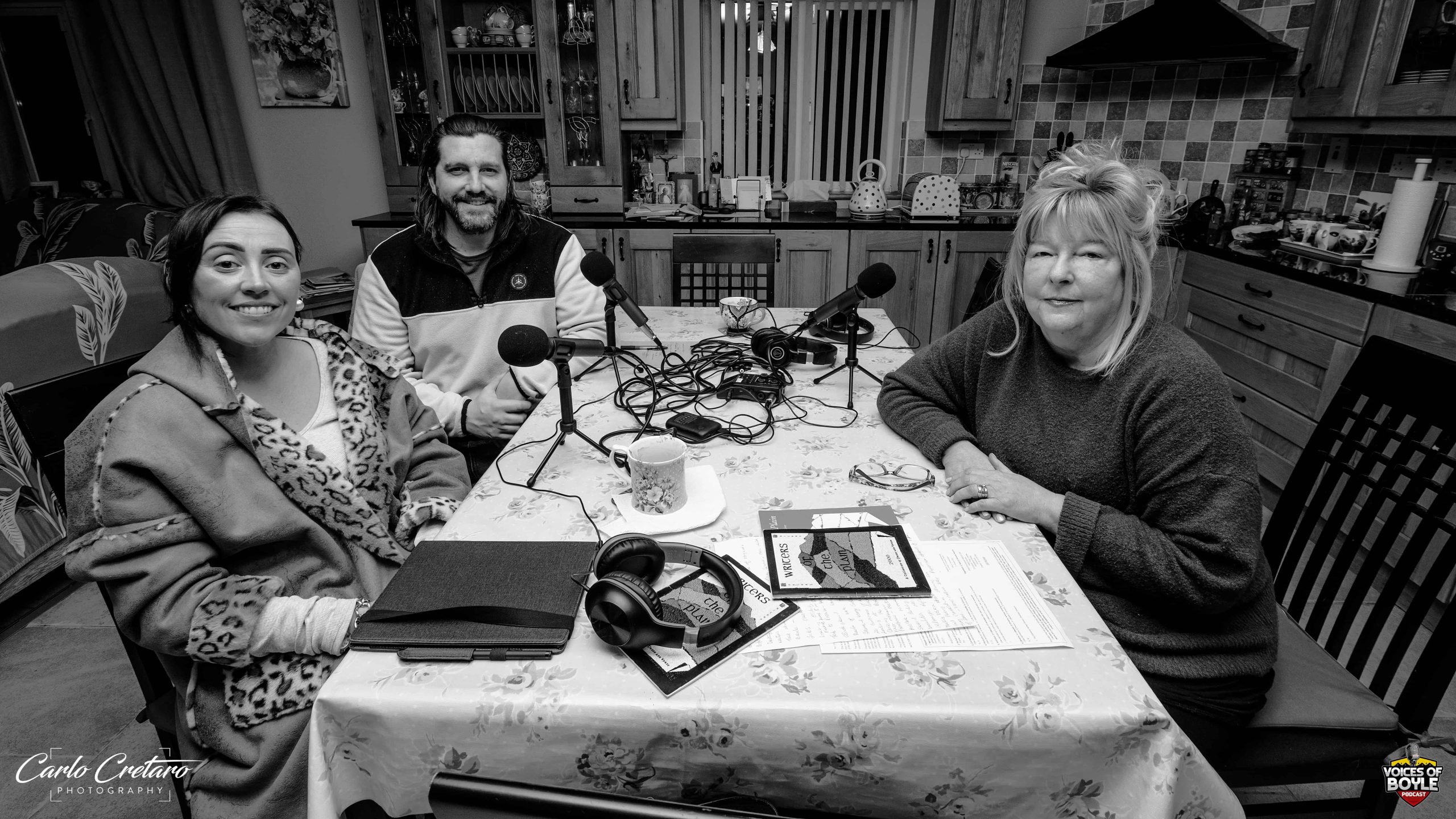
Thanks to Brendan O’ Dowd for creating and recording the musical piece for the podcast.
BE A GUEST ON THE SHOW!
If you’ve a story about Boyle, we’d love to hear it. You don’t need to have done anything remarkable, and you don’t need to prepare a thing. We sit down, have a chat, and you talk about whatever you want to. It usually takes about an hour.
Thinking of someone else? A parent, a grandparent, a neighbour who remembers how it used to be? Tell us about them. Some of our best episodes started because a son or daughter got in touch. You can find us at [email protected].