Episode 60
Eamon Perry – Reflections On Boyle
HOSTS & GUESTS
Carlo Cretaro
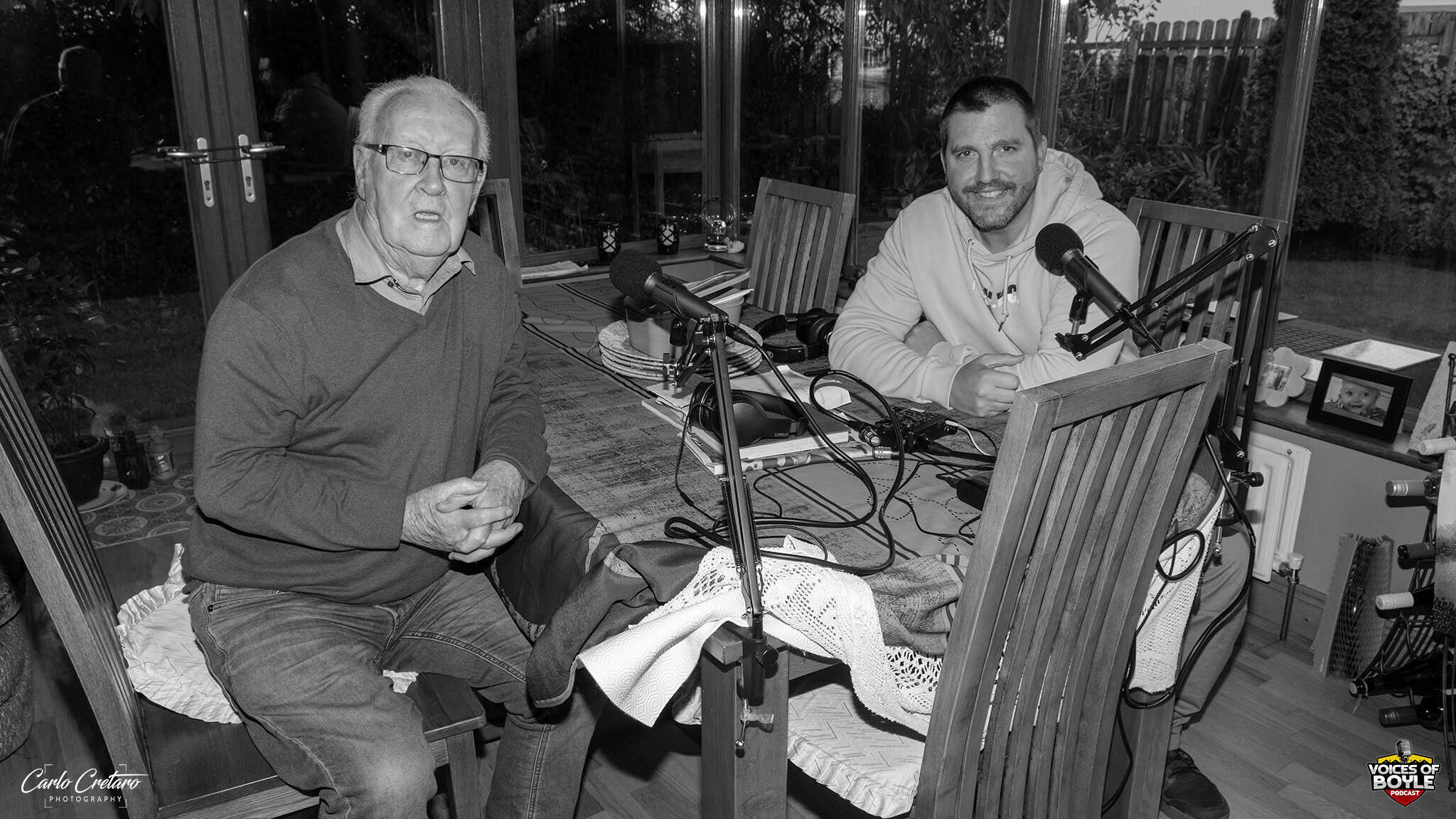
Eamon Perry
RESOURCES
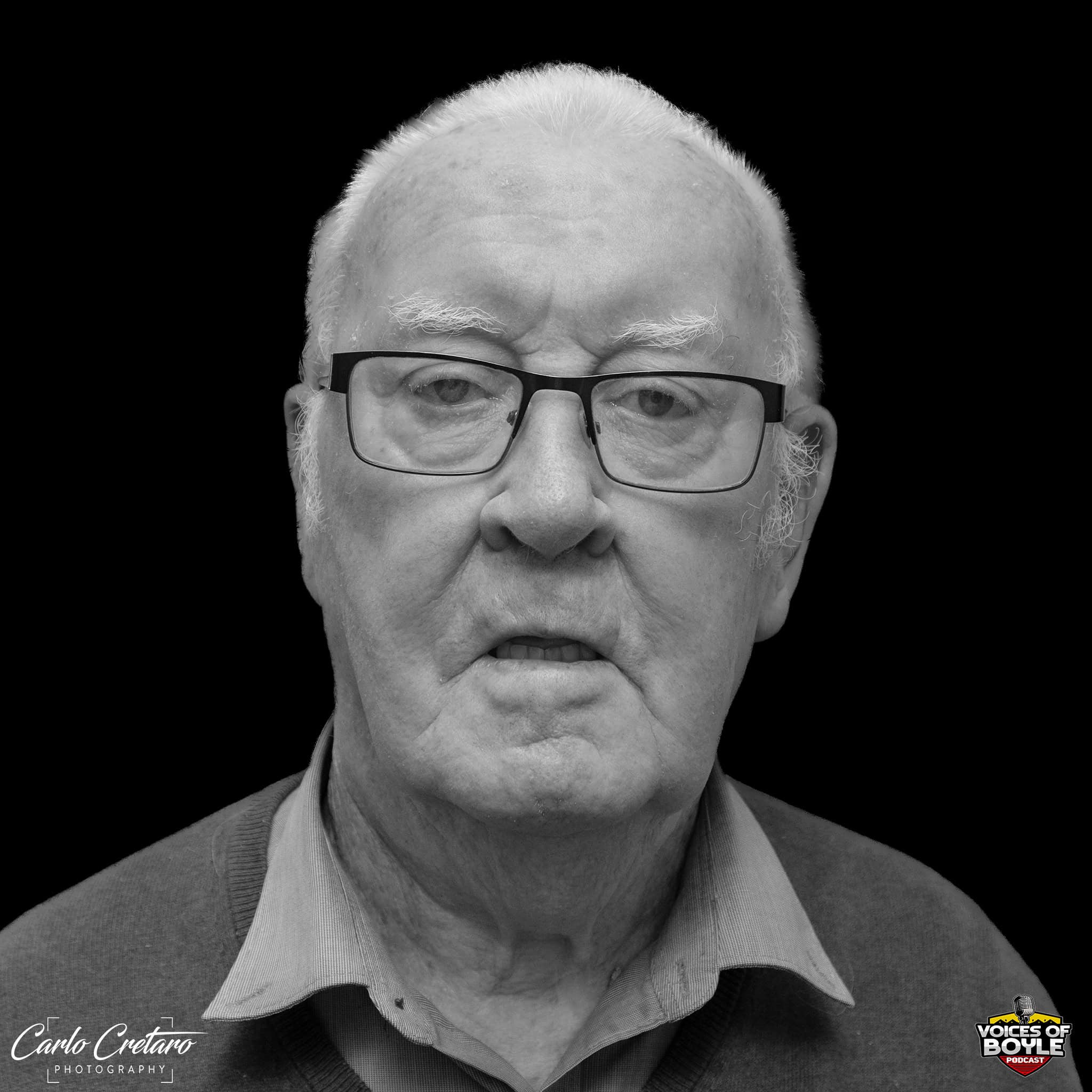
Eamon Perry’s father worked in the post office, and the snow of 1947 came down while he was on nights. When he got home in the morning the front of the house was gone under it, so he went round the back and let himself in that way. Then he opened the hall door from the inside.
“There was nothing there, only snow. There was even the impression of the knocker on the door in the snow.”
That is the memory Eamon goes to first when Carlo asks him about growing up in Boyle, and it is a fair indication of the kind of recall he brings to the whole hour. Snowballs and sliding on the road for weeks, because the frost held that long. The men of the houses gathering at McDonough’s Corner with shovels to dig a trench, so that coffins could be brought up for burial in Assylin. No train into Boyle station for weeks on end.
Johnny Gormley the postman went missing in it, and the version Eamon has is not much of a disappearance. He got as far as somewhere up near where the Four P’s is, badly in need of a bed, was given one, and stayed put until he could get home. Everyone at home assumed the worst, because there were no phones out those roads and nothing at all passing on them.
Number 13, and then number 23
The family started at number 13 Termon, in a house with two bedrooms. After about seven years they moved up to number 23, and the reason is the sort of thing that only survives in a first hand account. The Pollards had been in 23 before them and had divided the bigger of the two bedrooms in two, which made it a three bedroom house. Carlo calls it an upgrade. Eamon agrees that it was.
It was a good place to be a child, and the reason was arithmetic. There were families of five, six and seven in Termon, and one that he thinks had twenty, though he apologises immediately in case he has that wrong. Football was played on the street and there was a hierarchy in it that nobody had to explain. The big fellows, who were all of eleven or twelve, had no bother filling their own team, and a six year old could not get near it. Then you turned ten and it was your game.
The river worked the same way. In summer it was a magnet, and the small lads went down to Saint Patrick’s Well. The ambition was to get up as far as Assylin, where the water was deeper and the older ones were. The famine graveyard at Plunkett Avenue was the one place nobody went. You could still make out the individual plots in the grass, and Eamon says you would not dream of playing in it.
Never come into town
Three years in the convent, then across to Saint Joseph’s, which stood where John Joe Carty’s garage is now. Three teachers, one of them Frankie Tarpey’s father, who had started out in a country school and been brought into town because the parish priest had a vacancy and would not take no for an answer.
He never made peace with it. For the rest of his life, any time he met Eamon, he gave him the same piece of advice.
“Never come into town.”
Eamon took it. He spent 43 years in a country school and never taught a day in Boyle.
The shops get their due as well. Christie’s, McDonald’s the toy shop on the corner, and Mary Horan near the boys’ school, who did slab toffee and sweets and who Eamon says twice they supported. And Ambrose Keenan, who was always the first man in town to have ice cream in the summer. That sounds minor until you hear the reason it was an achievement. There was some ongoing problem with the electricity in Boyle and hardly anybody had a fridge or a freezer, so whoever cracked ice cream first had the whole summer to himself.
The other thing his father brought home, some time around 1946 or 1947, was an orange. The first one any of them had ever seen. Nothing was crossing the Atlantic during the war years, so there were none in the country.
On the microphone at the Fleadh
By the Fleadh of 1960 he was about nineteen, and he got a job going round the town in a car announcing where the various competitions were being held. There was one difficulty. He could not drive, because there was no car at home to learn in. So Liam McDermott drove and Eamon worked the microphone, and the hard part of the job was getting the car through the crowd at all.
He rates 1960 over 1966. He thinks 1966 was the bigger of the two, with more people about, but the atmosphere in 1960 was the better. Every premises in town that could be turned into a shop was turned into one. Sandwiches were made in every house and an awful lot of them were thrown out afterwards.
There was a fair day every month too, which meant a day off school, so the details he remembers are a schoolboy’s rather than a dealer’s. It started up at the fair green, and any beast that did not sell up there was walked down through the town for a second chance. On a big fair day there were always a few loads of cattle going out of Boyle station.
Three All-Ireland finals in the one day
Asked about the important figures of his childhood, Eamon names his uncle, Paddy Perry, who the local historian Tony Conboy has called the most famous athlete ever to leave Boyle.
Carlo has the record written down and reads it out. A first All-Ireland junior softball singles and doubles title in 1929. Eight consecutive All-Ireland senior softball singles titles, 1930 to 1937, a run not equalled until Ducksy Walsh. Thirteen All-Ireland medals in total, and a stack of Dublin county championships, because he was a guard in the city.
And then the one that stops people. Three All-Ireland finals in the one day, in three different sports. Football first, then hurling, and handball in the evening, by which time he was limping. He looked for a postponement. His opponent was never going to give him a postponement.
“So we played on, and I beat him.”
Paddy died in 1983. His mother lived in Saint Joseph’s Terrace and came to end her days with Eamon’s family on Marion Road, and Eamon describes her in about eight words, a handful of a woman and only about that height.
Boyle was full of handballers then. Paddy Reid, who ended up a guard alongside Paddy Perry on the gate of the station in the Phoenix Park. Paddy Kennedy, with All-Ireland records of his own. The Cochrane brothers, who lived just below the ball alley, one of whom went to England and never came home without calling in to the Perry house. Jim Clark, into whose pub Paddy went for a pint whenever he came down from Dublin. They all cut their teeth in John Casey’s alley on Patrick Street.
“Boyle was a real handball centre.”
There is no handball being played in the town at all now.
A swimming club at the wooden bridge
Eamon’s own sport arrived because three men in Boyle decided it should. Cecil Tiernan, Roger Malarkey and Brendan Coleman more or less set up a swimming club, brought two trainers down to the wooden bridge, and a few local lads got in and picked up whatever they could.
That was enough. From then on it was a gala nearly every Sunday of the summer, and the geography of it tells you how the sport worked in the west of Ireland at the time. Castlerea had a pool. Sligo had a pool. Tuam had a river. Galway had the sea.
In 1954 he won a scholarship to Summerhill College, and he is entirely upfront about how he chose it.
“I went to Summerhill College principally because I knew they had a swimming pool.”
He was there five years. The pool was closed for the real winter because the school would not heat it, which he says you would tolerate in September or October and would not fancy at all once November came. He came out with six Connacht medals, four of them at under 14 and under 16, and one he is still pleased about: the men’s 50 metres freestyle in Ballina.
It ended in 1959. He sat the Leaving Cert, got his call to the teacher training college in Dublin, and lived in, with nowhere to swim and no bicycle and no car to get anywhere. He liked the two years all the same. After five years in a school where fifty boys slept in one dormitory, being treated as an adult and fed properly came as a considerable improvement.
Forty three years in the one chair
He came home at the end of the course into a small piece of luck. There was a vacancy in Saint Joseph’s, Michael Carty came in from Grange to fill it, and that left Grange open. Eamon stepped into it and was employed from the first of July.
“I didn’t know that I was going to stay there for 43 years.”
One school. One chair. Two teachers the entire time, himself and a lady. The building he calls unsuitable, and he is not exaggerating: two rooms, one of them very small, until eventually they got a job done and better accommodation out of it. They were heated by stoves, and the way the stoves were kept going is the part of this that should be written down somewhere.
Every September the local families arrived at the school with a load of turf. They threw it in, and it kept the place going through the winter. Eamon calls those people fabulous and says they would support anything to do with the school, and the turf is how he proves it.
Numbers got up into the mid fifties. They also once fell to 22, which put the second teaching post in danger. What saved it was a guard called Eugene Craig, who had been given the job of standing outside the dole office when he came out of training, and who came home to a farm his father had left, bringing five children with him. The average went to 27 overnight and never dropped below it again while Eamon was there.
Was he bored? He is honest about it. There was always a certain amount of boredom involved, and there was always something happening as well.
The standout was the school’s centenary. A mass, a big day out in the school yard, and a book on the hundred years of the school with the names off the early roll books in it. He thought he had sold every copy. Then people started coming home to Boyle and calling into the school. Master, you wouldn’t have one of those books left, would you? He is down to two.
Summers on the buildings in England
A teacher’s salary and a growing family did not meet, so when the children got expensive he went to England for the summers, eight or nine years in a row. The arithmetic was six weeks of work and a week left over for himself, and sometimes Tish would come over to meet him and sometimes he came home and they went off somewhere.
He had good contacts, which he explains in a way that tells you exactly what those sites were like. They fitted him up with a job, kept an eye on him, and made sure nobody put too much pressure on the man who had arrived with soft hands off a classroom and would have his palms in bits after two hours down a ditch.
It was not all digging. Assisting carpenters, fetching boards, being a gofer. One year he was working on a large prison going up south of London, and a man brought him over to the perimeter wall and told him to run his hand along it. Pure shiny. Nobody would ever get a grip on that. Eamon has wondered ever since whether anybody ever got out of it.
He stayed with Tish’s sister Maureen, near the end of the Piccadilly line, and got up at half five to go through two or three tubes to reach whatever site he was on. Her children called him the master.
A bazaar, and a suit that went missing
He met Tish at a bazaar, which he then has to explain to Carlo, who was not born yet, patiently, as a man who taught for 43 years would. A hall, tickets, raffles, that sort of thing. He knew her before that, well enough to stop her downtown when she was doing her Leaving Cert and ask how it was going, so he suspects he had an eye on her already.
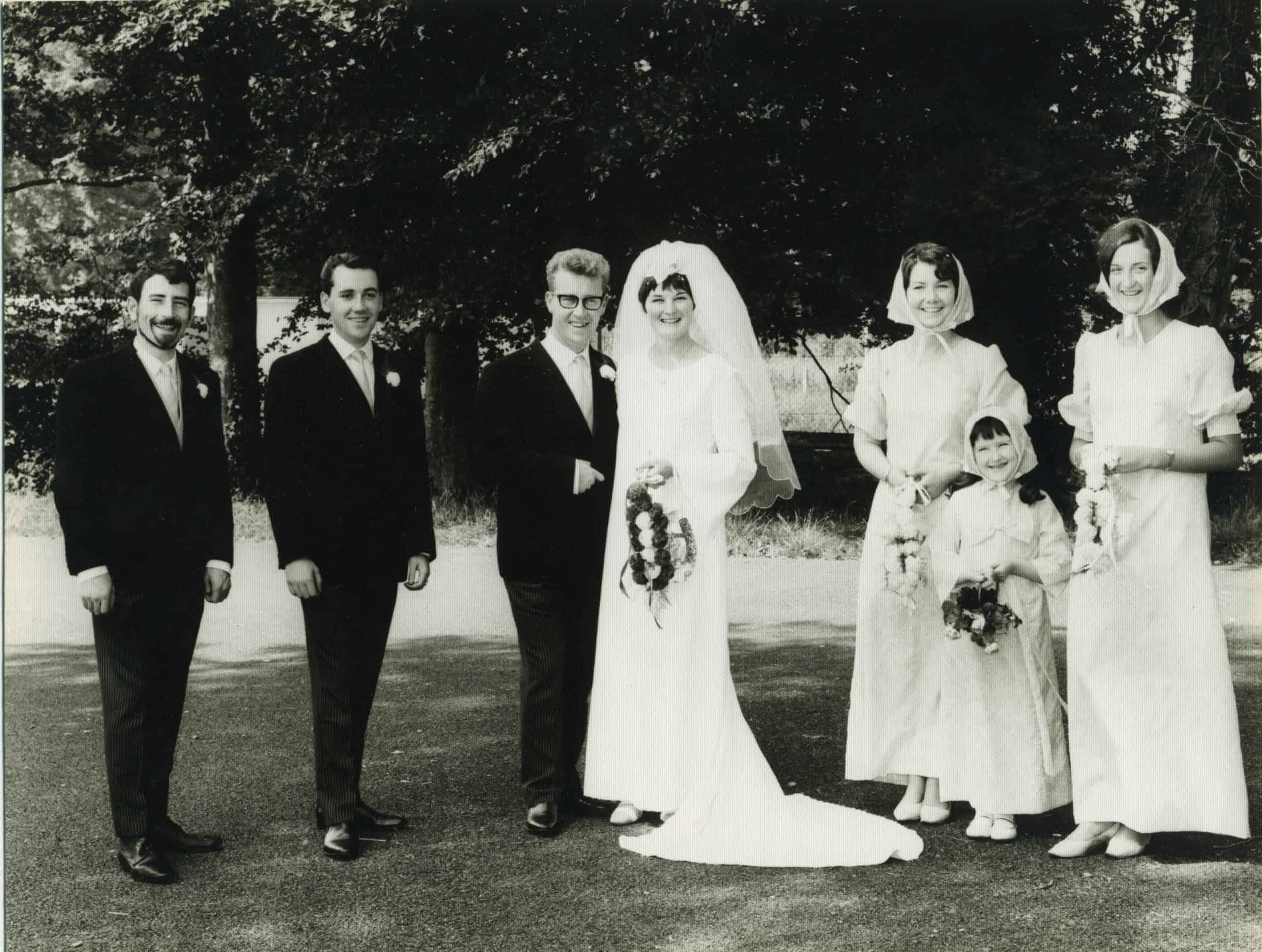
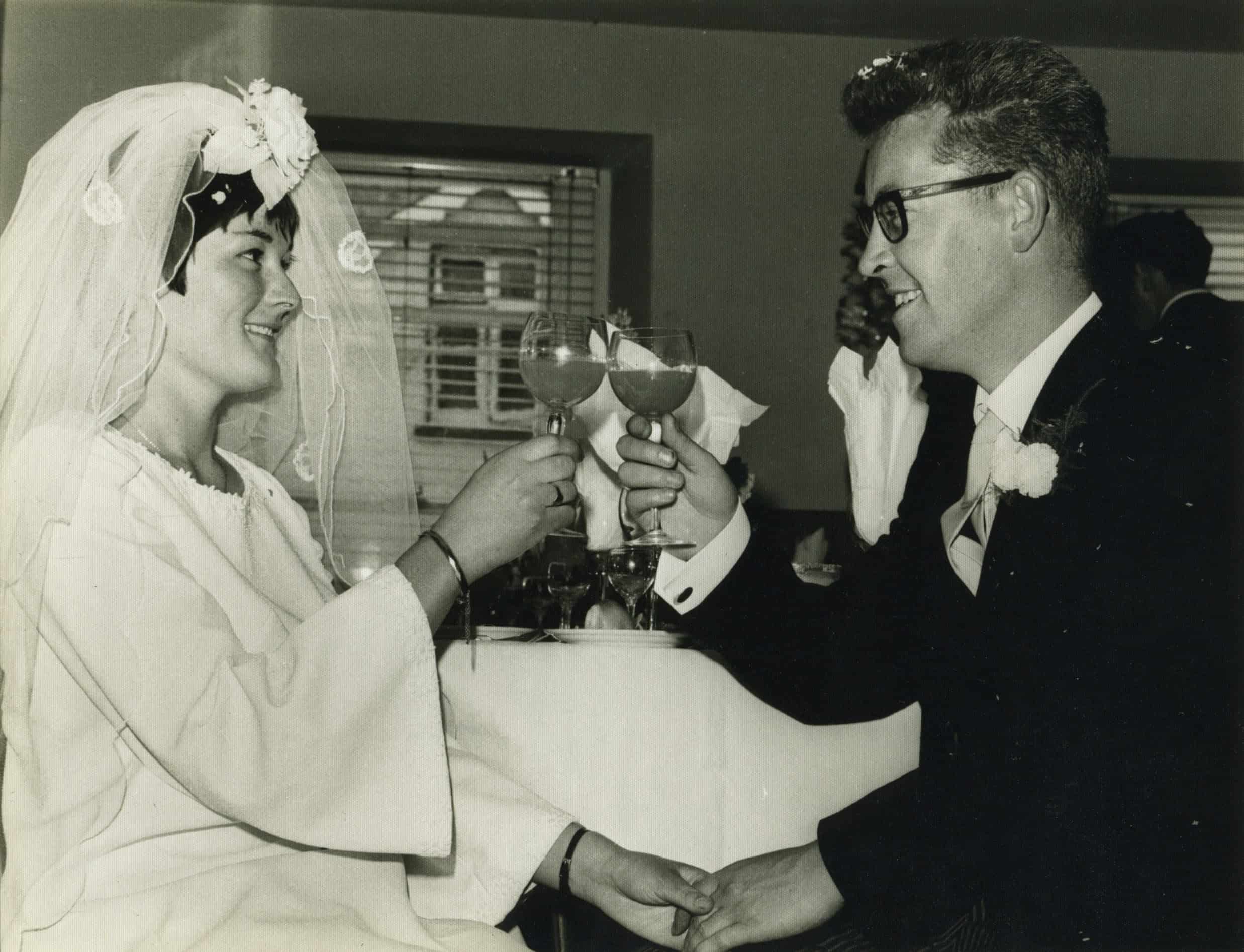
They married in 1968 and had the reception in the Royal, over a hundred people. A wedding at eleven in the morning, dinner at one, dancing after that, and away at six in the evening, which is where it went wrong. He had left his going away suit down at the hotel that morning, and when he went to change into it, it was not there.
He worked through his mates first and cleared them. Then he went to reception and said he wanted to be put through to the guards, because his suit had been stolen out of the hotel. Ten minutes later the assistant manager, a Miss Cottle, arrived in off her day off, asked what was going on, and told him she had moved it out of the room that morning because she assumed somebody had left it behind them.
The photographer was John Keeney from Carrick, and Eamon got him the way he got most things in those years. They met at the swimming galas every Sunday.
Nine holes, and a handicap of 8
He joined Boyle Golf Club in 1964, when the course was nine holes and sat on the ground where this interview is being recorded. Six par threes and three par fours, tight enough that you could lose a lot of balls, and a first tee you needed a very good drive to get anywhere off.
He was captain and he was president. Tish was lady captain twice and president once, which surprises Carlo, who did not know you could hold either office more than once. Eamon’s explanation is that they were running out of people.
He got his handicap down to 8 and played in nearly every Connacht competition going, and he sums up his own game in a sentence. Never long off the tee, but very tidy after that. Colm Loftus was the man to beat in his day. There are young lads up there now off six and seven. On the current handicap system, where women are off 53 and men off 35, he has exactly one observation, which is that you could come back again.
He is less cheerful about the club than about anything else in the conversation. He reckons the membership was stronger in 1964 than it is now, and he puts a fair share of that on the weather, because the winters are wetter and the course gets softer every year. Then he adds that everyone was remarking last week on what great shape the course is in, which is the kind of thing a former president says without noticing he is doing it.
He remembers the greenkeepers. Billy Feeley, and Christy Slann, a farmer from up the mountain who kept the course for years with a fraction of the machinery they have now, when the mowers will do the whole thing in a couple of hours. Thursday was men’s night in the summer. Singles, so you were on your own, and everybody put up a prize when their turn came round. The prizes were worth nothing much and that was not the point of them.
The Catholic club and two snooker tables
Asked what has kept Boyle itself, Eamon goes at the question from the other side and names the thing he thinks was lost. The Catholic club, the men’s club, now the Family Resource Centre, and the two lovely snooker tables that were in it.
He would come in from school, get a bit of dinner off his mother, and be down there for four o’clock when it opened. Play until six. Home for his tea. Back down again. When he first started going, newly out of the short trousers, you kept your mouth shut and you stood still while the older men were over a shot, and he means Tom Wynne and men like him.
He has one story out of that room that has nothing to do with snooker at all. Four men playing cards around the stove. A fellow called Paddy Quinlan mad for a game and trying to get at a table. And one of the card players, without looking up, telling him to push the snooker table out of his way. He got under it and pushed until the sweat came out on his forehead. Those tables do not move.
The fishing competition, and the river
Asked what he would bring back from the past, he does not choose a tradition or a way of life. He chooses the fishing competition that was dropped last year, and it was not money that stopped it. There was not enough help. He says plainly that he was sad to see it happen.
It goes back a long way for him. When he was ten or twelve the All England club had the river staked off for their fisheries, Englishmen with two rods each, feeding the fish first with all sorts of maggots. The locals could not make head nor tail of it. What chance have you if you fire a load of maggots in and then expect the fish to come and take your little worm? It worked for them anyway. His own rod, bought when he gave up the golf, has never come out of its sheath.
Asked what he wants for Boyle in fifty years, he has a specific and unsentimental answer, and it is about the water. He can see the beginning of a move to open the main street up to the river, one premises with planning permission and another with the building ready to go, front to back, looking out over it.
“They didn’t turn their back on the river.”
That is Westport, which he holds up as the town that got it right. He thinks Boyle is closer than it was, now that there is a walk from the bridge down as far as the car park, and that the river is more a part of the town than it used to be.
Jerry McGlynn
Carlo raises Jerry McGlynn at the end because everybody does. Florence recorded Jerry’s own episode in January 2023, nobody knew he was ill, and he died that July. Listening back, both of them think there are things in that episode which suggest he knew.
Eamon knew him in London. They once shared a room at Maureen’s, Jerry in the bed and Eamon on the floor. Jerry had to be in early at a viscose factory and would haul Eamon up with him, thoroughly pleased with himself, asking who in Boyle would ever believe that Jerry McGlynn had his bed made at half five in the morning. They would go down to a little pub for two pints each and meet Tommy Egan and his wife, and Jerry would announce, again, that he was going to give up the drink.
He did give it up. Eamon reckons he had 33 years without it when he died. Carlo thinks it was closer to forty. Jerry’s own line, as Carlo remembers it, was that he had drunk enough of it in his time.
The last time Eamon saw him was in the hospice. He had been called down one night and Jerry was very weak, and what he said was this.
“I tell you, Eamon Perry, it’s very hard to die.”
One more thing
Carlo has thanked him and Eamon has said he hopes it works out as something nice, and then he remembers a piece he left out.
When he retired he took a job with Hibernia College, the teacher training college, going out to schools to assess student teachers on placement and make sure they were doing it right. He covered eleven counties at it and had it for a couple of years. Then he got prostate cancer, and that put a stop to that. He is over it, thank God.
That is the whole of how he tells it, in about four sentences, at the very end of an hour in which he has given away everything else. Then he asks Carlo whether he can make something decent out of it.
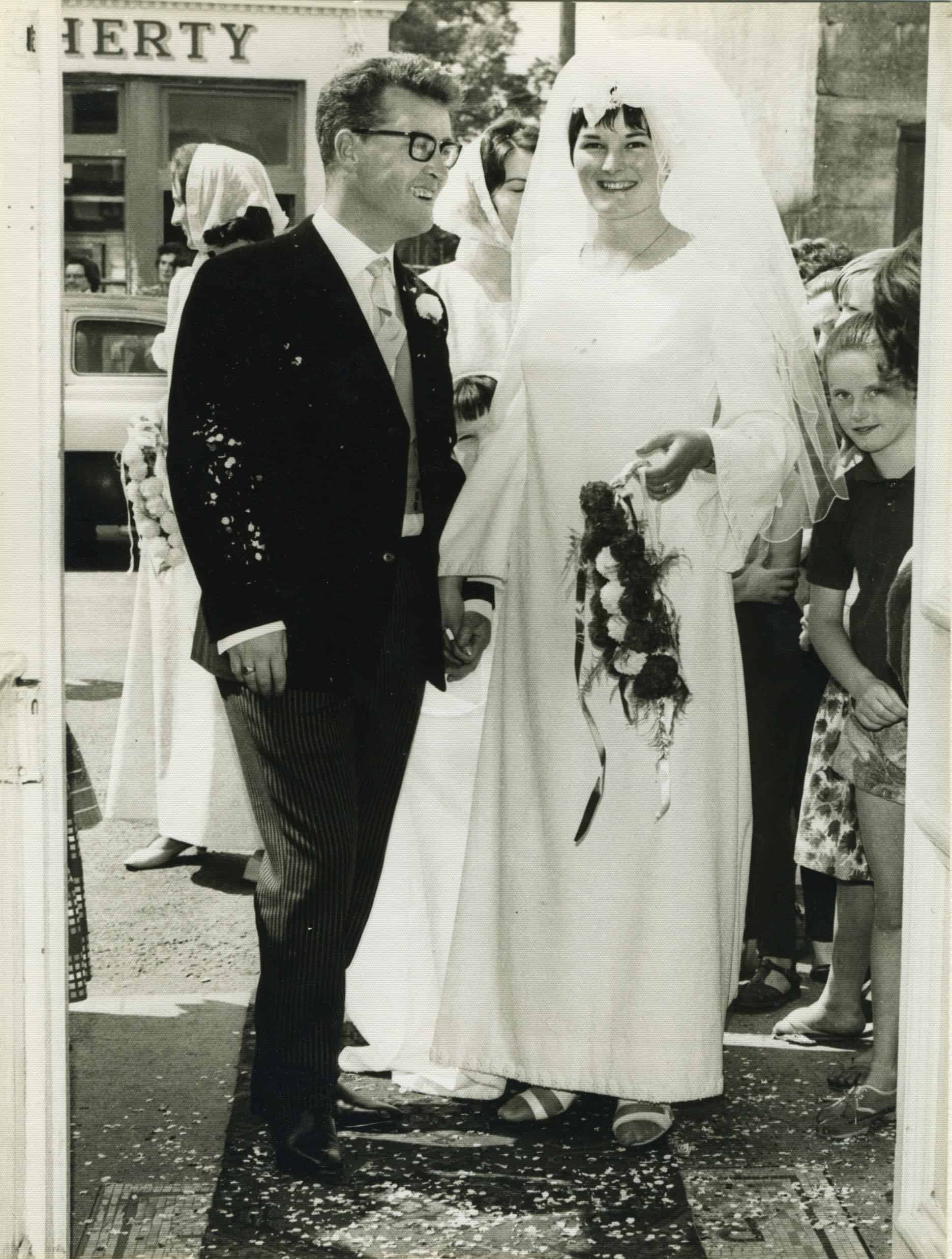
Eamon & Tish on their wedding day outside the front door of the old Royal Hotel.
Thanks to Brendan O’ Dowd for creating and recording the musical piece for the podcast.
BE A GUEST ON THE SHOW!
If you’ve a story about Boyle, we’d love to hear it. You don’t need to have done anything remarkable, and you don’t need to prepare a thing. We sit down, have a chat, and you talk about whatever you want to. It usually takes about an hour.
Thinking of someone else? A parent, a grandparent, a neighbour who remembers how it used to be? Tell us about them. Some of our best episodes started because a son or daughter got in touch. You can find us at info@voicesofboyle.com.