Episode 15
Gerard Tivnan – ‘Hill Of The Hare’
Hosts & Guests
Carlo Cretaro
Gerard Tivnan
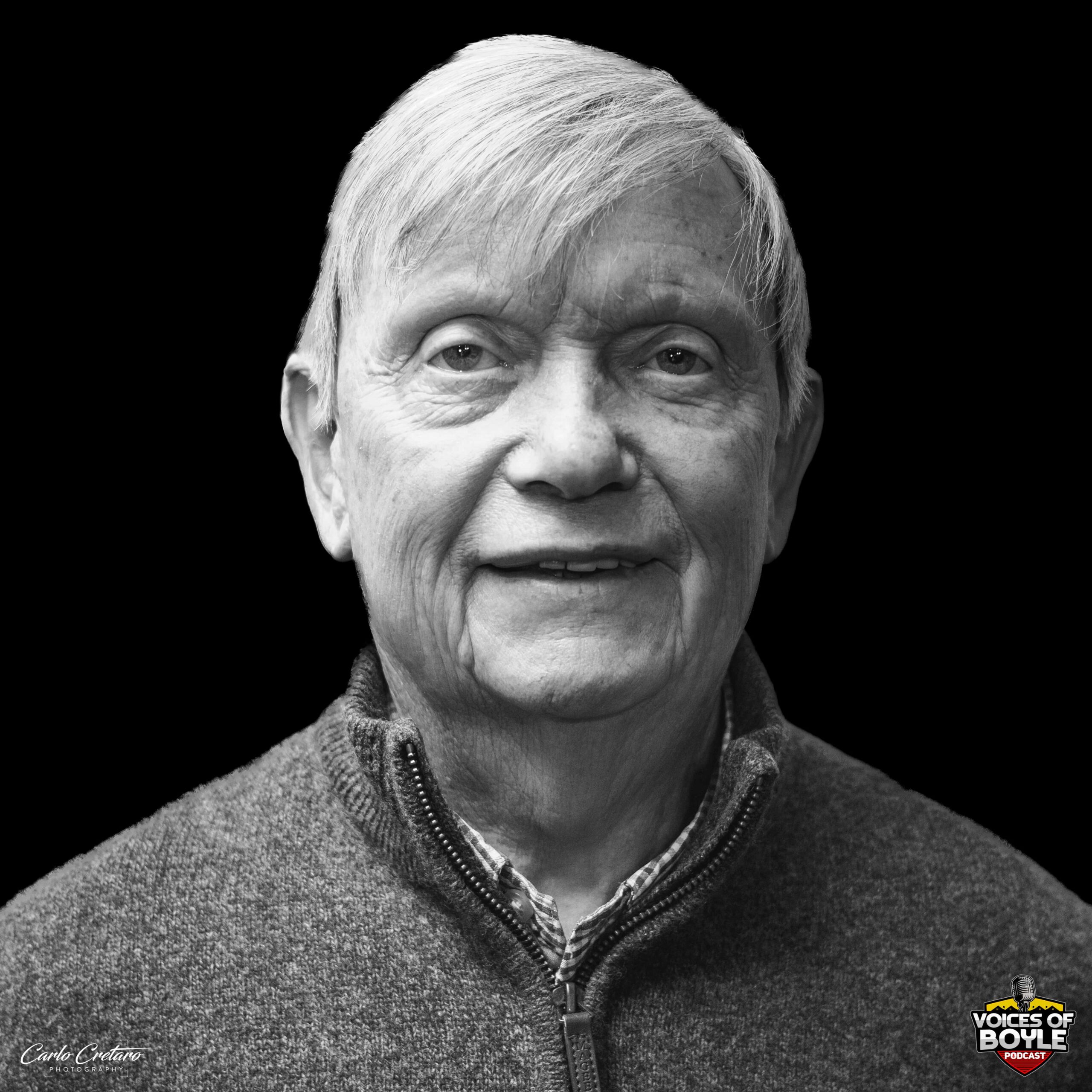
Once a month or so, on a Saturday, Gerard Tivnan and his two younger sisters walked into Boyle for confession. Their dog came with them, a brown dog they called the Sausage because he was the colour of a well done sausage. At Mockmoyne, where you could go up one set of steps, along in front of the houses and down another set further on, the dog went up as usual. Nobody paid him any heed.
He came down the far steps with a full soda cake in his mouth. Some woman had left it on the window to cool. There was nothing the children could do about it, so they made for the church at speed before she missed it.
Gerard tells Carlo the story in the house in Cornemilta where he was born on the 24th of January, 1953. The townland, as far as anyone can establish, means the Hill of the Hares.
“Through the fields, straight down our own land”
Gerard says he could have written Alice Taylor’s To School Through the Fields. His walk to Kilty Creighton National School went down his own land, through the bog, out onto the road. On the way there was a drain about three foot wide and three or four foot deep, and the children crossed it sideways on a plank four or five inches wide, at five and six years of age. They never fell in.
“We went to school through the fields, straight down our own land.”
It was a two room school of maybe 25 or 30 pupils. Boys and girls sat together in the one room, but in the yard they were split by a wall about seven feet high. “You wouldn’t see it in a prison,” Gerard says. His teachers were Miss Tiernan and then Miss McLaughlin, now Mrs. Pettit and, as far as he knows, living around Oranmore. Miss McLaughlin got a lift out with Miss Morris, who taught further up the road at Meenmore in a black Volkswagen. On snowy mornings the children stood at the school road hoping the hill would beat her. It very seldom did.
The bishop called to every national school before confirmation, and Gerard still can’t work out how, with schools dotted every mile and a half: Mooneens, Ardsalla, Tawnytaskin, Meenmore, Deer Park on the old Sligo Road. Father Geraghty, the Christian Doctrine Examiner, asked simple questions and handed out holy pictures.
An engine from the Herald works
His father farmed, but timber was his first love. He ran a sawmill in Cox’s Field, near the road up to Assylin Cemetery, close to where Candon’s had a creamery, through the late forties and fifties. Around 1959 he took the whole lot down and brought it up to Cornemilta, where Gerard’s brother Matthew is still in the timber business.
The engine that drove the saw was a single piston engine, built in England. It came out of the Roscommon Herald works in Jasper Tully’s time and is well over a hundred years old. It doesn’t run any more, but it’s there in Matthew’s shed to be seen.
“A great rambling house”
The Tivnan house was a rambling house. Neighbours came there rather than his father going out, three or four of them, a night or two a week. With no television and only an odd radio, they talked. Gerard remembers lying awake after stories of fairies and banshees, and of the picture that fell off the wall the night before somebody died. Of course, he says now, the twine was red rotten, and the stories were “fairly well embellished anyway for effect”.
One of the last ramblers was Michael Joe Kevill, who lost a leg in later years. For years and years, a couple of days before Christmas, he brought Gerard’s mother a half pound of tea from John McLoughlin’s shop, and the message was always the same: compliments of the season.
“Festooned with stuff that was for sale”
John McLoughlin’s on Patrick Street is gone now, but Gerard can see it. It was small and had absolutely everything, with more hanging off the ceiling than on the shelves: heads of brushes, heads of spades, kettles and teapots on S hooks, and cattle meal besides. If you hadn’t the money, you paid at the end of the week or the end of the month.
“The ceiling was festooned with stuff that was for sale.”
The Bilberry Farm
A couple of hundred yards up the road, in the house where the late Pádraig O’Gara lived and his wife Kathleen still lives, John Joe McGowan finished his days. He was born further up the Ballymote Road, close to the county mearing, on a small holding he called the Bilberry Farm. His brother Freddie, a character with an ass and cart, once told a guard who stopped him going the wrong way down Patrick Street that he was only going up as far as the town clock to turn.
When Freddie sold the farm to Tom McGuinn, he rounded up the last of the hens, and one flew up into a tree. Freddie told her she’d better come down or she’d be the only one left. John Joe was not pleased about the sale, and wrote a recitation about it maybe 75 or 80 years ago. Gerard recites The Bilberry Farm in full on the episode, from a copy his brother Frank kept safe.
A bicycle on the roof of the bus
If you cycled into Boyle and had a bottle of porter, you could put the bicycle on the roof, up a narrow ladder outside Daly’s, and the Ballymote Road bus would stop at your own gate. There were no bus stops.
The same bus brought day old chicks. You rang a hatchery from town, because there was no phone out in Cornemilta, and the chicks came in a cardboard box with holes in it, chirping like the devil. Order a dozen and you’d often get thirteen or fourteen.
“Not for me, they weren’t”
Gerard did five years at St Mary’s College, cycling the first year, then on the new free school transport. On the first evening they all sat into the bus they’d come in on until Anthony Martin put his head in the door and put them off it.
Canon Dodd taught him physics, or tried to, and once warned the class off drink with a recitation about a man in the gutter and a pig who didn’t care for the company. Des Kennedy taught agricultural science with sayings that stuck: lime and lime without manure makes both farm and farmer poor. There was a bit of corporal punishment, which Gerard says was no reflection on the teachers, but school was never the best years of his life. One of his closest friends right through, Michael Medlin, has since died. They kept meeting in Clarke’s.
Master farmers and field evenings
Agricultural college in Athenry was where he came alive. After a few weeks in the swine husbandry department at UCD’s Lyons Estate, which was not as grand as it sounded, he did the three year Farm Apprenticeship. In October 1972 or thereabouts he was placed with Billy Finnan in Kilross, between Tipperary town and Mitchelstown, a dairy farmer with 140 or 150 cows, paddocks and roadways. He stayed two years, and Billy was very good at passing on what he knew.
He joined the Mount Bruis club of Macra na Feirme for public speaking and drama. On summer Sundays each club held a field evening, with tractor backing and livestock judging until dark, then the Macra dance in the village hall.
“Not too bad, the job is half done”
Electricity came to the house when Gerard was nearly ten. Set beside the broadband rollout, he thinks rural electrification was a fantastic feat. Boyle had power before most towns, thanks to Stewart’s direct current. Gerry Cairns from up the Green wired every house around, two or three lights and a plug, and whenever you asked him how things were going, he told you the job was half done.
“Well, no, you can’t”
In 1979 Gerard came home and set up a pig breeding unit. For the first three or four years he had to drive into town to make a phone call, from the box outside Paddy Purcell’s, the one on the bridge, the post office, or the one up the Crescent beside the health centre. If the man he wanted was out and they offered to ring him back, he had to tell them they couldn’t.
Thirty two pubs and a stretcher
Back then, if you didn’t get to town on a Friday or Saturday night, you thought the world was ending. Gerard tells Seamus Flaherty’s way of remembering a lesson from Master Finan:
“You have 32 teeth in your head, there’s 32 counties in Ireland, and there’s 32 pubs in Boyle.”
He has film of two Heritage Days from the eighties or nineties, with the late Kevin Meehan on saxophone and Patricia Daly dancing on the footpath. He also once carried a stretcher in a race round the pubs, starting at O’Dowd’s on Elphin Street and finishing in Clarke’s, with the man on the stretcher having a drink in every one and the bearers tearing down the Crescent. It was ridiculous, he says. If he saw people doing it now he’d say they should be locked up.
“You could have it turned upside down”
He did seven productions with Boyle Musical Society, starting with Show Boat as Ravenal opposite the late Rosalind Moran, who would give his arm a gentle squeeze in a duet to settle him. Frank O’Mahony was the man, he says, and without him the musical as Boyle knows it wouldn’t have started. Mae Conroy was the pianist.
Rehearsing at Mae’s house in Abbeytown, he went up where he should have gone down, and Mae asked him could he not see it on the sheet in front of him. He couldn’t read music, and still can’t.
“Mae, you could have it turned upside down and it would mean the same thing to me.”
His son Jarlath, who first walked on stage in Boyle with a letter and a few words, now acts and writes for a living in Galway, and was a guest on Voices of Boyle himself.
“The happiest time of my life”
The pig unit ran for twenty years. To stay viable it would have needed to be at least four times the size, and Gerard says he’s a bit sorry he didn’t do it. He trained young farmers with Roscommon Partnership, then spent the last eighteen years of his working life as a community employment supervisor in Boyle.
“I loved the craic at the 10 o’clock break.”
His crews built the long flood wall towards the Bailey Bridge, which he says is nearly the Great Wall of China and has kept the Boyle River out of a few houses since. For three years, every second Saturday from October to March, he was up at half five to be at the National College of Ireland in Dublin for nine. He came out with a degree in human resource management, and a feel for how to ask people to do things.
The torch coming up the town
He was in Frank Geelan’s Battle of the Curlews reenactment, sang with the folk group for fourteen or fifteen years, and was on the microphone when the Special Olympics torch came to Boyle for, he thinks, the Mauritius team. He researched every stop from Athens so that, by the time the torch crossed the bridge, the crowd was roaring with him.
“It’s nice to be involved in the community in some form or other.”
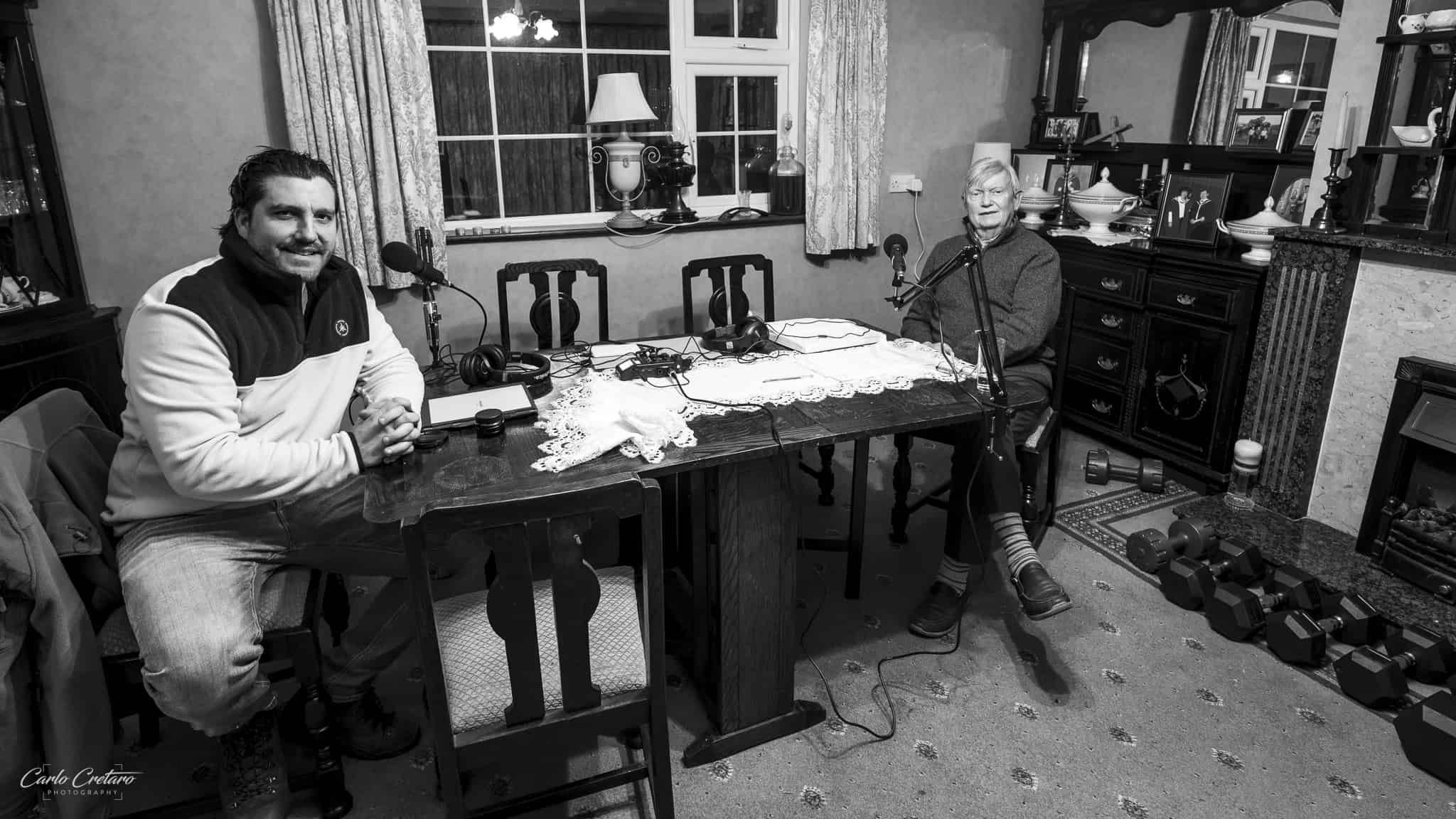
Thanks to Brendan O’ Dowd for creating and recording the musical piece for the podcast.
BE A GUEST ON THE SHOW!
If you’ve a story about Boyle, we’d love to hear it. You don’t need to have done anything remarkable, and you don’t need to prepare a thing. We sit down, have a chat, and you talk about whatever you want to. It usually takes about an hour.
Thinking of someone else? A parent, a grandparent, a neighbour who remembers how it used to be? Tell us about them. Some of our best episodes started because a son or daughter got in touch. You can find us at info@voicesofboyle.com.