Episode 35
Joe Mulleady – Pedalling Through Pain
Hosts & Guests
Carlo Cretaro
Joe Mulleady
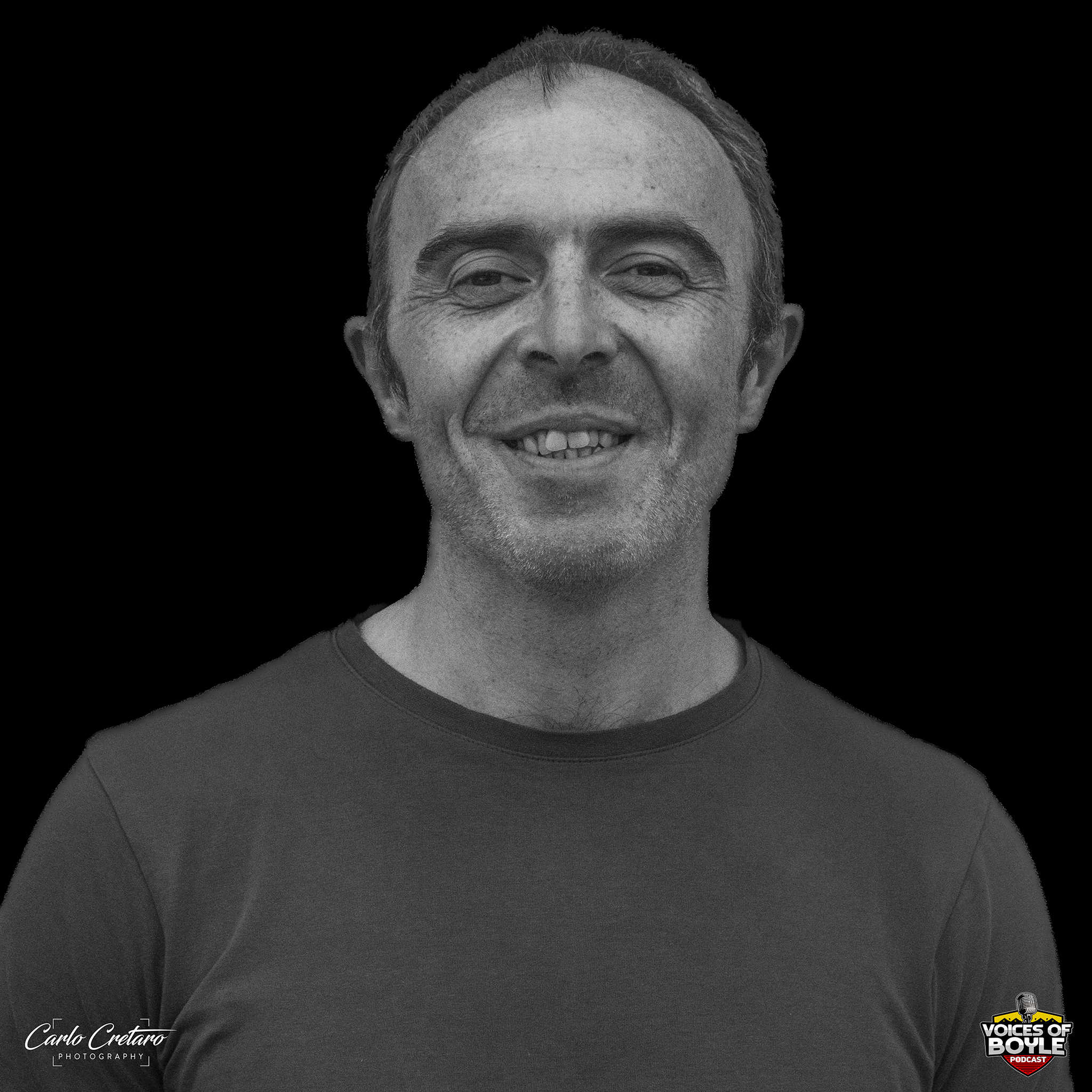
In May 2018 Joe Mulleady rode eight days around Ireland in the Rás Tailteann. It was the last year it ran as an eight day international race, and amateurs like Joe, training on their own time and paying their own way, lined up against semi professional teams from Europe and the UK. He finished it. He calls it probably the best achievement of his life.
A few weeks later, the day after a walk with the dog, he found a small dark spot under the strap of his watch. He thought it was a scab. It was a tick.
Joe grew up in Churchview in Boyle. His conversation with Carlo runs from street leagues to civil engineering, rugby, bike racing, Lyme disease, photography and Irish mythology, and through all of it is a man who cannot do anything by halves.
“I just don’t go in half arsed into things.”
Long, hot summers in Churchview
Ask Joe about growing up in Boyle and the weather comes first. Long evenings playing football on the street, cycling everywhere, swimming at Assylin. The estates had their own teams in the street leagues, Marion Road, Churchview, Forestview and Termon, and Churchview eventually got a rough pitch of its own at the bottom of the hill. Most games were three or four a side, first to 20, which became 21, then 25, then 30.
Warming the bench
Because of where his birthday fell, Joe and his next door neighbour Martin Mullen played school football a year above their own class, with lads they barely knew. They spent a lot of time on the bench. He had a short spell underage with Boyle Celtic and fell out of love with Gaelic around under 14.
Then came martial arts, with Green Dragon and John Sweeney from Sligo. It was the era of the Ninja Turtles and Gladiators, and Joe and one other lad from the street were the only two doing it. He reached purple belt and missed the grading that would have made him a brown. When the Boyle classes stopped and training moved to Sligo, he had no way of getting there, and let it go around the time of his Leaving Cert.
The crack we had was something else
The plan was a year out, a job, and a motorbike to get to college on. From Christmas he worked in Stuart’s Mill with Danny Shanley, Tony Shanley, Pat Roddy and Jason Byrne. They worked hard and had great crack, and he nearly did not go to college at all.
He went to Sligo, switching from construction studies to civil engineering when his results came out. It was a five year course, heavy on maths, with extra structures subjects because the college was chasing Engineers Ireland accreditation. By his count around 64 started first year with him, and two of those finished with the degree.
A position for you no matter what
In second year he found rugby, and it mattered. Joe had struggled with his weight for years and took the jokes in secondary school that came with it. Rugby had a place for every size, and nobody judged him.
“It didn’t matter what size you are, big or small. There was a position for you no matter what.”
At his heaviest he was 16 stone and played prop forward for the college, spending a fortune on protein and creatine. Martin Feeney, the prop on the other side of the scrum, talked him into joining Sligo Rugby Club. He arrived knowing nobody and was made welcome, and played there for three or four years after college. But once he was working, on a marina project in Termonbarry among other jobs, the travel wore him down. There was no time for the pint afterwards, and he felt a gap open between himself and the team.
“Even a home game in Sligo was an away game for me.”
Hammer and tongs
By then Joe had met his partner, and they were building a house in Leitrim Village. The lads in Leitrim Gaels asked him down for summer training, and he went back to Gaelic football with a confidence he never had in school. Rugby had given him that.
He was improving fast, but Gaelic turns on the feet in ways rugby does not, and he fractured a metatarsal. When the boot came off, the physio told him to cycle. He had a bike in the garage already, bought through the cycle to work scheme with a colleague in Leitrim County Council when they started designing for cyclists and decided they should ride the same roads.
You’re absolutely abusing yourself
The foot never came right for football. On a charity cycle with some Carrick-on-Shannon rugby lads he kept up on mountain bike tyres and finished wrecked, and they told him to get a racer. His first event on it was the Tour de Breifne. He had never ridden more than 40 or 50k, so naturally he entered the 100k.
It went fine for a few hours. Then the wind turned, the group split, and at the food stop he was dizzy with nothing left in his legs. At the bridge over the Shannon there was a turn that would have brought him home. He kept going, finished at the Leitrim Gaels pitch below the house, and could barely get off the bike. His phone said he had burned over 4,000 calories. For someone who had spent years trying to lose weight, that number got his attention.
Either 100% or 0%
He joined the club, started racing, and read everything. He is honest about the downside: he is either fully in or not in at all. Novice racing brought plenty of crashes, in bunches where there is about an inch between your front wheel and the back wheel ahead. Eventually he got a coach to save him from himself, because he was cramming in too much and getting sick. The coach suggested a plant based diet. Joe was already dairy free, had dropped pork, and found red meat heavy. He has not looked back.
The Rás
Joe had been racing four or five years when he rode the 2018 Rás. Stages averaged around 140k, the longest about 180k. Preparation started the previous October, long slow miles through the winter and more intensity as May got closer. On the bike, the banana goes in an hour and a half before the start, because that is how long it takes to reach the muscles.
A little passenger
After the Rás he took a couple of weeks off, expecting to come back flying. On a Sunday he walked the dog with his child, and the next day found the tick under his watch. He pulled it with tweezers, it broke, and a small black piece stayed in.
Over the next weeks his energy went, and his interest in the bike with it. On a family holiday in Spain he felt an emptiness he could not explain. He tells Carlo that he sat at the edge of the pool while his child wanted him to come in and play, staring into the water, and more than once wondered what would happen if he went in head first and did not bother swimming.
“I’d gone from the peak of a cliff, the best condition in my life.”
Back home he skipped the nationals in Sligo and went to his doctor in Boyle for bloods, convinced he was low on iron or B12. Almost as an afterthought he mentioned the tick. The doctor thought it was overtraining but tested for Lyme anyway. Two weeks later the result came back positive.
The great pretender
Six weeks of doxycycline brought no improvement. Joe was referred to an infectious diseases consultant at the Mater in Dublin and spent about six months on antibiotics, vitamins, minerals and probiotics, his days built around tablets.
Through the support group Tick Talk Ireland he heard about biomagnetic therapy, and one cold November evening he drove to a practitioner in Rossnowlagh. Joe says he walked out feeling better than he had in months. He believes it gave his body the positivity it needed to start healing, while accepting others would credit the antibiotics. When he told his consultant, he says the reply was that he did not know about it himself, but whatever Joe felt was working.
Joe never got the bull’s eye rash, and he says most people do not. He explains that the first blood test can miss an infection if the body is not yet producing the antibody, so people can be told they are fine when they are not. He calls Lyme the great pretender because it looks like so many other things. These days he gets three good weeks and one bad one, and has learned to rest when the bad one comes.
I lost my best friend
In September 2018 Joe wrote a Facebook post about losing his best friend. The friend was his bike. Fiona Quilter, whom he met through the Lyme groups, encouraged him to send it to the Sligo Champion, which printed it without changing a word. He wanted people to see it could happen to someone with a sporting background, not just the hiker, the farmer or the man out fishing.
“It can happen to anybody.”
What’s in the top of that hill
Photography is how Joe and Carlo got back in touch. The bike had shown Joe things a car never does: cottages hidden in fields, old Morris Minors under hedges, a hill he wanted to see the top of. In 2020 he got a drone for his birthday, and this time he committed, learning Lightroom and Photoshop from scratch. The forestry around Leitrim got repetitive from above, so he dusted off his old DSLR and learned the exposure triangle. He has since moved from big landscapes to the long lens, and after Carlo pointed him to Finding Vivian Maier, into street photography too.
We should have been told the stories
The newest obsession is mythology. Driving to work he heard Dave Fanning interviewing the author of Thirty-Two Words for Field, and bought the book. In it he found the Tuatha Dé Danann landing on Sliabh an Iarainn in smoke and flame and burning their boats. He had no idea that Leitrim mountain carried that story. Next came the Candlelight Tales podcast, and a list of places within reach: Knocknarea, Carrowkeel, Rathcroghan, the Battle of Moytura down the road at Highwood. From council work he knew the old OSI maps and the cottages on them that have since vanished. Now he goes looking for them, and pairs the photograph with the story.
He thinks Irish was taught backwards, grammar first, when kids raised on Gladiators and MacGyver would have bought into Cú Chulainn and the Red Branch. He sees it changing, and points to the Bealtaine fire festival at Uisneach growing every year. After the pandemic, he says, people wanted something to belong to.
“Our identity is our Gaelic heritage.”
He has been gone from Boyle 18 or 19 years, he reckons. Ask him where he is from, though, and he still says Boyle.
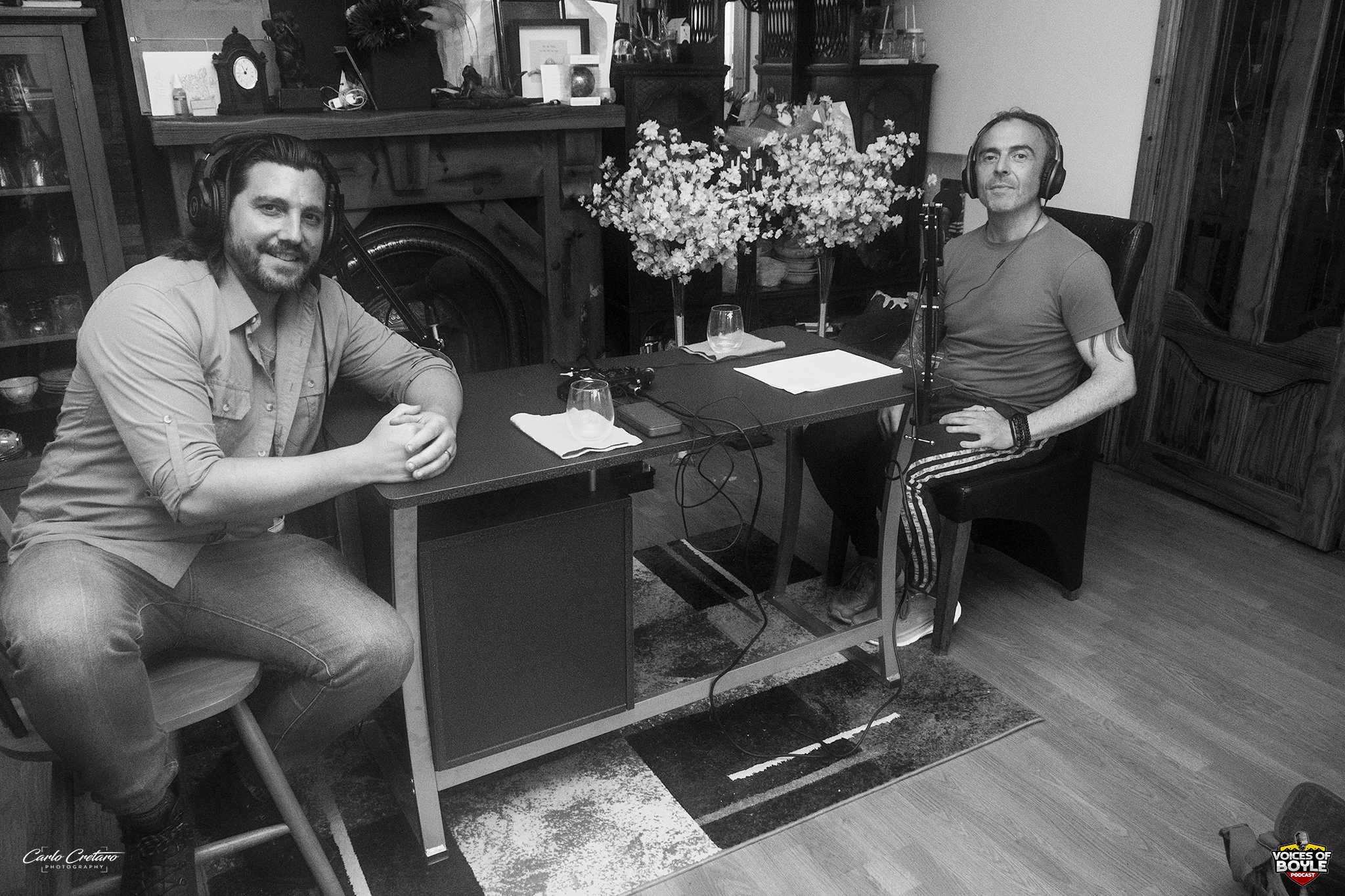
Thanks to Brendan O’ Dowd for creating and recording the musical piece for the podcast.
BE A GUEST ON THE SHOW!
If you’ve a story about Boyle, we’d love to hear it. You don’t need to have done anything remarkable, and you don’t need to prepare a thing. We sit down, have a chat, and you talk about whatever you want to. It usually takes about an hour.
Thinking of someone else? A parent, a grandparent, a neighbour who remembers how it used to be? Tell us about them. Some of our best episodes started because a son or daughter got in touch. You can find us at info@voicesofboyle.com.