Episode 82
Martha Higgins – The Mysterious Irishman Erased From History
HOSTS & GUESTS
Carlo Cretaro
Martha Higgins
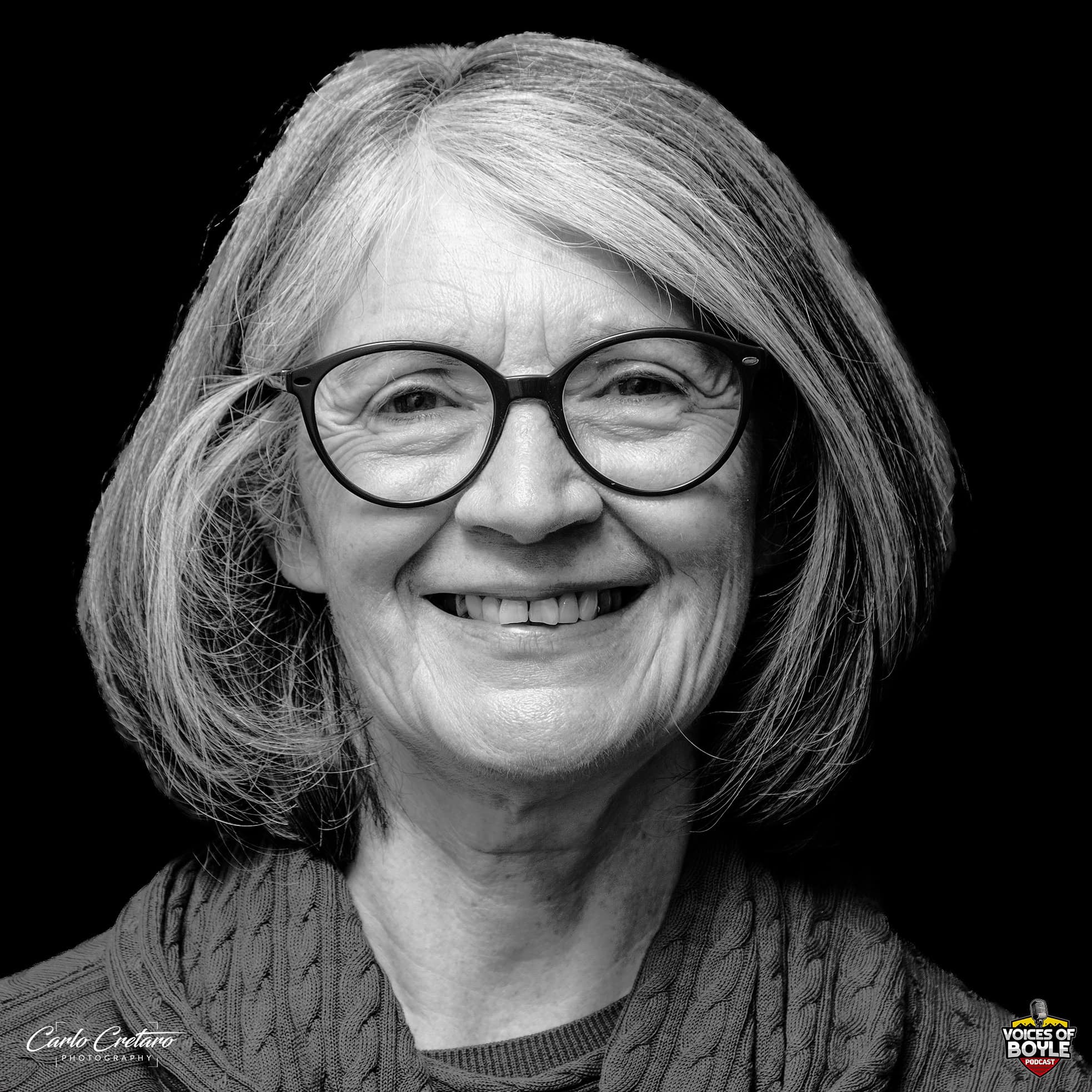
Welcome to Episode 82 of the Voices Of Boyle Podcast!
Martha Higgins was born in 1959 in the same house she grew up in. A home birth, on a small farm in Keash, Co. Sligo, where every morning started with jobs to be done before school and every summer was shadowed by the anxiety of whether the hay would be in before the rain came.
She is now a published novelist, a hill walker, a former resident of South Africa, and the woman who is currently writing a historical fiction about the only Irish man ever deported by his own government. She joined Carlo on the Voices of Boyle for a very interesting chat.
A Childhood That Shaped Everything
Martha describes the farm in Keash with the clarity of someone who has turned memory into craft. The family grew most of what they ate. Milk was bartered between neighbours according to the calving calendar. The days on the bog were hard and dirty and somehow, in the absence of the pressure that came with haymaking, deeply peaceful.
“There was something just so relaxing and nice about it,” she said of the bog. “I always remember those days.”
What strikes her most, looking back, is not how different life was from today, but how similar her parents’ generation was to her own. The gap between her generation and her parents’ was modest. The gap between her childhood and the present is vast, and she attributes almost all of it to technology.
Boyle in the 1970s
Martha went to secondary school in Boyle and carries memories of the town in its prime that are worth preserving in their own right. Candon’s horses pulling delivery carts on Bridge Street. The clippity-clop of Clydesdale-style horses on the cobbles alongside the cars. Two busy paper shops, the Bazaar and McDonaghs, at a time when paper shops were the first stop for everything. Cassidy’s on Bridge Street for things you could not find anywhere else. Ahern’s in Patrick Street, where her mother would sit in the snug for tea and biscuits. Sharon’s drapery, where everyone bought their clothes.
And Christmas. Taylor’s window full of toys. A simple string of lights across the street. The 8th of December as the great shopping day.
“It really seemed magical to us,” she said.
She mourns what has happened since. The dereliction pains her, she says, particularly in the context of a housing shortage. Main Street was once the hub. Patrick Street now feels desolate to her. The Royal Hotel, always the centre of civic life for weddings and funerals and everything in between, is now the gallery, which she values, but she still feels the loss of what it was.
“Going into town was a real social occasion, as well as just doing your shopping. My mother would meet everybody. It was the original community hub.”
Hiding from the Heart
Martha has always written, mostly for herself, as a way of processing what is bothering her. Short stories, community magazine pieces, fiction. But it was during COVID, with the time and the isolation of lockdown, that she began to take novel writing seriously.
Her first attempt was a historical fiction. She finished it. And then she recognised it was not good enough and set it aside. She does not regret it. Every writer, she says, needs to write that first book to learn what they are doing.
The image that became Hiding from the Heart came from an offhand remark at an online book launch. A friend had dressed up for the occasion despite it being virtual. Martha told her she looked like the girl who was ready for the dance while the rest of them were wearing the day. Her friend said there was a poem in that. Martha wrote one. And from that poem came a picture: a girl getting ready to go to a dance after a day on the meadow.
From that picture came Colette, seventeen years old when the book opens in 1975, full of dreams about the life she is going to have, inspired by watching Mary Tyler Moore on television and imagining herself in a newsroom. The book follows what actually happens to her instead, and how she navigates the distance between the life she imagined and the life she gets.
It took Martha two years to write and a third year to edit and submit. She rewrote it twelve times. Not from perfectionism alone, she says, but from a genuine refusal to release it before it was the best she could make it.
“Writers finish books. That is the only way you become one. Loads of people start books. You have to stick with it.”
The Discipline of Writing
Martha writes in the morning, first thing, before she has eaten. She heard Kevin Barry describe going straight from bed to his computer with a weak cup of tea, writing for an hour and a half before breakfast, and she recognised the logic immediately. The morning brings something of the night with it: dreams, the subconscious, material that has not yet been filtered through the daylight mind.
Evenings are for editing. She reads back over what she has done, considers what is working, cuts what is not.
Her advice to anyone with a book inside them is direct: write every day. Not a page here and a page there. Every day. Because if you leave too long a gap between sessions, you lose the thread. You have to rebuild your connection to the work each time. But if you write on Tuesday and pick up again on Wednesday, you know exactly where you are.
Stephen King says the same, she notes. When he has a book on the go, he does not leave it, because if he does, it starts to lose its pull and suddenly it does not seem like such a good idea anymore.
Jimmy Gralton: The Man Ireland Tried to Forget
Martha’s next project is a historical fiction based on the life of Jimmy Gralton, born in Effernagh, Co. Leitrim in 1886. She first came across him through Ken Loach’s 2014 film Jimmy’s Hall and through the book Deported, written by Des Guckian from Carrick-on-Shannon.
Gralton’s story is remarkable and, she argues, should be far better known than it is. He grew up in Leitrim not far after the famine, became aware of poverty and inequality at a young age, left for America, joined trade unions, and became an American citizen. He came back to Ireland in 1932 when de Valera’s government came to power. He built a hall at the local crossroads, the Pearse Connolly Community Hall, designed to give local people a space for education, music, dancing and meeting one another.
The Church called it a den of iniquity. Priests gave inflammatory sermons against it from the altar. The hall was burned to the ground. Gralton went on the run, hidden by neighbours for months. He was eventually arrested and, because he held American citizenship, was deported. He was the only Irish man ever deported by his own government. The files relating to his deportation have never been found.
“All he ever wanted was to give local people and poor people a fair chance,” Martha said. “And for that, they deported him.”
She has visited the family home in Effernagh with Paul Gralton, a cousin of Jimmy’s who still owns the old house. She has been in touch with people in America researching his time there. She hopes to have a first draft of the book within six months of returning to the desk this autumn.
“He had support. He was not just a maverick. Lots of people saw him as a very valuable person and a good neighbour. But they did not listen. And that is a big feature of governments now too.”
South Africa, Walking the Country, and Looking Up
Martha also spent two years in South Africa, arriving just as Nelson Mandela came to power. She found the inequality deeply shocking. Poverty on a scale she had never seen. Women not driving after dark. Routes planned before leaving the house. A far cry from the freedom of rural Ireland.
She walked the length of Ireland over several years with a friend, starting in Castletownbere in Cork and finishing, for her, in Omagh after an ankle injury, while her friend continued to Antrim. She describes what the journey taught her: that there are many Irelands, that what dominates the national conversation in Dublin has very little to do with how most people are actually living, and that people are, for the most part, generous and open when you arrive on foot.
She climbed in the Sierra Nevada in Spain earlier this year, five days of 600-metre climbs in the heat, staying near Granada, visiting the Alhambra.
And she ended the episode with something simple. She asked people to put down their phones and look at the changing leaves. It is autumn. The beauty is right there. You only have to look up.
Listen to the Full Episode
This conversation runs to just over an hour and covers more ground than most. Martha is a careful, thoughtful speaker with a lot to say and a clear sense of what matters. A very good listen.
Hiding from the Heart is available in Una Bhán in Boyle, Liber Bookshop in Sligo, the gallery at the Old Royal Hotel in Boyle, Mulvey’s in Carrick-on-Shannon, and on Buyireland.ie and Amazon.
Key Timestamps
00:00 — Welcome
00:18 — Born in 1959 on a small farm in Keash, Co. Sligo, a home birth
00:39 — The scale of change from that era to now
01:18 — The farm as the centre of everything
01:46 — Neighbours, haymaking, and the pressure of the weather
02:54 — Neighbour Annie and the cows grazing along the road
03:38 — Growing all their own food, bartering milk with neighbours
04:28 — Drinking raw milk straight from the cow
05:00 — Strongest memory: days on the bog, the peace of it
05:33 — Secondary school in Boyle
05:43 — Boyle as a vibrant market town: Candon’s horses, the shops, Christmas
08:27 — The fairs and the turkey market
09:07 — Life as a teenager in Boyle, the dances in the hall
12:03 — The Times Showband and the Swarbrigg Brothers, psychedelic lighting
13:11 — The biggest changes in Boyle: dereliction, the shift from Main Street
14:30 — Carrick then and now
14:44 — The Royal Hotel, always the hub of the town
15:30 — Hiding from the Heart: the debut novel
15:51 — Synopsis: Colette, 17, coming of age between 1975 and 1980
16:53 — How writing has always been how Martha makes sense of the world
17:46 — COVID as the impetus for writing seriously
18:01 — The first novel: a historical fiction that was abandoned
19:19 — The image that inspired Hiding from the Heart
20:26 — Writing in the morning, editing in the evening, the discipline of it
22:02 — Three years from start to finish, twelve rewrites
23:36 — Book launches in Sligo, Boyle, Galway and Dublin
24:38 — Where to buy the book
25:36 — Writing influences: Maeve Binchy, Donal Ryan, Kevin Barry
26:33 — The next project: Jimmy Gralton
27:08 — Who was Jimmy Gralton? His life, the hall, the deportation
32:42 — Ken Loach’s Jimmy’s Hall, 2014
35:16 — The state apology from Michael D. Higgins
36:03 — Freedom of speech, history repeating
38:21 — How Martha plans to portray Gralton in fiction
42:55 — Visiting the Gralton family home in Effernagh
46:26 — Walking: the Sierra Nevada in Spain
47:48 — Walking the length of Ireland over several years
49:26 — How COVID affected Martha personally
56:41 — Future plans: the Dolomites, the book, family and health
57:27 — Two years living in South Africa during the Mandela transition
59:36 — A love of nature and a plea to look up from the phones
Guest Bio
Martha Higgins grew up on a small farm in Keash, Co. Sligo and attended secondary school in Boyle. She has lived in Dublin, Galway and spent two years in South Africa during the period of transition from apartheid. She is now retired and living in Ballisadare, Co. Sligo. She is a member of Sligo Mountaineering Club and the Women’s Shed in Ballisadare. In 2025 she published her debut novel Hiding from the Heart, a contemporary fiction set in the late 1970s. She is currently working on a historical fiction based on the life of Jimmy Gralton, the only Irish man ever deported by his own government.
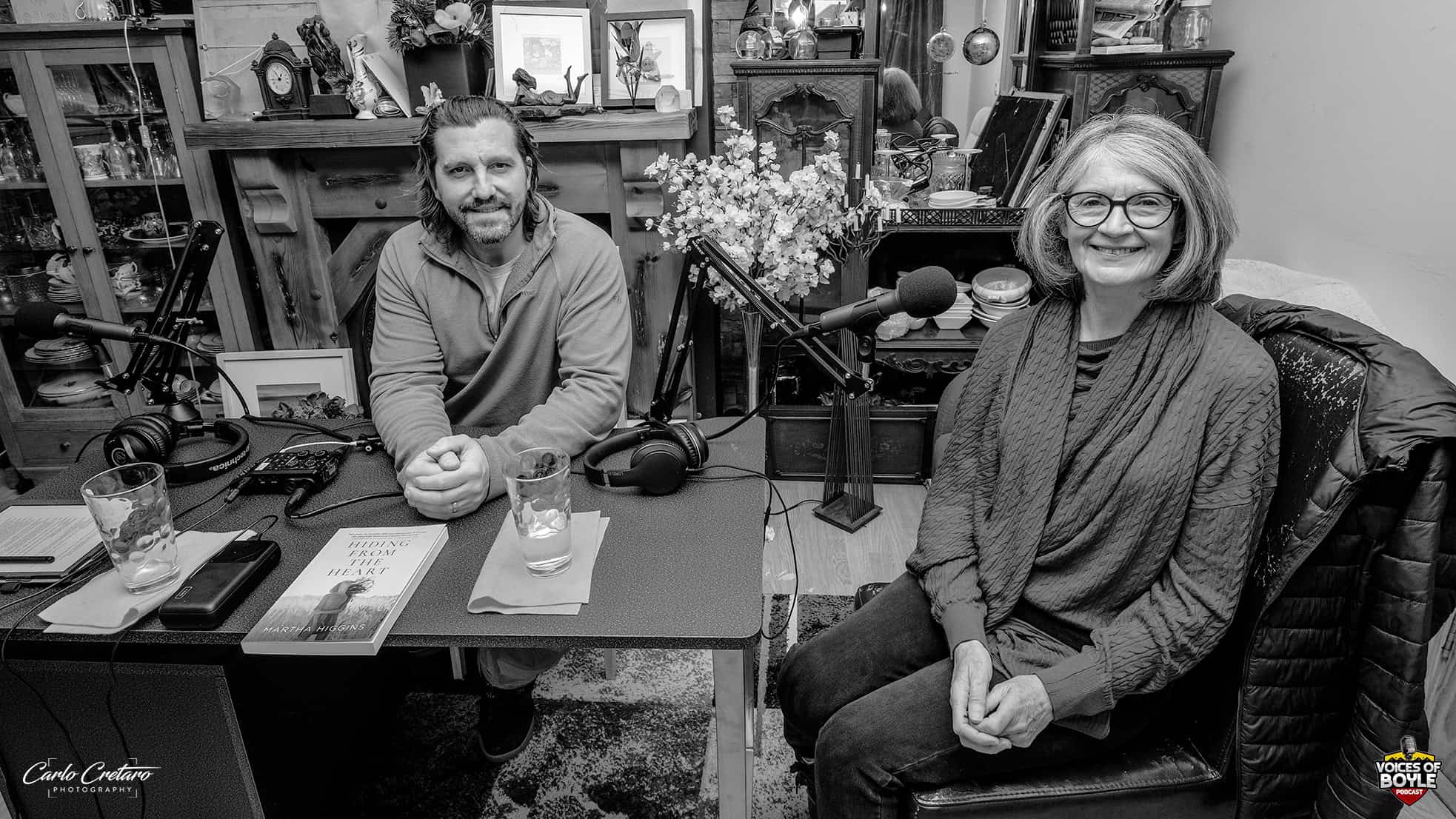
Thanks to Brendan O’ Dowd for creating and recording the musical piece for the podcast.
BE A GUEST ON THE SHOW!
If you’ve a story about Boyle, we’d love to hear it. You don’t need to have done anything remarkable, and you don’t need to prepare a thing. We sit down, have a chat, and you talk about whatever you want to. It usually takes about an hour.
Thinking of someone else? A parent, a grandparent, a neighbour who remembers how it used to be? Tell us about them. Some of our best episodes started because a son or daughter got in touch. You can find us at [email protected].