Episode 61
Matt Burke – Scissors & Strings
HOSTS & GUESTS
Carlo Cretaro
Matt Burke
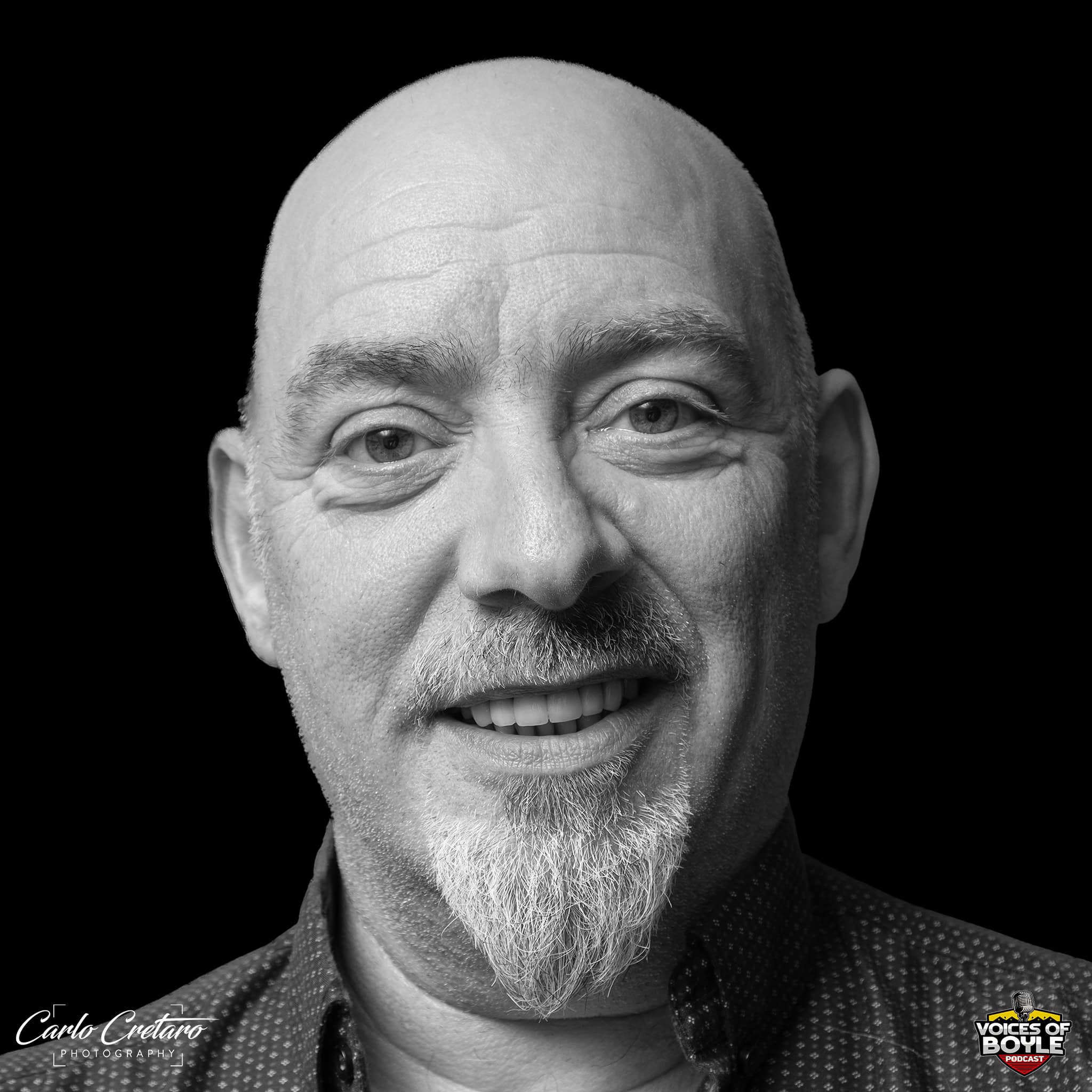
Most people in Boyle know Matt Burke as Matt the Barber, and most of them assume he has always been here. He has not. He is a Dubliner who ended up in a horse drawn caravan in a garden in Knockvicar, walked out of school at the front gate one morning, and took a hairdressing course purely because he had never done a job interview and thought he might as well practise on one.
Thirty eight years later he is still cutting hair in Boyle, and he still says he never actually wanted to be a barber.
The sea at the end of the drive
He was born in Dublin in the sixties, and he is quick to correct Carlo, who had guessed the seventies and got told it was a compliment. The house was on the coast. Out the front door, down the drive, across the road and you were in the water, and that is what the whole street of children did from about two years of age.
He learned to swim in the Irish Sea, drank half of it in the process, and cannot stand sea water now as a result. When you got older you got a bike, and then it was up and down the prom. Simple, he says, but good fun, and there were loads of you at it.
The detail that lands hardest is the walking. Two miles to school and two miles home, from about four years of age, no parent involved. You were handed your lunch box and off you went, winter, spring and summer. By seven he and his best mate, Jamie Cawley he thinks, were getting the bus into O’Connell Street on their own once a week for the pictures and a milkshake in Burgerland, which was what Ireland had before McDonald’s. Star Wars was the big one.
Carlo suggests you would be jailed for that now. Matt agrees, and adds, rightly so.
School in Dublin he describes as fabulous. There was a teacher with a big leather strap who would take it out and wag it, then start smiling with the tongue coming out the side of his mouth, and put it away again. It was the threat of it. It was never once used on anybody.
Down the country, and the wrong haircut
Then the family moved, and the strap stopped being a threat.
He was seven when his parents bought a pub in Corrigeenroe, around 1973 as best he remembers. School down here he calls a nightmare, twice. He and his brother Pete used to get slapped because Pete would not get haircuts, which is a detail worth sitting with given what Matt went on to do for a living. It was the seventies, long hair was in, and there was a wide gap between Dublin living and country living. The Burkes had denim jackets and long hair and nobody else had either.
He is careful here. There was no bullying between the pupils, that was all fine. Forty or fifty of them walked the two miles to school together. The problem was the adults.
“I’ve never come across a child that age that deserves a beating.”
He was mitching from school at seven and eight years of age because he was afraid to go in. He also says, without being asked to, that he did not get the worst of it, that he saw other children get awful hidings, and that it was not right, but there you are, that is how it was.
Two caravans and a winter
Three years in Corrigeenroe, then two back in the house in Dublin, and then his father bought an old county council house in Knockvicar and started renovating it. His mother’s people were from Knockvicar and it was seven miles up the road from his father’s home place, so even as Dubs, as he puts it, they were always country.
The timing did not work. The Dublin house sold before the Knockvicar house was ready, so the family moved into two horse drawn caravans in the garden. Matt and Pete in one, his mother and father in the other. Five or six months, he thinks, though he cannot be sure.
It was great crack for about a week. Then winter came. Scraping ice off the inside of the windows. Washing yourself in a basin. Getting dressed under the bedclothes. No cooker, so a campfire to cook on. He calls it living by the side of the road, and then says what people of that generation always say about that kind of thing, which is that things were different and you did what needed doing. There was no joy in the back, he says. No counselling, no fuss. The house got finished eventually and they moved in.
Out the front gate
He got as far as the Inter Cert in Boyle and was never fond of school after the move. He spent the summer plastering with his father. Persuaded to go back for fourth year, he lasted about three weeks.
Then one morning he walked out to the front gate for the school bus, watched it pull up, and said no. The bus drove off. His father was working in a pub in Ballyfarnon, so Matt walked to Ballyfarnon in his school uniform. His father asked what he was doing there. Matt said, I’m working with you now. His father said, all right, mix up a bit of stuff there.
He knew he did not want to be a builder or a plasterer. So he started applying for courses with AnCO, and the one he actually wanted was pipe metal welding. He must have written hairdressing in somewhere on the form, because hairdressing is what he got called for.
His reasoning for going is one of the best things in the episode. He had no interest in hairdressing whatsoever, but he had never done an interview in his life, so he would go up to Finglas and do this one for the practice and see what it was like. He was relaxed, because he did not care. He got one of the twelve places.
Then he went home and thought about it, and the logic was simply that he did not want to be a builder and it was only a six month course. We’ll give it a go.
A card with an address on it
The instructor in Finglas was a woman called Nancy Howley, and she told him early on that the course probably was not the right one for him, because he was going to be a barber. He told her he was not going to be a hairdresser or a barber, he was sixteen and had no idea where he was going.
He finished on a Friday. Nancy handed out the certificates, told him he had done really well, and then handed him a card. He asked what it was. She said it was the address of the barbershop he was starting in on Monday, in Talbot Street, and that was where he was going.
As far as Matt was concerned he was going home that evening and that was the end of it. He went home for the weekend, told his parents what had happened, decided he still had no better plan, and went back up to Dublin on the Sunday.
He walked in on the Monday morning thinking he was cock of the walk and knew everything, and by the end of the first day had worked out that he knew nothing at all. The real world and the training world, he says, are two different things.
The phone call that ended Dublin
He stayed three and a half years and finished his time. The money was shocking. His boss knew his trade but was mean with it, and Matt was on a pittance and hitching up and down the country because he could not afford the train.
One Sunday, home in Knockvicar on his usual Monday off, the house phone rang. He was to open the shop in the morning. Matt pointed out that he was in Boyle, that he did not drive, and that he did not have the fare because he was not paid enough to have the fare. The answer was that if he was not back up, he was gone.
Right, said Matt. I’m gone.
He is fair about it in hindsight and reckons they were probably both wrong. Either way, that was Dublin over.
“Are you a barber?”
Back home, he tried the barbershops in Sligo and there was nothing doing, because a barbershop in those days was a one man operation. You would see ten barbershops in a town, he says, and one man in each of them, not ten men in one shop. So he took a job as a general labourer on the courthouse in Boyle to get a few pound together.
One day, walking down the town after work, he noticed a shop with the windows whitewashed underneath Willie Lister’s office near the Royal Hotel. He walked up the stairs, covered in rubble, asked the secretary if the man upstairs owned the shop below, and got in to see Willie Lister.
Would you rent me the shop.
What for.
I want to open a barbershop.
“And he goes, are you a barber? And I says, I am a barber. And he says, go on. I’ll give you a go.”
Matt went home and announced he had rented a barbershop. He had not tuppence. He had a week’s wages and that was the whole of it.
What happened next is the part of this episode that says the most about the town. His father, a builder, started doing up the shop. The lads from the courthouse, plumbers and electricians and carpenters, came down and gave a dig out. Gerry Mattimoe called over to see what was going on, heard there was a barbershop opening, and arrived back with seating for the waiting area.
Within a week the doors were open. It was 1986. There was no master plan of any kind.
Carlo asks whether there were hurdles, permissions, legal routes. Matt’s answer: if there were, I didn’t know about them. He saw an empty shop, he opened a barbershop, end of story.
Four more haircuts to pay the rent
He says he has regretted it several times since, and then immediately says he is stuck at it, which in this part of the country is close to a declaration of love.
The early days were the hard ones. Rent day was Friday. He describes standing there at five o’clock on a Friday evening needing four more haircuts to make the rent, knowing full well that you cannot drag four men in off the street. It was not instant. He just stuck with it.
Necessity, then style
Ask him the biggest change in thirty eight years of barbering and he does not go to fashion first. He goes to why people came in at all.
In 1986 a haircut was a necessity more than a style. A man walked in with a good three months of hair on him and wanted it off. That was the style: let it go for three months, come back, get another one. Now somebody gets a cut they like and they are back in four weeks to keep it that way, or sooner.
He is careful not to say people were not stylish then. They were. Living was just different. You can go to your wardrobe now and find an outfit for every occasion. In the eighties you had two pairs of jeans.
What has changed the trade most, he reckons, is social media, which has blown fashion and style out of the water. Lads are as bad as girls with Instagram now, up with the selfies, look at my new hair, look at my new shirt. There is more scrutiny and more awareness than there ever was. He and Carlo end up on attention spans, the seven second rule, and the fact that neither of them is on TikTok. Matt thinks phones and gaming have a lot of young people addicted, that it will only feed on itself, and that AI will explode it altogether.
Could a machine do it
Carlo puts it to him that barbering might be one of the few trades AI cannot touch. Matt will not take the easy answer.
Nothing is impossible, he says. Who would have thought you could 3D print a house? That was impossible twenty years ago. So yes, some day you might walk in, sit down, pick your cut off a screen and let a machine with hands do the job. It might take thirty or forty years. But then he draws the line that matters.
“But then that’s not a barbershop anymore. That’s only just a room.”
Be the best at whatever you pick
Asked what advice he would give somebody going into the trade today, he says of course it is viable. Every business is viable if you do it right, unless it is genuinely a thing of the past. Then he gives the one piece of advice he has, and it is not about barbering.
Pick your trade and be the best at it you can be. He admits it took him years to click, that he had the shop open a good while before he understood it. He is not on TikTok but he is on YouTube, and he watches other people cutting hair for about four hours a week, men and women both, because you keep striving. He is quick to say he is not the best barber in the world, not by any means.
And it is not just barbers. If you want to be a painter and decorator, be the best painter and decorator you can be. Do not do the course and decide that is how good you are. Keep striving. All walks of life.
The app, and what COVID changed
He had tried a booking system before COVID and it was an absolute mess, because people were ringing and texting while he had his hands in somebody’s hair, and then arriving in convinced they were booked. It had to be shelved.
COVID forced it back. Coming out of the shutdowns he was allowed one person in the chair at a time, with masks, scrubbing the chair and disinfecting everything between clients, and that was what let the app work. Now the shop’s booking runs itself. He does not have to look at it.
He is candid that he was heading for burnout before any of that. Barbering was traditionally men rolling in whenever it suited them, which meant lunchtime and six o’clock. If your hours were ten to six, five lads could walk in at five to one, and once they were inside the door you had to do them, and in a small town you cannot tell people to go away. So you could sit doing nothing from ten until five to one, then five men arrive, then nothing again until five to six, then five more.
The booking app, he says, was a game changer.
Shaving mugs and Saturday nights
He has a theory about where that culture came from, and it is the best bit of social history in the episode.
Old barbershops stayed open until one o’clock in the morning on a Saturday night. Before safety razors, if you could not use a cutthroat yourself, you had no way to shave. So the barber kept your own shaving mug on the shelf beside everybody else’s, and on a Saturday night, when the men were put out of the pub, they went to the barber for a shave so they would be right for Mass on Sunday morning.
And Matt’s verdict on his own trade is that the barbers fed into it by letting it happen, when they could have said that they close at six and if you have not been in for your shave, that is tough. But that is not how barbers operated back in the day.
March 2020
He closed on 14 March 2020, three days before he was told to, on the logic that the quicker everybody closed the quicker everybody would be back. He thought it would be two or three weeks. Flatten the curve.
Then it went on, and they reopened, and then they closed again. He did not cut a single head on the sly. He lent his tools out to customers, and he adhered to everything. He is also clear that if it happened again he would put two fingers up and tell them to arrest him.
The thing he keeps coming back to is not the money, it is the uncertainty. Being told you are laid off tomorrow but you might be back next week, and then next week it might be next week again. If they had said nine months from day one, he says, you could have planned for nine months.
He is sharply critical of how it was handled, here and worldwide, and of politicians who kept having their own parties. He remembers watching every news bulletin, not for the numbers themselves but to see them come down so he could get back to work, and hearing nothing but bad news. That was the end of him watching the news. He has not watched it since.
Two images stayed with him. An old man getting out of his car outside the supermarket in a white hazmat suit, yellow rubber gloves to the elbows, a face mask and a face shield over it, and the thought of how frightened that man must have been. And people dying alone in a room with nobody allowed in to them.
What it did to people is what he objects to most. It turned people against people, he says, and in a town the size of Boyle you feel that.
Three hundred pounds’ worth of commitment
The other half of Matt’s life is music, and he did not start until he was twenty.
He wanted a guitar as a child and asked for one every birthday and every Christmas. He was the youngest, there were fiddles and pianos already bought for the others and left to gather dust, and no guitar ever arrived.
So he borrowed a half size guitar off John Ryan, with the strings a good two inches off the fretboard, and learned a few chords on it in the shop, badly. Then he went down to Bernie Flaherty and bought a guitar for three hundred pounds, which he calls animal money and reckons would be two grand today.
The reasoning was deliberate. He could have bought one for fifty pounds, but if he had, he would have had no heed on it. Spending that much meant he was going to learn it no matter how hard it was. He is not sure he ever mastered it. He still plays.
Six strings a night
He would sit in the shop when it was quiet, playing. Derek had picked up a guitar around the same time or a bit before, they turned out to be on the same wavelength and liking the same music, David Bowie and the like, and they started jamming, usually with a pint involved.
They would land into Kate Lavin’s, get a few pints in, and then somebody would say get the guitars, so they went and got the guitars. It was not gigs. It was lads having the crack and singing songs probably very badly, and it was great crack. Matt is careful to say it was never just him and Derek, that it was a genuinely organic thing with several members in and out over the years.
He is generous about Derek, who has a memory like an elephant for lyrics. Name a song they played in Lavin’s thirty years ago and Derek will sing it, word for word.
And then there is the guitar itself, and the blood on it.
“I wasn’t playing a guitar. I was beating the guitar to death.”
Six strings a night, regularly. Another string, another string, another string. Which is how the band got its name, because Frank Egan came into Lavin’s one night, took in the state of the guitars, and christened them the String Wrecks.
They were never a wedding band and had no interest in being one. It was pub gigs, and a Friday night residency on the Crescent, lugging all the speakers up there by hand because nobody had a car. The publican, by Matt’s account, could not stand them. Matt asked him straight out why he kept bringing them back every Friday, and the answer was that when they were in, the till went ding ding ding ding, and that was all he cared about. They had a local following. There was a reunion in Daly’s a few years back.
Waving in the background
Boyle Musical Society came next, some time around the nineties. He fell into it the way people do. He was knocking around with Geordie McGee and a few of the lads, the musicals were on, and he kept noticing the same crowd out in the pub on the same nights. Why are they all out? They were at a rehearsal. Matt’s conclusion: this sounds like good crack to me.
He is good on why the town was like that then. There was an awful lot of twenty somethings around, all the pubs were busy, and there was crack and fun in them. You did not have a wide circle of friends so much as a wide circle of associates, and whatever pub you walked into you knew somebody. Playing the music helped with that too.
Frank O’Mahony was the main director, and Matt’s description of him is affectionate and pointed at once: Frank always had a way of getting what he wanted, and some people would call that another thing, but that was Frank.
Matt joined the first musical with a very clear plan. Way up the back in the chorus. No dancing, no singing, no acting. Just waving in the background, on the basis that this was exactly what Geordie got away with. He told Frank as much and Frank said that was fine, no problem, Matt.
Four or five weeks into rehearsals, in front of twenty or thirty people, Frank started saying, Tommy out, Matt in. And that was Matt hooked into dancing without ever agreeing to it, because you cannot turn it down in front of a room. That, he says, was the way Frank did it.
He came round to it. Frank later asked him to play Bill Sikes in Oliver!, and Matt said yes straight away, on the grounds that Bill Sikes is rough and tough enough that you can roar the songs rather than sing them, and beyond that all you have to do is grow the beard and be an evil fecker. He loved it. Great crack.
Then there are the stunts. Rucksacks that had to be worn on stage, filled with concrete blocks by the lads. A swing hung with flowers down the ropes for a girl to sing a sweet song on, with the seat drenched before she sat on it, and her having to stay all sweetness with a wet dress for the rest of the number. A fellow in a bed on stage who was supposed to have a girl get in beside him and got one of the lads instead. There were always a few cans in the dressing room, and the girls coming in to check the outfits were really coming in to find out where the drink was. There was a night out after every rehearsal, never mind the week of the show.
Why it changed is not really about the musicals. You cannot drink and drive. You cannot smoke indoors. A lot of the cast come in from outside the town and have to drive home, so the plan for a pint afterwards gets you three takers instead of twenty. That changed the whole dynamic. And the shows themselves, he says, have got far more professional.
Ó No Somalia, 1992
The charity album came out of a single. Once the title track had done well, Sean Nicholson’s suggestion was, why don’t we do an album, lads.
Matt’s summary of Boyle at that moment is worth keeping. There were musicians everywhere. There were bands everywhere.
The String Wrecks were asked for a song and contributed Oh Mister Misery, written by Derek, so Derek got to call it whatever he liked. Some of it was recorded in a makeshift studio in a house out the Carrick road. The rest was recorded at Sean Nicholson’s, where walls had been knocked to get mics into different rooms, with Brendan O’Dowd producing on a big reel to reel tape machine.
What Matt remembers is the crack of it. Everybody chipping in, other acts doing their songs, and a night that ran very late, during which Brendan stopped and asked the lads had they heard that, because there was a ghost. There’s a ghost. There’s a ghost somewhere. Matt still does not know.
There was a big launch night in Cleo’s when it was all done, and a night to hand over the money. It reached the top ten. All the proceeds went to Somalia. He still has a tape of the whole thing somewhere, and nothing to play it on.
The buildings
Asked what makes Boyle unique, he says it is on the verge of regeneration in a big way, and then spends the next three minutes on the one thing he thinks is holding it back.
There are buildings on Green Street that have been sitting empty since he opened there in 1993, with no effort whatsoever made to do anything with them. He wants the law changed so that you cannot leave a building in the middle of a town idle for more than five years, and he would go as far as compulsory purchase.
He is not abstract about it either. He knows people in the town with property sitting for years and years, and he meets them out and they tell him life is great.
“But they’re strangling the town. Every one of them, they’re strangling the town.”
He says he cannot figure out the logic of owning a building, driving past it once a day, and thinking that is grand. It does no good for the owner and none for the town. He would feel guilty owning one. If you have no intention of doing anything with it, sell it, or let it, and let somebody else do something with it. Why leave it sitting for thirty years? Was it the right time thirty years ago? Twenty? When is the right time? Now.
Even turning them into private accommodation would leave a much better town, he says, and he has better ideas than that.
The people
What he thinks Boyle actually has going for it is a long list. It is beautiful. There is a river running through the middle of it. The Pleasure Grounds have been done up, the Lawn is being done, and the Mill is going to be amazing, and he says there is no word about that one, meaning nobody is talking about it enough.
But when Carlo asks his favourite thing about the town, the answer is one word.
People. The people around Boyle are solid. Genuinely solid. It is a great place to rear your kids and it is safe. And he has watched newcomers arrive over the years and simply be accepted. Not tolerated. Accepted. Carlo brings up the line from Christy Wynne’s episode about Boyle being a stranger’s paradise, and Matt agrees with it.
“I’m proud to say I live and work in Boyle. Really am.”
What he misses are the shops. Every second door was a shop or a pub. He counted twenty seven pubs in the town when he opened in 1986. They are down to six now, and only six because Wynne’s reopened, which means twenty one buildings that used to be pubs and are not. DH Burke’s. Christy Wynne’s. Mattimoe’s. Bob Fear’s. All the little shops down every street, all of them part and parcel and the heartbeat of a town. And he is unsentimental about it: they are gone, and they never will be back, because times have changed.
Characters
Ask a barber of thirty eight years about characters and you should expect a good return.
There was a small man called Conlon who worked for the county council, known to Matt and the lads as wire brush Conlon on account of a short spiky crew cut. Mattimoe’s was their pub on a Saturday evening and there would be twenty five coins lined up around the pool table waiting for a turn. They would always let Conlon on, and let him win a few, because everybody knew that once he was beaten he would take it badly. Somebody eventually had to beat him. Take him off now, Matt, he’s had his time. And then he would get ticked with you and the row would start.
There was Sonny Regan, always on the bridge, eating a sandwich out of his pocket. Fiery enough about money, but if you handled him right he was sound. He just had to get his way, or feel like he had got his way.
And there was Frank Mahan, who Matt calls a pure gentleman. Every Saturday morning he had his little bet, and he would be in Wynne’s with the bookies around the corner, standing outside the door with the bicycle and a fag, whistling his little tunes or singing away to himself, always smiling. Nice man.
A now person
Carlo asks him what future generations should remember about this period in Boyle’s history, and Matt does something unusual for a guest on a podcast about memory. He pushes back on the premise.
“You should never forget the past, but you can’t live in the past.”
You have to forget in order to move on, he says. Just because a thing has always been done one way does not mean it should always be done that way. He will not look back at himself in 1996 and wonder whether he was better off then. You have to think about where you are living at the moment.
He would be more a now person than a past person. Which is a fairly remarkable thing to hear from a man who has stood in the same trade in the same town for thirty eight years, and it is probably the reason he is still standing in it.
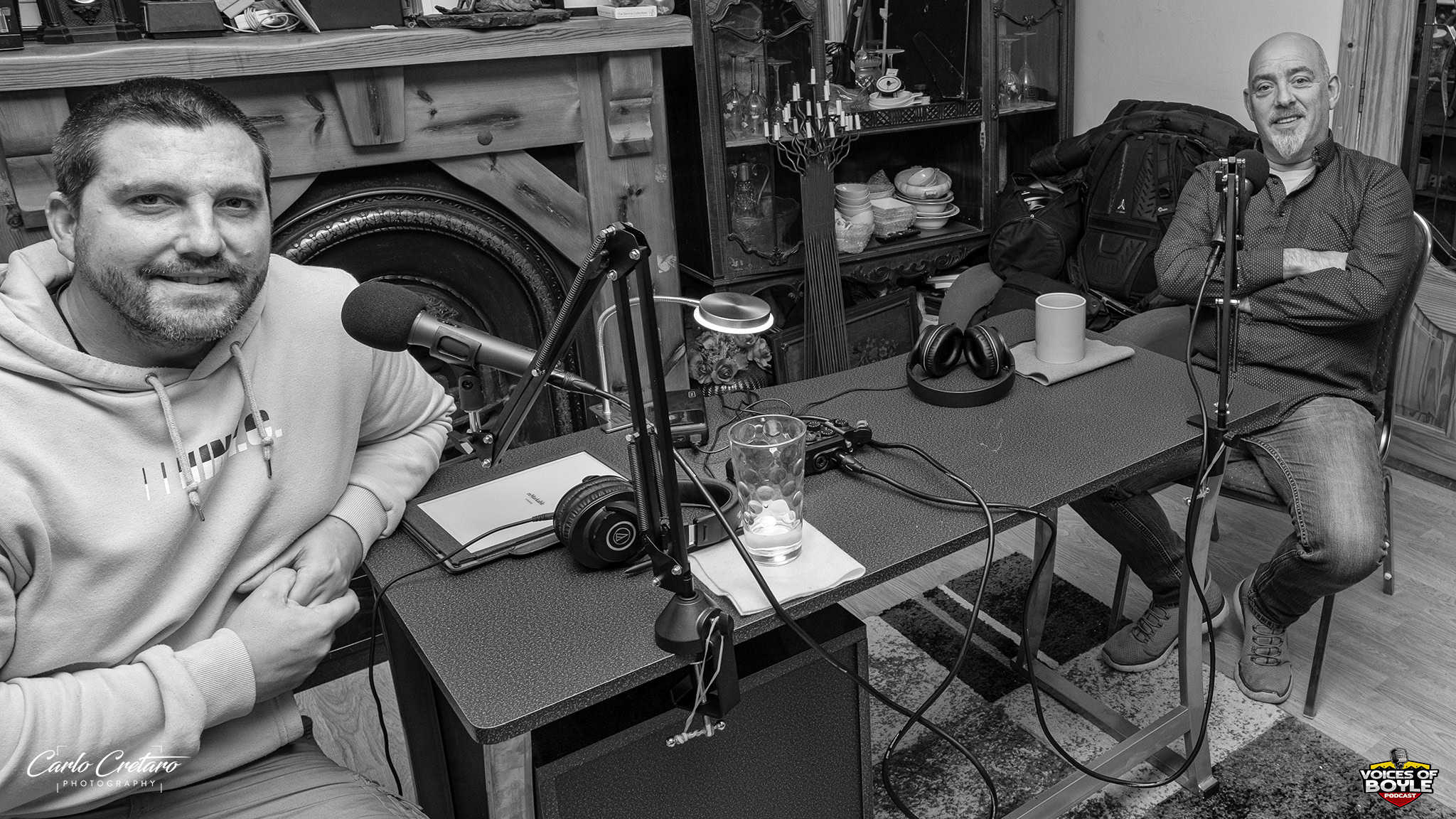
Thanks to Brendan O’ Dowd for creating and recording the musical piece for the podcast.
BE A GUEST ON THE SHOW!
If you’ve a story about Boyle, we’d love to hear it. You don’t need to have done anything remarkable, and you don’t need to prepare a thing. We sit down, have a chat, and you talk about whatever you want to. It usually takes about an hour.
Thinking of someone else? A parent, a grandparent, a neighbour who remembers how it used to be? Tell us about them. Some of our best episodes started because a son or daughter got in touch. You can find us at [email protected].