Episode 70
Nathan Haynes – Exploring Community, Connection, and Wisdom in Boyle
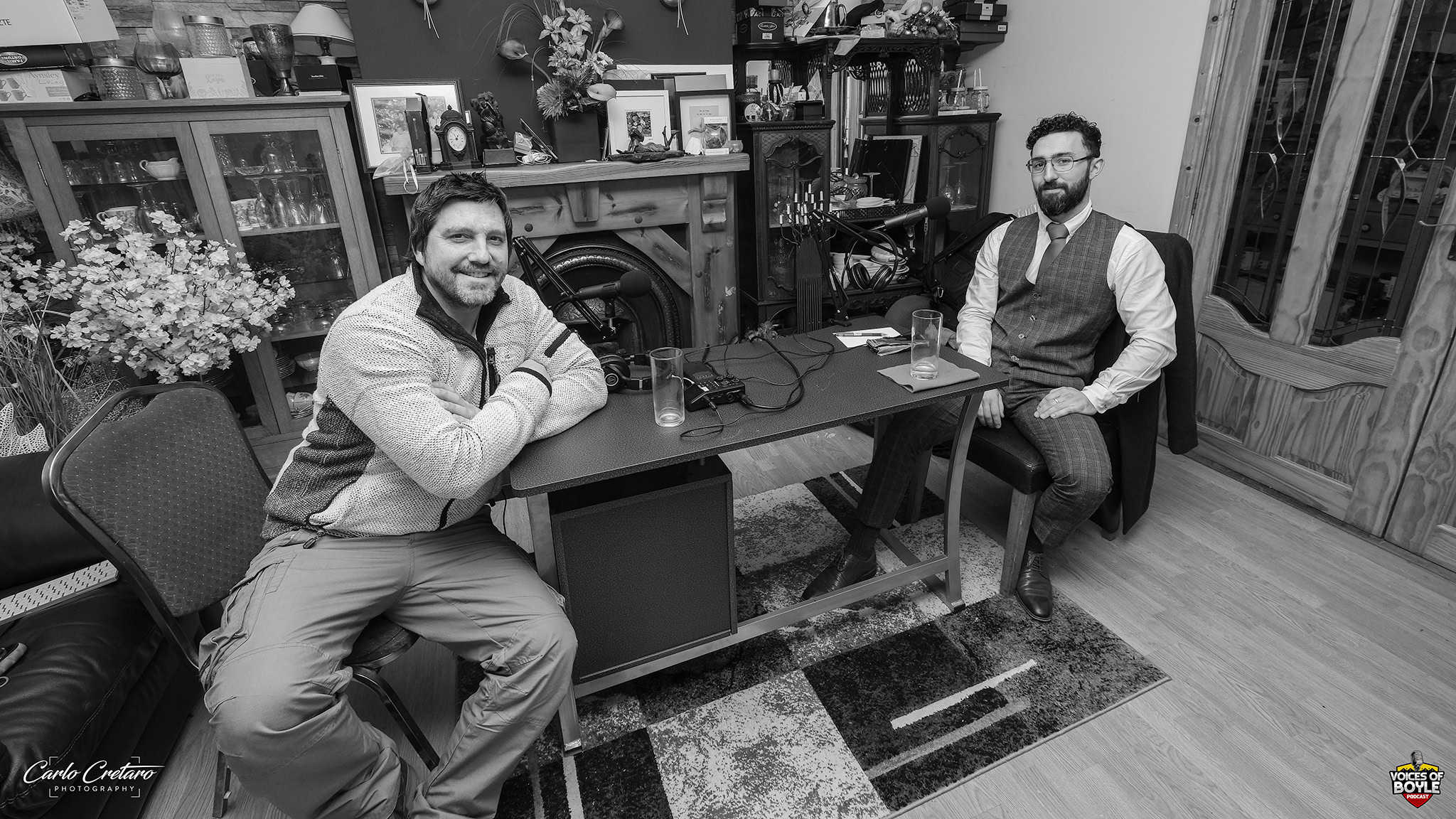
HOSTS & GUESTS
Carlo Cretaro
Nathan Haynes
RESOURCES

Nathan Haynes has been in Boyle just over a year, and the first thing he does when asked why he came is admit he cannot properly answer the question.
What he can do is list what caught him. A town of four thousand people that somehow has an art studio, an old abbey, an estate house and a forest within five minutes of a walk. The Carrowkeel cairns up the road, as old as the pyramids. Half an hour to Sligo, Yeats Country and The Model, which he calls one of his favourite places anywhere. He describes Boyle as a rich place and says he is here for the long run.
What interests him is not the list itself but the fact that somebody bothered. He talks about a cafe in Sligo where the food is good and, more to the point, presented like it matters to the people making it. He compares it to the food at home in Abbeyshrule, which he loves and describes as hearty and honest, and he is careful to say the difference is not quality. It is passion. Somebody decided to aim higher than they had to.
One complaint
Carlo asked for the dislikes as well, and Nathan had exactly one ready.
The astroturf in the small park. He says it is slippy and close to useless, and he addresses whoever the local councillor is directly. He wants it on record that he loves the rest of the park, the playground, the ironwork, feeding the birds. Just not the astroturf. That is the whole list of complaints from a year of living here.
Nobody is counting the insects
Asked what Boyle could improve, he went somewhere Carlo was not expecting.
A friend of his works in water quality and has talked him into caring about it. The argument is that how a place treats its water decides what kind of ecology grows up around it, and that over the last fifty years we have lost around seventy per cent of insect biomass. Boyle has a river running through it, a lake beside it and a forest park on its doorstep. As far as Nathan can tell, nobody locally is monitoring any of it. He asked whether there was a group. There was not.
He is not lecturing anyone. He describes being stuck on an eight hour journey to Ben Nevis with this friend, who talked passionately the entire way and never once repeated himself, and he says it with affection.
What he calls his frontier
Nathan uses the word frontier for the thing a person spends their life circling. For some people it is technology. For others it is business, or money. His, he says, is connection and intimacy. Bringing people together in a way that gives them a rich sense of themselves and of each other. Community, in other words, hopefully without the small town gossip.
That frontier explains most of what follows.
Residential care, and a thesis on perspective shifting
About twenty five minutes in, Nathan stops mid answer and realises he has not introduced himself.
He works in residential care with young people aged sixteen to eighteen, supporting them as they prepare to come out of the system. He describes it as being close to the space that initiation used to occupy: the passage from being someone the world looks after to being someone who holds weight in it. He has an undergraduate degree from Galway and a master’s in psychology from Limerick, and his thesis was on perspective shifting.
What he wants from the young people he works with is one specific thing. He wants them able to argue for what they want from three different angles. Here is what I want. Here is why you might say no. Here is the compromise. If a young person can do that, he says, he has no ground left to stand on, and neither does anyone else. That is the mission.
Pregnant speech and empty speech
The idea that runs through the middle of the conversation is a distinction between two kinds of talk.
Pregnant speech is a conversation with ten live possibilities in it, brimming, capable of going anywhere. Empty speech is small talk that goes nowhere. Nathan is quick to defend small talk generally, and he is good on why. When you tell your mother the weather is desperate, neither of you is talking about the weather. She is reading whether you are having a good day. That is small talk doing real work.
What the young people he works with cannot stand, he says, is the other version, the sterile one. And they will tell you so directly.
Then he does the same trick with silence, and this is the part worth stopping for. There is pregnant silence and there is empty silence. Do not run away from a pregnant one. If somebody at the table needs a moment to take in what just happened, do not fill the vacuum. If they need five seconds to make a decision, let them have it. See what comes out.
“Do not run away from pregnant silence.”
He is honest that it is not always comfortable. Pregnancy, he points out, is sometimes painful.
The first generation whose world adapts to them
Nathan is careful not to blame young people for the state of their attention.
His argument is that this is the first generation whose environment reshapes itself around them in real time. If the feed is not good enough, the feed changes. If their interests move and an app does not move with them, the app gets dropped, and there are enormous sums of money making sure that never happens. The algorithms are very good. That is the problem, not the users.
He is specific about the mechanism. A short video app shows you a dog, then an interior, then someone making a mistake, ten seconds each. Your brain wants to follow the dog outward into everything a dog connects to, your mother’s dog, your grandmother’s dog, the name of it. It never gets to. He argues the damage is not to attention span in the abstract but to the ability to make connections at all.
What helicopter parenting actually is
Carlo used the phrase helicopter parenting and Nathan corrected him, which turns into one of the more useful stretches of the episode.
Helicopter parenting, as he describes it, is a specific style from the last twenty or thirty years. No playing in the estate, no going out on the roads, summer camps instead, keep them busy, there is money around. It came from a good place and it protected children well. What it also did, he argues, was remove their contact with risk.
What has replaced it interests him more. The current style is oriented towards nature and travel, the caravan, the forest, the trip. Still no playing on the street. And it has a side effect nobody has a name for yet: children now form and lose friendships at a rate we do not recognise. A best friend for one summer, gone by the next. A friend who got you into badminton, or chess, and then a different place and different faces the following year. He is careful to say this is a trade off rather than a disaster. His own son plays basketball in Sligo, which would not have been on offer a generation ago, when it was hurling or nothing.
Cold plunges, saunas, and what they are actually for
Carlo asked about breath work, cold plunges and meditation, and whether they all fall under perspective shifting. They do, and Nathan is precise about how they differ.
A cold plunge, for him, works like a shot of coffee. Pure adrenaline, awake in a way you have not been awake. Meditation is the opposite: any thought that arrives gets an “ing” put on it, I am worrying, I am fantasising, I am anticipating, and then you return to the breath. Contemplation is a different thing again, closer to a stoic practice or the Dalai Lama’s question about loving strangers the way you love your family. He rates it highly and insists it is not meditation. Yoga, Tai Chi and Qigong make a third category, embodiment.
The point is not optimisation. It is knowing which one you need. Sitting all day and feeling itchy means you need movement. Talking to people all day means you need to be alone. Alone all day and catastrophising means you need other people in a room. Stressed at a desk with people living rent free in your head means coming back into the body and noticing that nothing in your actual surroundings is threatening you.
He also has a practical trick. Classically condition yourself. If the sauna is where you feel capable of enduring anything, find the sandalwood or whatever the smell is, and carry it. Rub it on your hands at your desk on a bad day.
Structure is what makes creativity possible
One of the strongest ideas in the episode is about tension, and Nathan builds it slowly.
Authenticity means listening to the inside voice. Humility means listening to the outside voice. Both get stronger as you get older, and they pull in opposite directions, and you cannot do both at the same time. He argues we are simply made of internal conflict, and that this is not a fault.
“In the tension is where the music’s played. If you try to get rid of the tension, you do not get music.”
Which leads to the line most likely to be useful to anyone who makes anything. The more structure you have, the more freedom you have to be creative. Waiting for inspiration makes you a slave to your own moods. Get up at the same time, sit down at the same desk, do the hour, and pray that the muse turns up. He points to Viktor Frankl writing Man’s Search for Meaning in the worst circumstances imaginable, and to people who held on to their practices in secret when everything else was taken.
The houses we knocked down
Nathan borrows the term psychotechnology for all of this. Psycho for mental, technology for tool.
Prayer is one. You are asking a future version of yourself for the strength you do not currently have, and imagining what it would be like to have it. Singing in a choir is another, a collective practice where your voice disappears into other people’s. His argument is that every one of these tools used to have a home, and the home was religion or some other set-apart space, and we knocked the houses down without building new ones. What we have instead is a version of meditation repurposed to make you better at your job. Cold plunge for productivity. Sauna for productivity. Everything in service of output.
He is emphatic that none of this is an argument for religion, and he says so twice.
Why Ireland is in better shape than most
This is the part likely to surprise listeners.
Nathan reckons Ireland is closer to a healthy headspace than most countries, and the reason is timing. We industrialised and urbanised late. In the 1980s, before the boom, people here were still connected to the land, and to community, and to tradition. He does not romanticise it, and he is direct that there were travesties. But the soil, as he puts it, was rich.
The practical result is that Irish grandparents still have all of it intact. Time alone, walks in nature, community meals, some tradition, some creativity even if it is only jokes. They do not need the theory because they are already living it. The young people he works with have none of it. They can be alone all day, so no collective practice. They can be in their heads all day, so no meditation. No traditions, and pure creativity in the sense of doing whatever they want whenever they want. He is not sneering. He is describing a gap.
Planting seeds
Asked whether he brings these practices to the young people he works with, Nathan is honest about the limits.
“I plant seeds, and I don’t get to see if they grow.”
He has no idea what sticks. The talk about meditation, the trick with the smell, any of it. The one thing he is hard nosed about is the three perspectives, because that is what makes somebody able to state a need and be heard. His example is a couple who used to go on date nights and no longer do, and someone able to say: this is what I need now, I understand you are in a different place, and if we are sixty and still not doing this I will be sad. Three angles. Then start the conversation.
Collective sense making, and the one room AI cannot enter
The last half hour is the part Carlo said made his head explode.
Collective sense making, at its simplest, is team spirit. A team goes into the changing room at half time, sits in the wreckage of a bad half, nobody says anything inspiring, and they come out with a second wind. Who decided that? Not one person. Nobody could have.
The harder version comes from research Nathan cites on the Wason selection task, a reasoning puzzle designed so that individuals reliably fail it. Well educated people score around ten per cent. Put them in groups of four and the success rate goes to eighty or eighty two. As he points out, that is not four times ten. It is not addition, it is multiplication. Something appears in the space between people that was not in any of their heads.
And this, he argues, is the one space AI cannot occupy. Not because it lacks intelligence. Because it solves too fast. In a room of four people, somebody offers a genuinely bad idea, everyone agrees it is terrible, and it turns out to be the foothold somebody else needed to jump somewhere good. Hollywood calls it the dirty pitch. An AI will only give you the logical answer, and it will never give you the stupid one that changes everything.
His illustration is domestic and it lands. You are arguing with your partner and she is furious, and you are cycling through explanations, is she hungry, is it work, how dare she talk to me like that. And then something shifts and you see it in her eyes: she is hurt, she is protecting herself, something happened. That shift comes from outside the problem space entirely. He does not believe a machine gets there.
Choose Your Chaos
Nathan makes videos on YouTube, and he is refreshingly bad at selling them.
The channel is called Choose Your Chaos. The idea behind the name is that there is no safe position. If you want to be the structured, disciplined, orderly one, you will have to learn how to keep a soul at the end of it. If you want to be the creative burning the candle at both ends, you will have to learn structure or end up at the mercy of your own moods. Whichever road you take, you eventually have to go and learn the other side.
What he wants from it is a space where people talk about the things they build their entire identity on and cannot define. Authenticity. Humility. Love. He describes a session where a group circles a virtue for an hour, walled garden, contact with the world, co-writing with the world, back around again, and nobody lands on an answer, and everybody feels closer to the thing than they have ever felt. He compares it to wine tasting and warns that it is a terrible spectator sport.
And the point is not to arrive. He wants the world in two hundred years to be more authentic than it is now, and he thinks it probably will be, in bumps and waves rather than a straight line. Arrival, as he puts it, would just be death.
“It’s a town of 4,000, and I’m still going to aim for beauty. I’m still going to aim for the truth. I’m still going to aim for the good.”
Thanks to Brendan O’ Dowd for creating and recording the musical piece for the podcast.
BE A GUEST ON THE SHOW!
If you’ve a story about Boyle, we’d love to hear it. You don’t need to have done anything remarkable, and you don’t need to prepare a thing. We sit down, have a chat, and you talk about whatever you want to. It usually takes about an hour.
Thinking of someone else? A parent, a grandparent, a neighbour who remembers how it used to be? Tell us about them. Some of our best episodes started because a son or daughter got in touch. You can find us at [email protected].