Episode 32
Niall Queenan – Ink to Screen: A Netflix Screenwriter’s Story
Hosts & Guests
Carlo Cretaro
Niall Queenan
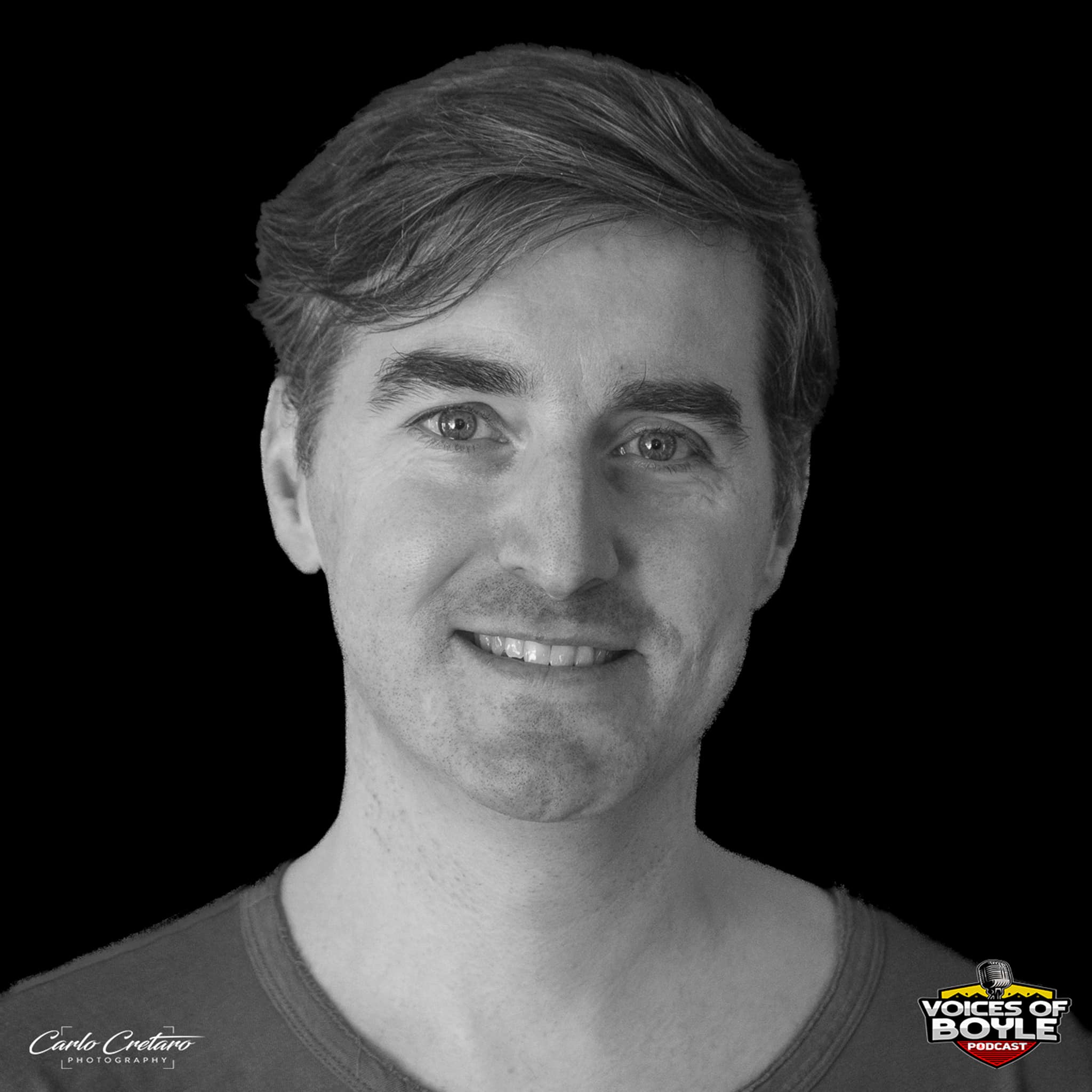
Niall Queenan was about thirteen and sitting in class in St Mary’s the day the cinema in Boyle burnt down. At lunchtime he was down the town, and the firemen were still there, smoke hanging in the air.
He had a suspicious mind about it even then, he admits, so he went up to one of the firemen and asked what happened. The fireman leaned in close. They had a lead, he said. Two lads, Maguire and Paterson.
Niall had never heard of them. Somebody had to tell him, about five minutes later, that Maguire and Paterson was the name on the box of matches.
The poster outside the cinema
Niall grew up about three and a half miles out the road from Boyle. He did a year of baby infants in Boyle, then moved to Corrigeenroe National School, where his mother had gone herself, and on to St Mary’s. His mother, Mary Queenan, was the public health nurse, and Niall spent many an evening doing his homework in the clinic or in the back of the car while she finished her calls. “We certainly got to see all parts of Boyle,” he says.
He also saw a lot of the cinema. It had about 300 seats, upstairs and down, and a balcony you wanted to be on rather than under. The posters outside could stay up for months. The Commitments hung there for what felt like half a year, and he wasn’t old enough to see it.
He did get into the first Batman, the Michael Keaton one, at maybe ten. He was so nervous about going into a dark room full of people that he got sick on the way.
Carlo mentioned that the podcast hoped to get Brian Kelly, who owned the cinema, to tell its history, and that a film club was being set up in Boyle at the time of recording. Niall was all for it. “Who wants to get in a car and drive over to Carrick if you don’t have to?”
Somebody else was guiding me
He studied management and marketing at DIT, did a master’s in strategic management, and went to work in pensions and insurance at Scottish Provident.
He was always writing something. At Scottish Provident it was the saga of Action Man. Niall’s team stole a rival’s Action Man, and Niall sent round updates and photographs from the doll’s point of view as it tried to escape captivity.
Then, in 2002, he saw Catch Me If You Can. He was more into thrillers and horror at the time, and it surprised him that a Spielberg film with Leonardo DiCaprio and Tom Hanks was the one that did it. Walking home across the bridge afterwards he felt something new. He could sense the writer behind it, a voice on the page coming through the actors, guiding him through the story.
“I have to try this. I really want to do this thing and create that feeling in someone else.”
Who talks like this?
He started handwriting scripts in the evenings and at weekends. Like most beginners, he says, he thought each one was the greatest thing ever written.
On MySpace he found a working Hollywood screenwriter who critiqued scripts for a fee. Niall’s plan was to impress him and be in the door. He paid for notes page by page, which he calls the worst mistake he ever made in screenwriting.
He sat down in the kitchen at home to read them, and on page one he felt the floor go. You could feel the man’s anger building with every page. Then he got to the line about his dialogue: WHO TALKS LIKE THIS, in capitals, and a big UGH with exclamation marks.
“I was on the first page of the notes, and there’s probably 30 pages of them.”
Niall told him to keep the money and skip the second script. He refused, being a professional, and the second one was “an absolute bloodbath.” But he also told Niall he was taking it well, and to go and read professional screenplays and books on the craft.
Niall did nothing for three months. But leaving the ideas in that state felt like unfinished business. So he read the screenplays and the books, printed out the notes, crossed out the quarter he thought was just cruel, and rewrote both scripts from the rest. For a beginner they turned out not too bad, and they read like screenplays. That was enough to keep him going.
Everyone else was on the same page
In 2009 he joined the writers’ groups started by the Writers Guild of Ireland. Every couple of weeks someone handed in a script and the group gave their notes face to face. It thickened his skin, and it taught him to give notes that make the other person want to do another draft. He took courses at Filmbase, which he misses, and when the recession came he moved to another pensions job.
After 14 or 15 months there, he was close to a permanent contract. He had a feeling that if he took it, he’d end up with a mortgage and every reason not to try. So he put his savings into a year at IADT, the National Film School in Dún Laoghaire, doing the master’s in screenwriting.
A week to go and €8,000 short
At a writers and directors networking night, set up like speed dating, he met a director called Kevin who had an idea for a film called The Hit Producer and needed a writer. The money had to be crowdfunded. After a false start on an English site, they moved to the Irish site Fund it, aiming for €18,000 when, as far as Niall knew, no film there had raised more than 10 or 15,000.
A week from the end they had 10,000. Niall spent that last week on 18 hour days, pushing the project on Twitter and Facebook. They hit the target a day or two before the deadline and finished just over 20,000. Family, friends and everyone else had chipped in.
Kevin had asked for a low budget script and got night scenes, car scenes and gunfights. He still reminds Niall. Nobody was paid, Niall ended up on screen as an awkward cameraman, and it was shot before Christmas. It premiered at the Cork Film Festival in 2014, went to festivals in Mexico and America, and a year or two later played in Omniplex cinemas around the country.
Then my name came up
The noir detective thriller Niall wrote on his master’s went into the PAGE International Screenwriting Awards, one of the few Hollywood competitions the industry takes seriously, and moved month by month into the final.
The results came through an online ceremony. Niall was living in a tiny box room at the time and hadn’t told anyone, in case nothing came of it. They counted down the thriller and horror category. Number three wasn’t him. Number two wasn’t him. Then his name came up.
A day or two later, Peter Katz, a manager in Los Angeles, emailed to say he’d read the script and wanted to represent him.
Sharks and a tornado
The award helped him into the Red Rock writers’ room as editorial assistant, in the old John Player factory in Dublin. In story meetings with executives from Element Pictures and Company Pictures, Niall noticed nobody was writing anything down. So he did, and sent everyone a tidy version that evening. After that he sat in on every meeting.
He watched episodes broken out on whiteboards, five acts each, scene by scene. And there was a sign on the wall that every new person was pointed to.
“The next time you think you have a bad idea, remember, in a room somewhere, once someone said, let’s make a movie about sharks and a tornado.”
Say it anyway. It might spark something in someone else.
I’m not looking for writers
Through producer Liz Gill, Niall interviewed with Jeb Stuart, who wrote Die Hard and The Fugitive, a film Niall had worn out on tape from McDonough’s. Jeb wasn’t looking for writers, but he wanted Niall in the room as an assistant, and at the end of 2019 Niall spent season 1 of Vikings: Valhalla at Ashford Studios in Wicklow.
A month or two later Liz asked if he had a TV sample. He asked for the weekend, barely slept, and rewrote his own pilot. Jeb rang him. The call lasted under five minutes. With Jeb and Morgan O’Sullivan backing him, MGM and Netflix said yes.
A week or two after he got his first episode, the country went into lockdown and the room moved to Zoom. At the end of the year he was given a second, and his name is on episodes 5 and 6 of season 2. He finished his work in summer 2021. They came out in January 2023.
“An idea that you thought was great at the beginning, you never knew how great it could become beyond that.”
Covid kept him off the set apart from one visit to a huge quarry where a place from his head was being built. His one regret is not getting down for the shoot.
The hardest story I’ve had to find a way through
At the time of recording, Niall was writing a biopic of Dr Patrick Treacy, one of the pioneers of aesthetic medicine, whom he met through a friend. Dr Treacy had tried a couple of writers before, as Niall understood it. His life covers a lot of ground. He smuggled cars from Munich to Istanbul to pay for medical school, took a needlestick injury from an HIV patient when nobody knew what to do about it and had a friend cut the flesh out of his leg, spent about a year in prison in Iraq, got out just before the invasion of Kuwait, and later became Michael Jackson’s dermatologist.
Niall’s approach is a man who seems to have everything, cutting back into his past. Only afterwards did he notice it was the structure of Catch Me If You Can.
Saving Hollywood from itself
The conversation was recorded while the Writers Guild of America was on strike, and a big part of that fight was about AI. Niall’s fear is that a studio gets AI to write a draft, then hires a writer for a cheap rewrite with no ownership and no share in the back end. He mentions Billy Ray’s podcast, where an AI answered questions in the voice of Morgan Freeman.
A background actor he knows was scanned head to toe on a big production, and the contract allowed that likeness to be used forever, for one day’s pay. The writers, as Niall sees it, are trying to save Hollywood from itself. Take out the human voice and you get something generic, and people stop showing up. He admits someone might listen back in ten years and call him an idiot.
Everyone has a story to tell
His advice is to write as many days of the year as you can, and to network, even though it’s the least fun part, especially for an introvert. Go to the Galway Film Fleadh, your local festival, a writers’ group or an online forum.
If you get slaughtered and three months later you still want to do it, you have your answer.
At the time of recording he had an original crime drama with a quirky edge out with his manager, and a feature treatment with an Irish company. Your family is your first drama, he says, and reading teaches you the shape of a story before you ever study it.
“Everyone has a story to tell is what they say.”
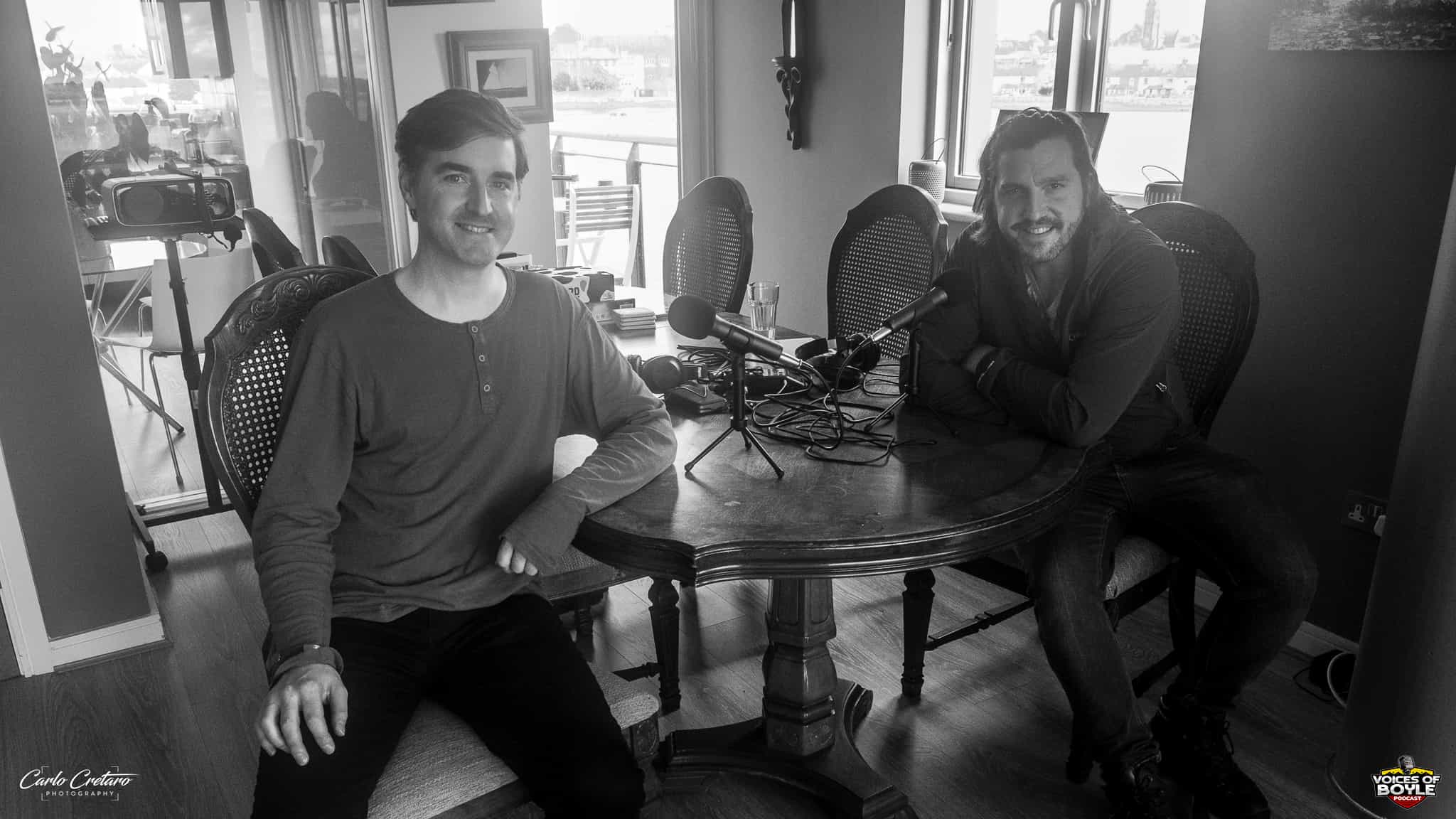
Thanks to Brendan O’ Dowd for creating and recording the musical piece for the podcast.
BE A GUEST ON THE SHOW!
If you’ve a story about Boyle, we’d love to hear it. You don’t need to have done anything remarkable, and you don’t need to prepare a thing. We sit down, have a chat, and you talk about whatever you want to. It usually takes about an hour.
Thinking of someone else? A parent, a grandparent, a neighbour who remembers how it used to be? Tell us about them. Some of our best episodes started because a son or daughter got in touch. You can find us at info@voicesofboyle.com.