Episode 71
Reece Shanley – Boyle Will Always Be Home
HOSTS & GUESTS
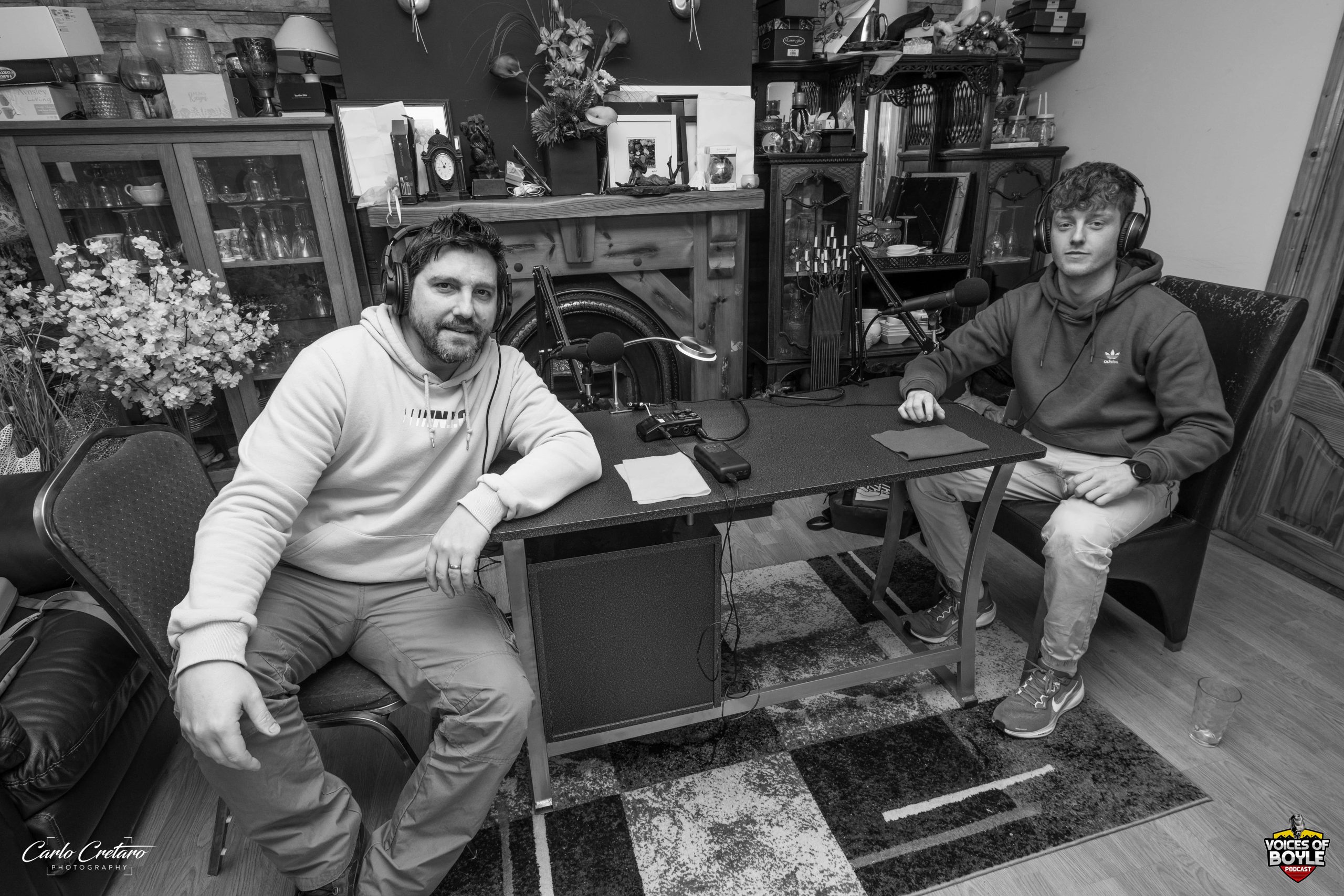
Carlo Cretaro
Reece Shanley

Reece Shanley was 21 when he booked a month in Thailand. He asked around, nobody else was going, so he went by himself. That decision runs through most of the rest of this conversation.
He was born in Boyle in 2001 and grew up on St. Patrick Street. He runs Super Softwash, a roof cleaning and soft washing business covering the west and midlands. He is 23, or 24 by the time you read this, and he has already had three goes at building something.
Six in a class in Grange
Reece did not go to school in town. He was, in his words, a very energetic child, and his parents decided a closer eye was needed. So he went out to Grange National School, where there were two teachers, two rooms, and six people in his class.
He is fond of it. The whole school was mixed, all ages in together, so a young lad had to learn to deal with the older classes from day one. When he arrived into Abbey Community College and found himself in a year group of twenty plus, it did not throw him the way it throws some people.
Sitting still was the problem, not the people. Biology held his attention because he was interested in the human body and had notions of becoming a physiotherapist. Maths held it a bit. Everything else, not so much. He did his Leaving Cert in 2018.
A town that got quieter
Ask Reece what has changed in Boyle since he was a teenager and he says the same thing a lot of guests say, but from the other end of the timeline. It has got quieter.
He points at Halloween. In the 2000s it took over the town for weeks. Not all of it was well behaved, and he is quick to say that some of what has stopped is no loss. But something went with it. He puts a fair bit of the blame on phones, which is where a good chunk of this episode eventually ends up.
A month in Thailand, on his own
He went in October, just after the COVID restrictions eased, and came home in November. He had an itinerary. Three days here, four days there, tick off the whole country. It lasted about a week.
Bangkok was too much for him. He describes it as a concrete jungle and says crossing the road was a genuine event. Chiang Mai was better. From there he hired a scooter and drove the mountain road up to Pai in shorts and a shirt, feeling, as he puts it, like Bruce Wayne. He arrived at the top with the temperature down from thirty degrees to six and wanted straight back down.
Pai was the one. He was meant to stay two days and stayed eight. Seventy per cent backpackers, thirty per cent locals, and no traffic to speak of after Chiang Mai. He met a group of people and stayed with them. After that came Phuket, then Koh Samui and Koh Tao. He skipped Krabi and the Phi Phi Islands on purpose, so he would have a reason to go back.
Asked to describe the month in one word, he said absolutely amazing. Then, when pressed, amazing.
The other thing he mentions is the cost. He had been to Lanzarote for a week with two friends the year before and spent more there in seven days than he did in Thailand in a month, flights and accommodation included.
“You need a bit of difficulty to get out of the comfort zone.”
Raffles, doors and false starts
The business took three attempts. The first was an online raffle operation. He ran two of them, two people won, he broke even, and then he lost interest. There was not enough friction in it to hold him, which is a phrase worth noting from someone who could not sit still in a classroom.
The second was door to door sales, switching people’s electricity suppliers. He worked the urban areas, Longford, Castlebar, Athlone, knocking a hundred doors a day and hoping for one signature. He took the job on purpose, as a challenge, having decided from working at the boats in Lough Key between the ages of 14 and 17 that he was reasonably good at talking to people.
Door to door sales corrected that assessment fairly quickly. He did six months of it and rates it as the most useful thing he has ever done.
Super Softwash
While he was still knocking doors he started buying equipment. He had been watching American operators doing roof cleaning and gutter work and noticed the money in it was better than power washing, because the risk is higher. The first year was a side thing. It was enough to pay for Thailand.
The hard year came after. He went back to work in Dublin on the sites, four days a week, up at half four on a Monday morning and home at nine on a Thursday night, then out on the Friday and Saturday to clean roofs and driveways around Boyle. He did that for a full year. He also ended up as a project manager on the sites, which meant he was carrying someone else’s pressure during the week and his own at the weekend.
He went full time in March last year. He took on two lads for the season, dropped them to jobs with the ladders and poles, and used the time to build systems rather than swing the scrapers himself. He calls last year a setting year. This year the foot is back on the gas, and the plan is another van and another two lads.
The work goes wherever it goes. Galway, Mayo, Sligo, Leitrim, Longford, Mullingar, as far as Kinnegad and Cavan. Anything within about an hour and a half. He would rather drive two hours than sit at home.
Never power wash a roof
This is the part to send to anyone with moss on their slates.
Most power washers run at three to four thousand PSI. Point that at a roof and the water has to go somewhere, and where it goes is into the timber structure underneath. Reece says it might take two or three years before anyone notices, and by then the damage is done. On top of that you have someone standing on a wet roof holding a pressure lance.
He says the proof is in who hires him. Roofing company owners get him out to do their own houses. One of them told him the lads power washing roofs are the ones keeping him in business.
The Super Softwash method is manual. Moss scraped down from the gutter with a long extension pole, gutters cleared out, and a moss and algae treatment sprayed on afterwards that kills the growth at the root. It takes a week or two to fully develop. Walls get the same treatment approach rather than a pressure wash, which avoids blasting the plaster and paint. Driveways and patios still get power washed, because that is what power washing is for.
He also calls jobs off. In November in Carrick he had a customer waiting and gutters frozen solid, minus figures in the morning, four or five degrees at best in the day. He pulled the lad off it. He is clear that he will take a risk on himself before he lets anyone working for him take one.
The books
Asked who in the world he would hire to help run the business, Reece went with Russell Brunson, because the problem is not doing the work, it is getting the work. He has been reading DotCom Secrets. He also rates Alex Hormozi, and has read $100M Offers and $100M Leads, mostly for how simply Hormozi explains things.
His take on that is the best line in the section. The only way you know you really understand something is if you can teach it to a child. If you cannot, you do not know it as well as you are letting on.
Dopamine and the morning scroll
Reece does not have TikTok and is not keen on Instagram, which he admits is probably a business mistake. He has been reading about dopamine instead.
His argument goes like this. Dopamine is a reward chemical and a motivator. A few hundred years ago you got a hit of it after two days of hunting when you brought something home to your family. Now you get it before you are out of bed, over and over, from a screen. The brain wants to sit in neutral, in homeostasis, because that is where clarity lives, and it spends the rest of the day trying to correct for spikes it was never built to handle.
He is blunt about the effect on himself. If he scrolls for the first hour of the day, he says, he will not function properly. And he links the wider version of it to why so many people his age feel anxious and flat.
There is a related point about comparison. His generation is in constant contact, so meeting up is no longer the occasion it used to be, because everyone already knows everything. And watching other people’s version of success online sets a standard that has nothing to do with your own life. As he puts it, everyone does their own thing at their own time.
“The rarest commodity I’ve ever seen in this world so far is peace.”
Ten minutes and a timer
Reece expected people to be surprised that he meditates, and he is right that they will be. He also does not much care.
The method is simple. Sit down, set a timer on the phone, throw the phone away, and stay there until it goes off. Breathe in through the nose. Your mind will race and that is the point. Whatever is bothering you from yesterday, or coming at you tomorrow, will come rushing in, and you get to notice it and name it.
He is careful about what he promises. You will not wake up the next morning feeling transformed, because everything else in your day is delivering bigger hits than ten minutes of silence ever will. What you get is gradual. For someone juggling twenty jobs, materials, phone calls and a lad on a ladder, it means feeling the stress without letting the stress run the day.
He compares it to prayer, which he points out is the oldest version of the same practice. Sit down, let the distractions go, and talk to yourself honestly for a while.
The billboard
Carlo asked what he would put on a billboard at the Crescent for a few weeks, aimed at the younger generation coming behind him.
Reece’s answer was a quote he carries around: do not take advice off people who are not where you want to be in life. If you want to be a doctor, do not ask your local mechanic what to do with your life. Find someone who has done the thing and listen to them, and with YouTube and social media those people are findable now in a way they were not before.
He added a qualifier straight away, which says something about him. That applies to professions. It does not apply to older people around you with life knowledge. That is a different thing entirely.
“I’ll be in and out of Boyle. I’ll never leave. It’s my hometown. It’s made me into the person who I am.”
Where he sees it going
Reece calls himself a dreamer and has his goals written down. The plan is to make money first, then get the money working, and eventually get to a point where enough of it comes in passively that he can travel properly. He is candid that he does not know exactly what the shape of it will be, only that he intends to keep going.
He will not leave Boyle for good. He will be in and out of it, and he has three months away already in mind, but the town stays home.
Asked what he loves most about it, he did not hesitate. The people. Everybody knows everybody, which he acknowledges has its downsides for anyone who values privacy, but he reckons ninety nine per cent of the town would do you no harm at all.
Then he turned the microphone around and asked Carlo when he and Florence are going to sit in the guest chair themselves. Listen to the end for that answer.
Thanks to Brendan O’ Dowd for creating and recording the musical piece for the podcast.
BE A GUEST ON THE SHOW!
If you’ve a story about Boyle, we’d love to hear it. You don’t need to have done anything remarkable, and you don’t need to prepare a thing. We sit down, have a chat, and you talk about whatever you want to. It usually takes about an hour.
Thinking of someone else? A parent, a grandparent, a neighbour who remembers how it used to be? Tell us about them. Some of our best episodes started because a son or daughter got in touch. You can find us at info@voicesofboyle.com.