Episode 77
Sean Nicholson – From Boyle to London and Back
HOSTS & GUESTS
Carlo Cretaro
Sean Nicholson
RESOURCES
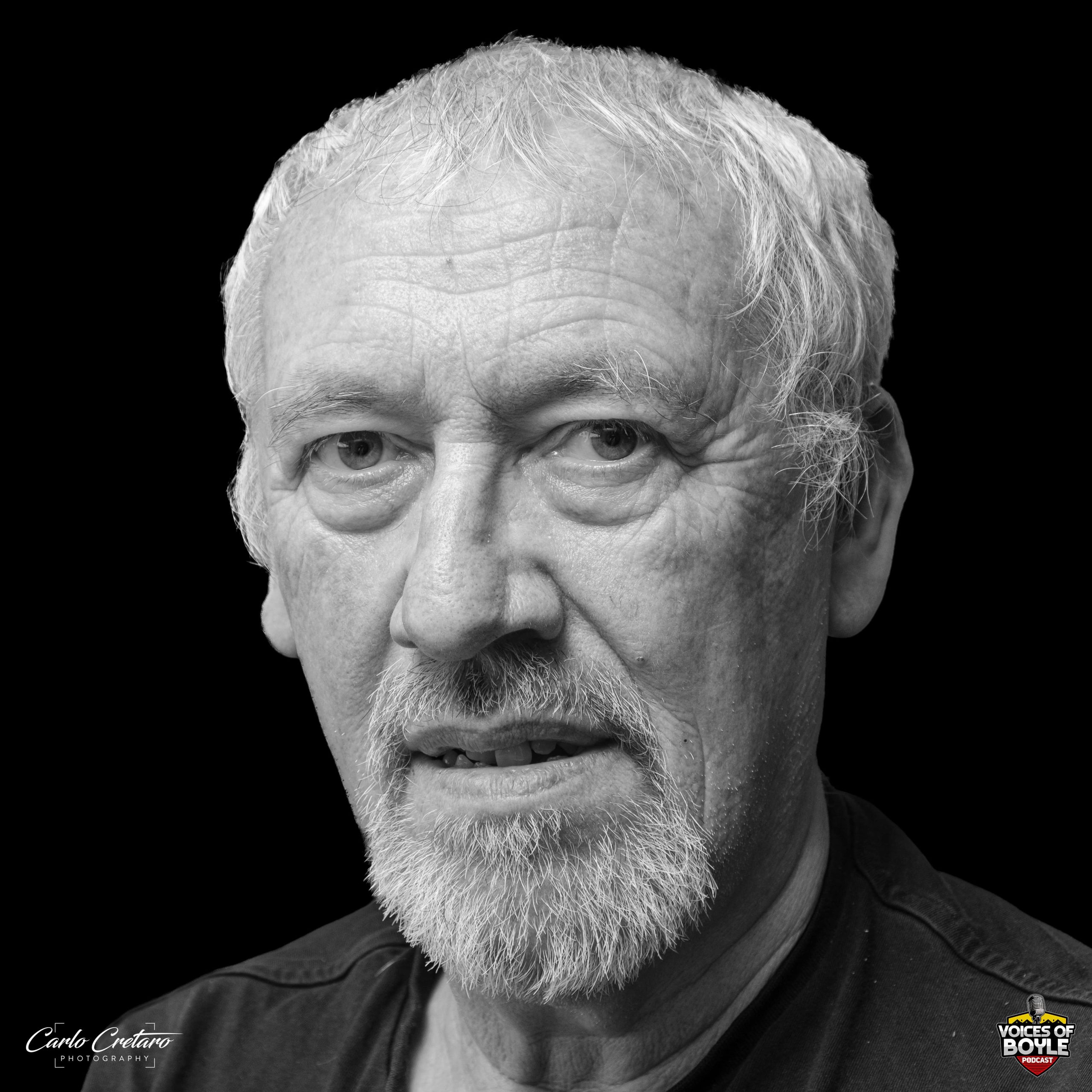
Welcome to Episode 77 of the Voices Of Boyle Podcast!
The Nicholson house at the top of the Curlews was one of the first in the area to have a television, and for a while that made it the centre of the parish. Neighbours came in to watch whatever RTÉ was showing. When the programmes ended the tea came out, and after the tea somebody usually started a song.
Sean remembers Jody Sheridan arriving with the milk, sometimes with Frank Chute and Michael Scanlon along with him, and a sing song getting going in the kitchen. He was small enough to be taken out and stood in front of people to sing, which is how he got used to singing at all.
“I suppose you took music for granted.”
The family moved down to Deer Park, across the road from the McGlynns. Joe McGlynn was a fiddle player and his brother Tom played flute, and Sean’s father would bring him up for bits and pieces on the whistle and the fiddle. Proper lessons came from Nancy O’Connor, a relation of his mother’s, who taught whistle, harmonica, singing and elocution and was strict enough that he can still taste the chalk on the three fingers she wedged into his mouth to get it open wide enough.
She had him singing The Minstrel Boy. Joe McGlynn had him singing a different version of The Minstrel Boy involving a bog and a bank of turf, and Sean kept mixing the two up, which drove Nancy mad and delighted Joe.
Nancy would not teach guitar. She said it was only for Beatles. So Sean went out on the Wren, gathered the money, and bought his first guitar above in Taylor’s furniture shop for four pounds ten shillings.
Bands, street leagues and tug of war
He was playing in a band by fourteen with John Joe and Kevin Conlon and Tony Manani, and his father drove them around. There were too many guitar players, so they put him on bass and he taught himself a few riffs. By sixteen he was playing with the late Seamus Byrne, who could sing all night without getting a sore throat. Sean remembers a night in Flynn’s in Arigna that turned into a contest between Seamus and the old time waltzers, the men taking out white handkerchiefs to wipe their foreheads, everybody waiting to see who would stop first.
Outside music there was the street league, which Doon entered as Doon Street Celtic and won, to the mild irritation of the townies. And there was the Rockadoon tug of war team, trained by Joe Tormey and anchored by Tommy Rock. Training meant hauling a digger bucket filled with metal and stones up to a pulley on a tree, running down to the Doon shore and then running back up the hill backwards to build the muscles at the back of the legs. Tommy had them eating raw liver for iron. Sean was too young to make the team but did the training anyway.
He left St Mary’s after two years and went to work for John McGrath out the Carrick road, cutting inscriptions on headstones. He talks about it as good work: marking out the template on a blank piece of granite, blasting it, and watching something come out of nothing. McGrath had a name for being contrary, but Sean is quick to say that if you went to him stuck for money he would hand you half of what he had.
London, 1986
After qualifying in electronics in Sligo, Sean went to London with about a hundred pounds and a Hagstrom fretless bass. The first week was on a building site, which was no good to him because he could not turn up to an engineering interview covered in muck. So he took a security job at a chemical plant instead: less money, but clean clothes and night shifts, which left his days free for interviews and his nights free for writing applications out of the Evening Standard.
It worked. Granada offered him a job delivering and setting up televisions around London, and his first customer was Des O’Connor in Maida Vale. Then British Telecom came back with an offer he could not refuse. The catch was that Granada paid monthly with a month in hand, and British Telecom paid fortnightly, and by the time it all worked through he had gone about eight weeks without a wage. He would not phone home for help. He pawned the bass instead, for a hundred pounds, with a month to buy it back at a hundred and fifty. When he went back with the money the man who had taken it in was gone, and nobody knew anything about it.
“As my grandmother used to say, let all bad luck go.”
He got playing again with a band eventually called Your Man, an English fellow’s idea on the grounds that people would book one act and get four. Because he needed his driving licence for the BT van, he played the whole London Irish circuit sober on Coca Cola. That produced the line he gave a policeman at a checkpoint near Liverpool Street, after being asked to read the time off his watch: that he had come across something very rare, a Scotsman and an Irishman coming home from a pub with nothing in them.
There were characters. Jim Slattery, a jazz drummer who played with the best in London. Uncle Albert, a veteran who had drummed with Rod Stewart in his young days and now arrived at gigs in a yellow Robin Reliant with a duffle coat and a flask of coffee. And Kim, a Chinese guitar player with terrible timing and no fear at all, who once took a request for James Connolly and asked the room to put their hands together and give James Connolly a big round of applause.
There was also a Boyle within London. Sean came down Edmonton High Street one day and met Frankie Tarpey and Jerry Morris, and found a whole crowd from home living together up on the Great Cambridge Road.
Ó No Somalia
Home for a spell in the early nineties with a redundancy from British Telecom, Sean bought a second hand eight track recorder and set it up in the family house in Deer Park. Brendan O’Dowd wanted to use it, then Frankie Simon, and the idea grew from there. The Somalia famine was on the news, and Sean and Brendan started putting names together.
Around twenty five Boyle people ended up involved. Tony O’Connor wrote the title track. Twelve tracks were recorded in a makeshift studio with Richard Connolly keeping the fire and the kitchen going. Ó No Somalia was released as a single, reached number three in the charts at Christmas, and RTÉ News used it behind their famine footage.
Sean played through it with a finger he had nearly lost. He had fallen off a horse and been told in Sligo that the finger would have to come off. He refused, because he wanted to keep playing, and it stayed stiff and straight for six months until a physiotherapist at the Plunkett Home got it moving again. There is still no feeling on the inside of it.
There is one night that has passed into local legend: a car sent into town at five in the morning to round up backing singers from Kate Lavin’s after the music society rehearsals, and what Tony O’Connor described as a drunken choir of angels. Sean was lying on a bed trying to sleep while the harmonies were worked out, and offered the line that it sounded like scandals of a Christmas Eve.
A docket signed Richard Starkey
Back in London, Sean worked for Videotron in Kensington and Chelsea, first as a service technician and later as an installation supervisor. The dockets came marked VIP. One of them sent him to a mews house behind Harrods where a man in a shell suit with a black beard had already seen off three engineers and was in no mood for a fourth.
The last engineer had said the set needed a booster. Sean thought the picture looked too strong rather than too weak, and started shaking cables until he found the one that arced. The television’s two pin continental plug had been wedged into a square pin socket. He was not allowed to touch a customer’s own television, but he took pity, asked for a plug, and sat on the floor making one up out of the bits the man found in a drawer.
While he worked he kept trying to place the face. There was a grand piano polished like a mirror and instruments on the walls. He looked up at a mandolin and asked whether the man played a bit of music. Then he looked further up and saw a gold disc with the Beatles on it.
“I looked up on the wall and I seen a gold disc with the Beatles, and the penny dropped.”
The name on the docket was Richard Starkey. Sean asked for the autograph, and got told to fix the television first. The docket is laminated and framed.
Coming home
When Videotron was being taken over and redundancies looked likely again, Sean’s daughter Zoe was not yet a year old and he wanted her in school in Ireland. He wrote to the Irish Embassy for a list of telecoms companies operating here, rang the first one, and was told there was a vacancy in Sligo. He got the job and came home in 1996.
Boyle was not the town he had left. Eleven years had been enough for the crowd he used to meet for a pint to have grown up and settled down, and he found himself asking Bernie Flaherty who people were and being told they were the sons of men he had known.
“I felt a stranger in my own town.”
He and Zita moved to Sligo, where they have been for twenty years, and where he is now retired. Asked what advice he would give his younger self, he says he would not change anything and has no regrets. The only advice he offers is for anyone heading over: he saw men who chased the big pay packets on the buildings and came out with less than he did on a salary, and he saw men like Black Jack, who wore three donkey jackets in the heat, had no bank account, cashed his cheque in the pub he drank in, and never went home.
Timestamps
00:00 Welcome
00:25 A rambling house at the top of the Curlews
01:59 Joe McGlynn, Nancy O’Connor and the minstrel boy
03:42 A four pound ten shilling guitar from Taylor’s
05:42 Seamus Byrne and the waltzing competition in Flynn’s
09:15 Street leagues, tug of war and raw liver
13:15 Leaving school and cutting headstones for John McGrath
16:06 London 1986 and the Evening Standard
19:56 Granada, British Telecom and eight weeks without pay
27:00 Pawning the Hagstrom bass
29:54 Playing sober, and the checkpoint on Liverpool Street
33:02 Kim, the shamrock and James Connolly
38:46 Uncle Albert and his Robin Reliant
43:52 Ó No Somalia
51:59 A drunken choir of angels at five in the morning
58:52 Kensington, Chelsea and the docket signed Richard Starkey
1:05:05 Coming home in 1996
1:09:10 A stranger in his own town
1:11:07 Black Jack, and no regrets
Guest bio
Sean Nicholson is a musician, songwriter and retired telecommunications engineer. He learned tin whistle, harmonica and singing in Boyle before teaching himself bass, and played with bands around Roscommon, Sligo and Leitrim from his teens. He spent eleven years in London working for Granada, British Telecom and Videotron, and playing the Irish pub and club circuit with his own band. He co-wrote Drowning the Shamrock and Paddy’s Tour of Duty, the latter recorded by Seamus Moore, and helped bring together the twenty five Boyle musicians behind the 1992 charity single Ó No Somalia. He lives in County Sligo.
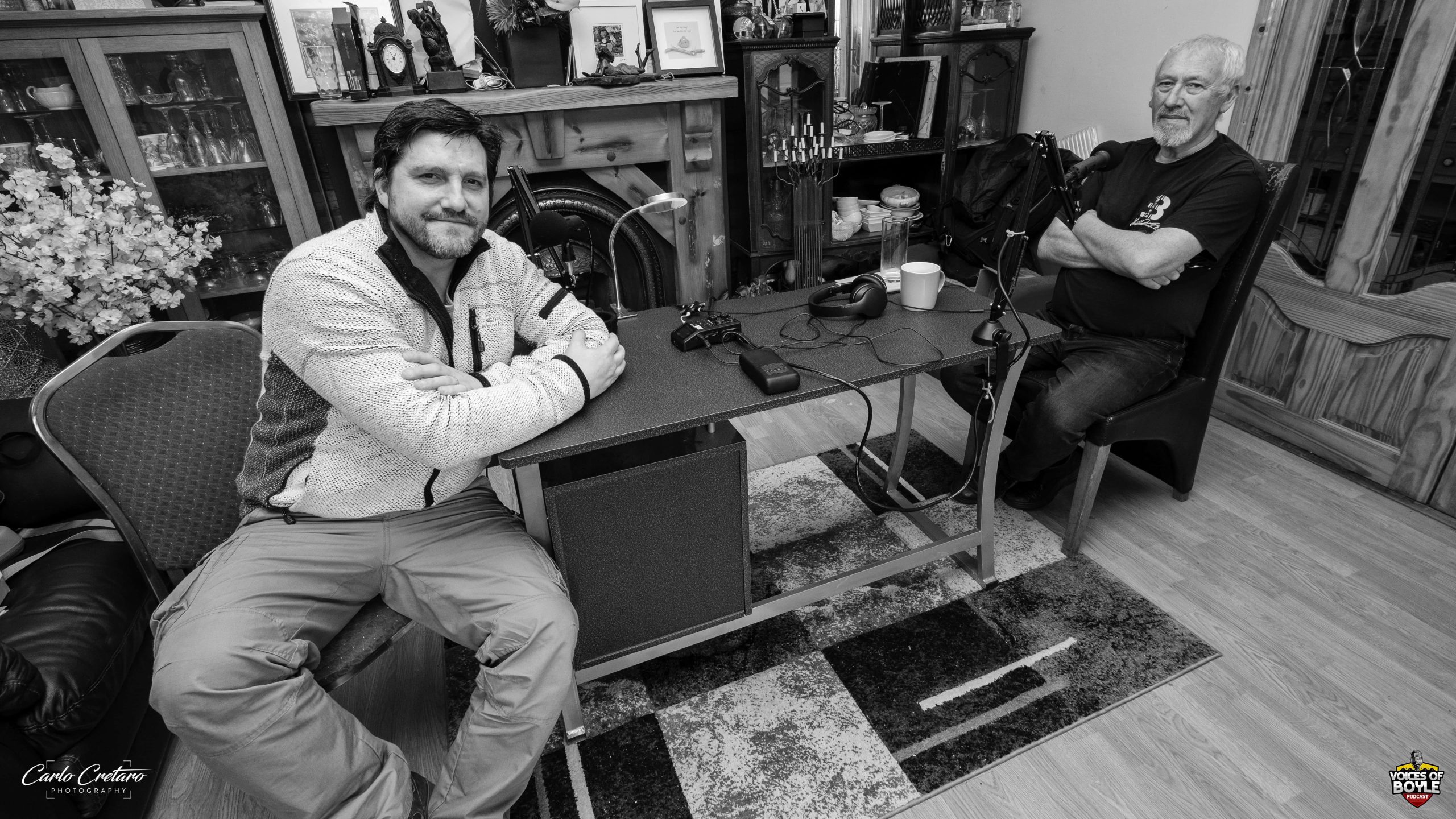
Thanks to Brendan O’ Dowd for creating and recording the musical piece for the podcast.
BE A GUEST ON THE SHOW!
If you’ve a story about Boyle, we’d love to hear it. You don’t need to have done anything remarkable, and you don’t need to prepare a thing. We sit down, have a chat, and you talk about whatever you want to. It usually takes about an hour.
Thinking of someone else? A parent, a grandparent, a neighbour who remembers how it used to be? Tell us about them. Some of our best episodes started because a son or daughter got in touch. You can find us at [email protected].