Episode 97
Ruth Regan – A Dive Into The Archives
HOSTS & GUESTS
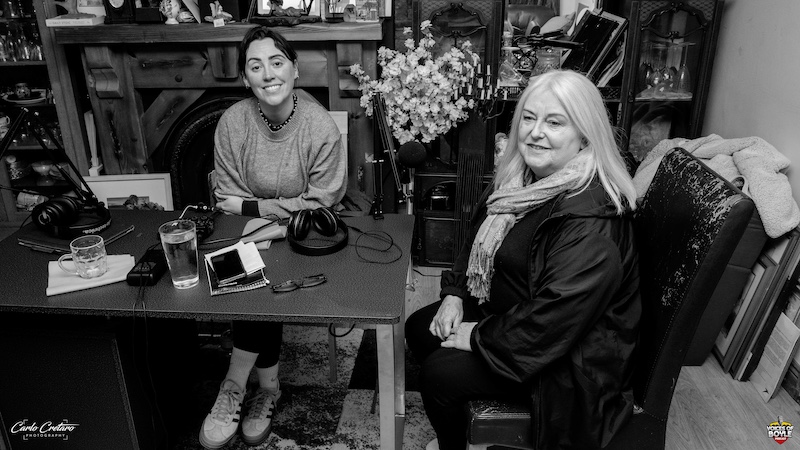
Florence Cretaro
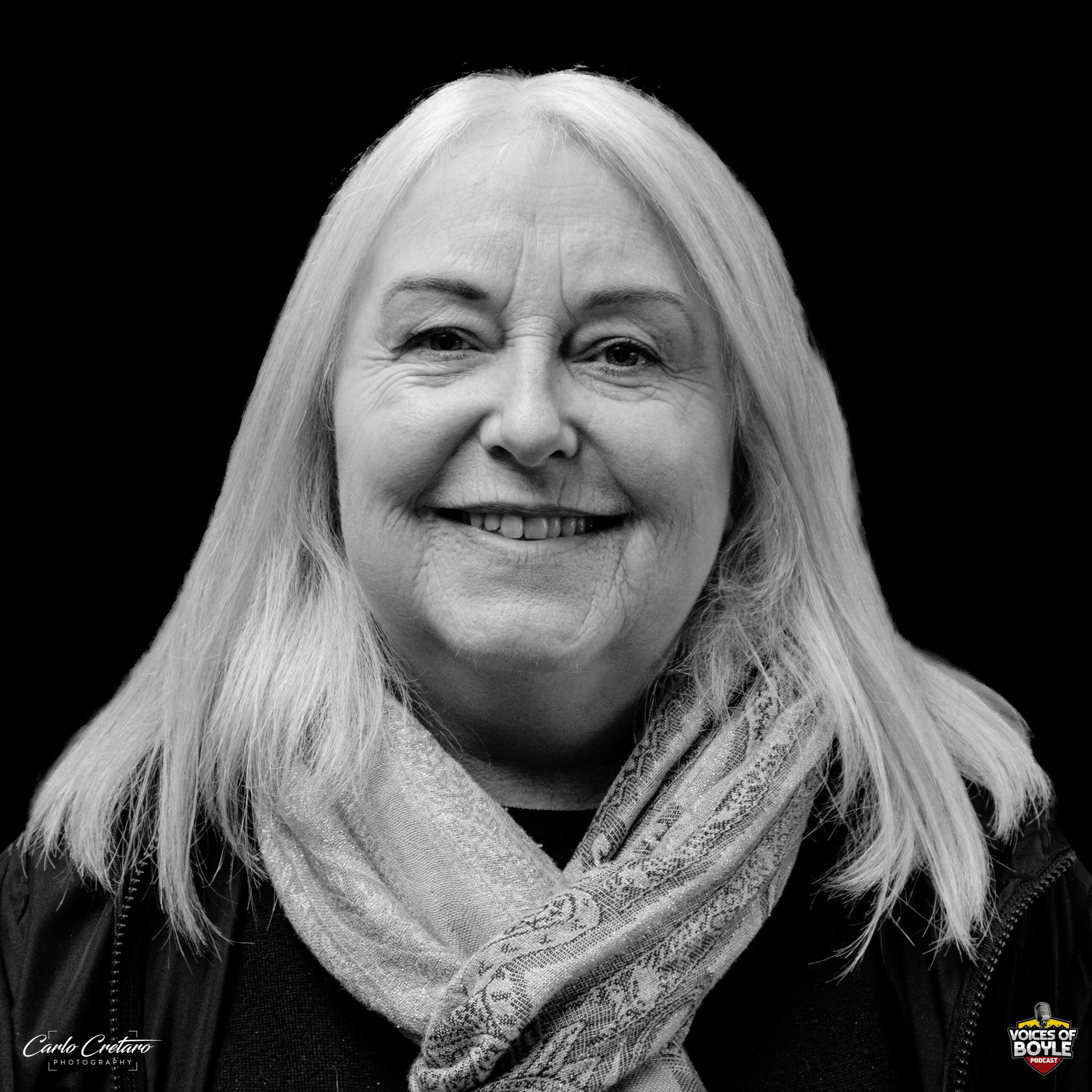
Ruth Regan
RESOURCES
Years ago, a man being held in the Bridewell behind Boyle courthouse asked the jailer to let his wife in. It was a busy time on the farm, he said, and he had instructions for her.
The jailer let her in. While she was inside, the two of them swapped clothes. He walked out in her bonnet with a cloak over his head, crying and upset, and the jailer felt sorry for the poor woman leaving her husband behind. On the road home he fell into conversation with a policeman, just to see if he could get away with it a second time. He did. Nobody found out for two days, until someone brought the woman’s child in to her.
Ruth Regan found that story in an old newspaper. She has found hundreds like it, sitting at a big screen at home reading Roscommon’s digitised papers back to the 1730s. She brought a phone full of them to the recording. But she started with her own Boyle.
“I was a disco queen, but there was never many discos.”
Out in the street playing morning till night
Ruth was born in 1967 and grew up on Handley Avenue, one of six children, with neighbours who all had loads of kids. She reckons she has 67 first cousins and over 140 second cousins, so a trip into town means meeting some of them.
Secondary school meant running home for lunch, first home every day and first back, with five pence to spend in Bob Fair’s shop, which he ran out of his house. The pleasure ground filled with children from early morning. There was five-a-side soccer, swimming at Doon Shore and Assylin, thumbing lifts out to Rockingham, and bonfire night. She calls it a great life, “so easy and innocent.”
“Francie, do you know when the disco’s going to be on?”
Ruth was mad about discos and there was only one a year, run by Francie Geelan through the Boyle Community Games. At 11 or 12 she took to calling down to his house to ask when the next one would be. She won a trophy for disco dancing in the hall. She had it for years and cannot find it now.
Red velvet double seats
The cinema in Boyle reopened in 1977, in the building where Better Buys is now, and the first film was Bugsy Malone. It was the first film Ruth ever saw. One screen, red velvet double seats, and an usher everyone called Flashlight Joe, whose real name she cannot remember. “He used to kill us,” she says. They were always messing.
When Grease came out and was not showing in Boyle, her father put about 15 children into the car and drove them to the cinema on the main street in Carrick.
In 1979 she went to Knock to see the Pope, got carsick on the way, and never saw him.
The church burned in 1977, when Ruth was in fourth or fifth class. She was about to get in trouble with Sister Gerard over her handwriting when the class was let go to the window to watch. She skipped a few slaps that day.
“There was loads of shops”
Ruth remembers Boyle packed. There was the Royal Hotel, the Forest Park and Lynch’s. You could buy shoes in Mahon’s, Bowles’s or McCarthy’s. The arcade had a bakery, a jeweller, a fashion shop, a shoe shop, Langan’s fruit and veg, the Little Chick, and a restaurant upstairs called Level 42. There were about 30 pubs.
She worked Sundays in the Three Counties for Michael Martin, when the football crowd came in after the match, and played on the darts and pool teams. Liz O’Dowd, who had a boutique called Uptown Boutique across from the National Irish Bank, met Ruth in town one day, said she was going on holidays, and handed her the keys. Ruth had never met her before.
“And I was 39”
Ruth married in 1987 and spent about ten years in London, where Luke and Shauna were born. She brought the family home to Boyle because she thought her eldest, Tanya, would be safer here.
She worked in the fish factory, then went back to the Tech for a FETAC course. She had left school at 16 or 17, and computers were only starting. That led to a diploma and then a degree in business management through Sligo IT. The third year was in Sligo itself, where the building was so big that some classes were over by the time they found the room. She finished at 39.
“Their S looks like an F”
A Gateway placement with Roscommon County Council’s library had Ruth putting an RFID self-checkout system on all the books, and working with the archives. She had always liked reading old headstones in the graveyard. Now she had the Roscommon Herald and the other papers on a screen.
“It was just fascinating to look back to see what was going on at the time.”
The oldest papers, from the 1730s, use the long S, which looks like an F. It took her a long time to get used to it. There were four papers in the county: the Roscommon and Leitrim Gazette, which was the first, the Roscommon Journal, the Roscommon Herald and, later, the Roscommon Champion.
“Some sad and some happy”
Some of what she found is just odd. In 1736 a poor woman in Abbeytown was delivered of “three lusty boys”, and the gentlemen of the town provided for two of them while she minded the third. With triplets in Galway too, the paper concluded that potatoes must be very prolific.
In 1861 Bosco the German Wizard played the courthouse, which used to host plays and all sorts. He trampled a large scarlet bag flat, put his hand in and took out an egg. A man from the audience searched the bag and found nothing. He put his hand in again and found another egg. Bosco took nearly a dozen out.
In June 1844 the Roscommon and Leitrim Gazette reported a lady in Boyle whose cat had been in her family for 20 years and had just had two kittens. In 1904 Alex Linton, a sword swallower from Boyle, was swallowing blades of 27 inches. In 1920, after pressure from the town commissioners, Boyle was about to be connected to the rest of the country by telephone, “big gains for traders, cattle dealers, and business people.”
“There’s really violent things”
A lot of it is grim, and Ruth reads it as written.
In 1780 Mary McDermott Rowe was murdered near Boyle by her husband, Michael, with the help of her brother and others. The Boyle Volunteers gathered to the sound of drums and caught the brother and two accomplices after a long march. Michael got away. The paper described him down to his olive corduroy breeches and a hat bound with velvet ribbon.
In 1850 Bridget Corcoran, a bonnet cleaner in Liverpool, poisoned her two children and set fire to their bed. She and her husband fled and were arrested in Boyle, where they came from. In 1863 a girl in a Boyle lodging house was taken to the Bridewell and was, in the paper’s words, still there “a raging lunatic.”
Many stories are about babies. An infant was found dead in the back lane, up near what is now Chapel Street, abandoned and attacked by a pig. In another case a mother came back to find a sow at her child’s cradle. In the workhouse nursery the nurse, Mrs Orr, pulled pieces of soap from an infant’s throat. There was a birth that left a midwife shocked and a father who took the body to Dublin to sell to the Royal College of Surgeons.
Ruth says the workhouse was so bad that people escaped it and tried to drown themselves in the Boyle River. Farmers selling a cow at the fair would drink the money, lie down in the cart and let the donkey bring them home, and some were attacked and killed on the road. In 1867 a naturalist with the Geological Survey drowned on Lough Key trying to save two boys who had gone through the ice. In 1836 a man named Layden, drunk, fell on the reaping hook he had just bought.
“It was like the Wild West.”
“You didn’t really have to do much”
The quarter sessions handed down six months’ hard labour for a turkey. Three people were transported for seven years for “wearing apparel.” Pat Muldowney stole a horse from George Johnson of Boyle and was sentenced to death. Two men who broke into a house and carried off a woman named Mary McCormack, the way Ruth says the brothers do in Seven Brides for Seven Brothers, were also sentenced to death.
Then there were the duels. Thomas Fry of Frybrook House met H. Irwin of Sligo at the county bridge, exchanged shots, missed, shook hands and went home. Edward McDermott and Dennis O’Connor of Willsbrook were not so lucky. On the second pistols, both were badly wounded.
Ruth does all this alone, and was at it the morning of the recording.
“There she is with the camera”
Ruth has loved taking photos since her eldest was born in 1984. She photographs nature, Bluebell Woods, Boyle, and her grandchildren, who start posing the minute the camera comes out. Most people who see her coming say, “There she is with the camera.”
The balloons were the highlight. She remembers seeing them out the window of national school years ago, and went out to photograph them on an earlier visit. The morning they rose at sunrise, with the reflection in the water, she was on a high for two days. She would not go up in one.
“Oh, the reflection of the balloons in the water, it was just magical.”
“It humbles you”
During COVID, Ruth found a lump and knew what it was, because breast cancer runs in her family. Once she got the first appointment, things moved fast between Sligo and Galway: six months of intravenous chemotherapy, a year of injections, a big operation. She did not need radiotherapy. Her last chemo was on 6 July 2021, and she rang the bell. She is on tablets for five years, with about a year left.
She went to every appointment alone. She had always been afraid of doctors and hated getting blood taken. Now she does not mind. She says the illness humbles you, and makes you appreciate being here at all. Her father had died of stomach cancer just before her diagnosis, and some of her cousins too.
“At the time you think, oh, is this ever going to end? But like, I’ve nearly forgotten about it.”
Her father drove a lorry for Stewart’s, worked in Stewart’s Mill, and later ran a taxi, bringing young people over and back to Carrick. On Halloween he would wait upstairs with a bucket of water for the trick-or-treaters. He never got to retire. “He was the best father ever,” she says.
“They just keep me going”
Ruth has three children, Tanya, Luke and Shauna, and calls being a grandparent even better than being a parent. Mia was scouted for the Sligo Leitrim team and plays every sport going. Eva and Owen are both seven. Shauna has been in Perth for 15 years, and Ruth spent five weeks there in the hottest summer they had.
“Just comes into me head sometimes”
Ruth finishes by reading three of her own poems: one on the September 11th attacks, which was published in America, one about firemen, and one about yellow tulips that begins, “When I see those tulips yellow, I suddenly begin to feel quite mellow.” She does not write much any more. The poems just come into her head sometimes.
Thanks to Brendan O’ Dowd for creating and recording the musical piece for the podcast.
Keep Listening…

Ep 48: Owen O’ Donohoe
Episode 48 Owen O' Donohoe - Challenging Beliefs

Ep 47: Pete Higgins
Episode 47 Pete Higgins - Music, Documentaries & Memories HOST & GUEST Florence Cretaro Pete Higgins The band were three weeks old. Four lads out of Boyle, none of them older than fifteen, and somebody had got them a Christmas party in Castlerea Prison....

Ep 46: Mary Lavin
Episode 46 Mary Lavin - The History of King HouseHOSTS & GUESTS Carlo Cretaro Mary Lavin RESOURCES King House Website Discover Boyle In 1987 Roscommon County Council came to Boyle, looked at the wreck of a Georgian townhouse with the roof fallen in and...
BE A GUEST ON THE SHOW!
If you’ve a story about Boyle, we’d love to hear it. You don’t need to have done anything remarkable, and you don’t need to prepare a thing. We sit down, have a chat, and you talk about whatever you want to. It usually takes about an hour.
Thinking of someone else? A parent, a grandparent, a neighbour who remembers how it used to be? Tell us about them. Some of our best episodes started because a son or daughter got in touch. You can find us at info@voicesofboyle.com.